In this article
- 1. SBA: Map the missing employer setup tasks
- 2. IRS Publication 15 (Circular E), Employer's Tax Guide
- 3. IRS Publication 15-A (read the contractor section if you pay freelancers)
- 4. IRS Publication 15-T (only if you calculate withholding yourself)
- 5. DOL Wage and Hour Division fact sheets
- 6. USCIS I-9 Central and the Handbook for Employers (M-274)
- 7. Your state's new-hire reporting and labor department pages
- 8. EEOC Small Business Resource Center (the equal pay part applies now)
- Resources for first-time employers: records to keep
- Turn a saved link into a completed task
Free Government Resources for First-Time Employers, in Reading Order
Official sources checked: October 28, 2026
Your first hire starts soon. Which official forms and guides should you open first, instead of reading every HR website? A New Jersey owner has accepted an offer for employee A to start in two weeks, but the registration, payroll and onboarding folders are still empty. These free resources for first-time employers are a route to filling those folders, not a reading assignment that must be finished cover to cover. The hypothetical business is an ordinary nonfarm private employer hiring a first W-2(employee wage statement) employee; household, agricultural and other special-employer rules can follow a different route.
Each stop below ends with a concrete decision or record the owner can keep. The order is a recommended workflow, not a legal schedule: if the start date is tomorrow, the I-9(employment-eligibility verification form) and wage rules are immediate priorities even if payroll registration is unfinished. Read the first-hire overview for the overall process and the New Jersey guide for the state-specific execution.
1. SBA: Map the missing employer setup tasks
Open the Small Business Administration's Manage your business page and find “Hire and manage employees.” The old dedicated hiring URL now redirects into this broader page, so look for that heading rather than expecting a standalone article. It's the right first stop because it shows the whole sequence in one place. It won't give you enough detail to act on any single step, which is exactly why the next items exist. For A's owner, the result is a task list with a responsible person beside EIN(employer tax ID)/employer registration, payroll setup and required employment notices. If that list already exists, move directly to the unresolved task instead of rereading the whole overview.
2. IRS Publication 15 (Circular E), Employer's Tax Guide
Publication 15 is the IRS's main guide to federal employment taxes. It covers withholding income tax, Social Security and Medicare, when to deposit those taxes, and how to file Form 941(quarterly federal payroll-tax return) each quarter. Some very small employers file Form 944 once a year instead, but only if the IRS tells them to, and farm employers use Form 943. Every employer is responsible for these rules, even if a payroll service does the work, so it's worth understanding what your provider is doing on your behalf.
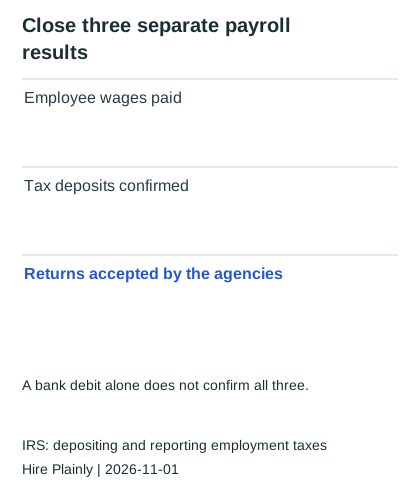
Use the contents to open section 11, depositing taxes; section 12, filing Form 941 or 944; and section 14, federal unemployment tax. A filing date is not the same thing as a deposit date. In the owner's payroll calendar, create separate rows for the return, payment schedule, person responsible and confirmation evidence; do not assume that paying a provider completes those rows. The IRS updates the publication annually, and the page checked October 28, 2026 is the 2026 edition.
3. IRS Publication 15-A (read the contractor section if you pay freelancers)
Publication 15-A supplements the main guide with harder cases, most usefully how the IRS tells employees and independent contractors apart. If you plan to use freelancers alongside your first employee, read its section on that distinction. It also covers other special cases, such as certain fringe benefits and sick pay from third parties, so keep it handy even if everyone you pay is a W-2 employee. For A's owner, mark whether any such special situation exists, then read only its section before determining the tax treatment; an all-W-2 workforce does not make the entire publication irrelevant.
4. IRS Publication 15-T (only if you calculate withholding yourself)
Publication 15-T has the tables and worksheets for figuring federal income tax withholding from each paycheck. If you use payroll software, the software applies these tables and you'll rarely need to look. If you plan to run payroll by hand, this is required reading, along with your state's withholding tables. Start with A's completed Form W-4(federal withholding form), the actual pay frequency and taxable wages; without those inputs, a net-pay estimate is not a withholding calculation. Keep the worksheet or payroll preview with the pay period and tax-table year rather than guessing from a salary percentage.
5. DOL Wage and Hour Division fact sheets
The Department of Labor publishes short fact sheets on the Fair Labor Standards Act, each covering one topic in a few pages. For a first hire, three are most useful: the one on overtime(overtime pay) exemptions (Fact Sheet #17A), the one on recordkeeping (#21), and the one on what counts as hours worked (#22). Use direct links to #17A, exemptions, #21, records, and #22, hours worked. The owner should leave with a workweek definition, a time-recording method and an unresolved-classification question if the duties have not been assessed. A salary label alone cannot answer that question.
Remember that these cover federal law only. Many states have higher minimum wages and stricter overtime or exemption rules, and when state and federal rules differ, you generally follow whichever is more protective of the employee.
6. USCIS I-9 Central and the Handbook for Employers (M-274)
Covered new employees hired for pay in the United States must complete Form I-9, including U.S. citizens. Independent contractors are not your I-9 employees; consult the handbook for other exceptions, such as certain casual domestic work. Form I-9, which verifies identity and work authorization, has employer completion deadlines measured in days. I-9 Central is USCIS's hub page with the current form and instructions. The Handbook for Employers (M-274) is the detailed manual behind it, including which documents are acceptable and how to handle reverification.
Read the I-9 Central overview before your first hire's start date. Download the form and instructions from the main form page, and keep the M-274 handbook for receipt, remote-examination or reverification questions. Record who will examine A's documents and the Section 2 due date; keep the completed form securely rather than filing it with USCIS. An I-9 does not replace a new-hire report.
7. Your state's new-hire reporting and labor department pages
Every state requires employers to report new hires, on the state's specified schedule, and each state runs its own reporting site. The Office of Child Support Services directory links to state reporting sites, which is the fastest way to find yours.
While you're on your state's pages, look for the labor department's required workplace posters and its rules on minimum wage, paid sick leave and final paychecks. Do not stop at the general deadline. For A's New Jersey employer, the reporting fundamentals specify reports within 20 days of hire, rehire or return to work, and electronic or magnetic submissions in two monthly transmissions 12 to 16 days apart when there are employees to report. The date of hire is the first day services are performed for pay, not the offer-acceptance date. Record the actual reporting method, first-work date and submission confirmation; another state's reporting schedule must be checked on that state's page.
This is the item most likely to surprise you, because state requirements often go well beyond the federal pages. Our first-hire guide walks through the state differences for California, New York, Texas and New Jersey.
8. EEOC Small Business Resource Center (the equal pay part applies now)
The Equal Employment Opportunity Commission's size guide explains federal anti-discrimination rules in plain language. The equal pay law applies from your very first employee, so read that part now. Most other federal anti-discrimination laws start at 15 employees, and the age discrimination law starts at 20. The exception is your state: some state anti-discrimination laws, including New Jersey's, apply to employers of any size, so check your state's civil rights agency now.
Resources for first-time employers: records to keep
Use the checklist as a completion test, not a replacement for the agency instructions. The owner can stop reading a section after answering its question and saving the output; return when a fact such as the work location, classification or payroll arrangement changes.
| Question in A's hiring week | Open first | Keep as completion evidence |
|---|---|---|
| Which setup tasks are still unassigned? | SBA hiring section | Task owner and outstanding registrations/notices |
| What do I deposit, and what do I file? | Publication 15 sections 11, 12 and 14 | Separate deposit and return calendar; provider responsibilities |
| Is there a special worker or payment arrangement? | Publication 15-A relevant section | Decision or documented question for CPA/agency |
| How was this paycheck's federal withholding calculated? | Publication 15-T and W-4 | Applicable-year worksheet or payroll preview |
| Which work time gets recorded and paid? | DOL #21/#22; #17A if exemption considered | Workweek and timekeeping procedure; classification review |
| Who completes and checks the I-9? | USCIS form/instructions and M-274 | Responsible examiner and deadline; secure completed record |
| Where and when do I report this hire? | State new-hire portal | Method, first-work date, required inputs and confirmation |
| Which discrimination rules already apply? | EEOC size guide plus state agency | Applicable thresholds and pay/hiring review questions |
A blank answer is the next task, not a reason to read another unrelated guide. If a provider says it handles registration or reporting, ask which agency and form it covers and where the acceptance confirmation will appear. Free guidance explains the rules; it does not create the account, make a deposit or submit a report for the owner.
Turn a saved link into a completed task
Start with a question narrow enough to answer, such as "Which state's new-hire report covers A's work location?" Record the agency page and the section that answers it, then assign the submission and save its result. A bookmark without a work location or next action is still a research note.
If two sources disagree, retain both dates and check the responsible agency rather than selecting the shorter answer. The action log distinguishes a source being read, a task being submitted and an agency accepting it. It can also record that a question is still open without treating an unverified answer as complete.
This article is general information, not legal or tax advice. Rules change and every business is different, so check with your state agency, an employment attorney, or a CPA before making decisions.