In this article
- Employee or independent contractor
- EIN and the federal employer number
- New York employer registration
- Insurance coverage before work starts
- New-hire forms and written notices
- Wages, leave and paydays
- New-hire reporting and confirmation
- Time records, corrections and approved weekly hours
- The first paycheck, payment and tax filings
- What the recovered-wage case can and cannot prove
- Records to finish before the first payday
- Put the state checks into the first payroll
- My take
- FAQ
How to hire your first employee in New York
Official sources checked: October 27, 2026; wage-statement clarification October 28, 2026; selected NY clarifications October 30, 2026

When you hire your first employee in New York, three kinds of insurance have to be in place along with your state payroll accounts. Take a made-up Queens café that hires Alex for October 5, 2026, and sets the first payday for October 16. Alex is an adult, nonexempt (worker covered by overtime rules) employee earning $24 an hour for five eight-hour shifts, with no tips or bonuses. The owner approves time and runs payroll.
Keep the New York first-payroll checklist open as you go, or print a blank copy. Recruiting and special worker arrangements need their own review.
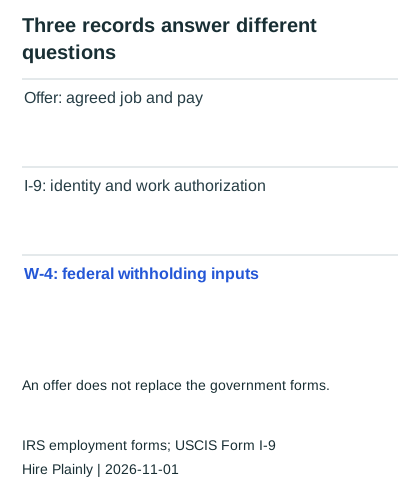
For the café, the work starts with the forms Alex signs on day one. What it budgets for the year and what Alex receives on October 16 are two different numbers.


Employee or independent contractor
A job title or a signed "contractor agreement" doesn't decide this. For most purposes, New York looks at how much control you have over the work: who sets the hours, who provides the tools, who decides how the job gets done. Construction and commercial trucking have stricter tests that start from the assumption that the worker is an employee.

If you do hire a freelancer, New York's Freelance Isn't Free Act generally requires a written contract when retaining a covered freelancer for services worth $800 or more, including contracts aggregated over the preceding 120 days.
Everything below applies only to employees. Misclassifying an employee means back taxes, unpaid unemployment contributions and possible penalties.
EIN and the federal employer number
If you formed an LLC (state-law business entity) or corporation, you probably have one already. A sole proprietor who used a Social Security number until now needs an EIN once they have employees. It's free on IRS.gov and usually issued right away.
New York employer registration
Register as soon as you hire, after getting the EIN, so the withholding account is ready before the first payroll. Do not use the UI wage threshold as a reason to postpone withholding setup. Most private employers become liable for New York unemployment insurance once they pay $300 or more in wages in a calendar quarter. You register through New York Business Express or Form NYS-100. The same registration sets up your account for state income tax withholding.
For 2026, the new-employer unemployment rate is 4.1% of the first $17,600 of each employee's pay. That's about $722 a year per employee, paid by you. You also withhold New York State income tax from pay, plus applicable New York City resident tax or Yonkers resident/nonresident withholding. Yonkers work can trigger nonresident withholding even when the employee lives elsewhere.
You can't send the taxes you withhold until these accounts exist, and late registration brings penalties and interest.
Insurance coverage before work starts
New York requires three kinds of coverage, and most small businesses buy them together.

Workers' comp: Required for nearly every for-profit employer with even one employee, including part-time workers. Have it in place before the first day of work. Penalties for going without are figured for every 10 days without coverage, depend on how many employees you have and can reach $2,000 per period.
Disability benefits (DB): Pays a partial wage for injuries and illnesses that happen off the job. Coverage is required four weeks after an employee's 30th day of work for you, and those 30 days don't have to be in a row.
Paid Family Leave (PFL): Pays a partial wage while an employee bonds with a new child, cares for a seriously ill family member or handles certain military family needs. It's required on the same timeline as DB, and insurers usually add it to the DB policy.
You may take part of the cost out of employee pay:
| Coverage | Most you can withhold from the employee in 2026 |
|---|---|
| Disability benefits | 0.5% of wages, up to $0.60 a week |
| Paid Family Leave | 0.432% of wages, up to $411.91 a year |
You pay the rest of the DB premium and all of the workers' comp premium. Premiums depend on job type and payroll, so get quotes for your actual roles.
Without coverage, you can owe the full cost of an injured employee's claim on top of the penalties.
New-hire forms and written notices
Form I-9 (federal): The employee completes Section 1 by the first day of work. You review their documents and finish Section 2 within three business days, or on day one if the job lasts less than three business days. You keep the form; it doesn't go to the government.
Form W-4 (federal) and Form IT-2104 (New York): The W-4 sets federal withholding. The IT-2104 sets New York State, New York City and Yonkers withholding.
Pay notice: At hire, give each employee a written notice of their pay rate, overtime (overtime pay) rate, regular payday and any allowances you count toward minimum wage. For hourly workers, the state form is LS 54, and other forms cover other pay types. The employee writes their primary language on it, and you also give the notice in that language if the state has a version. The employee signs it, you give them a signed copy and you keep the original for six years. If anything on the notice changes, tell the employee in writing at least seven days ahead, except for a qualifying pay increase outside hospitality that appears on the next wage statement. A pay reduction requires advance written notice, and a café must give a new written notice before each hourly-rate change.
Sexual harassment prevention policy: Every New York employer, whatever its size, must have a written policy, give it to employees at hire and train every employee at least once a year.
Other notices: If you monitor employee email, phone or internet use, give written notice at hire and get it acknowledged. In New York City, also give the city's Notice of Employee Rights and your written sick leave policy at hire, and keep proof that the employee received them.
A missing pay notice can cost up to $50 per employee for each workday it's missing, up to $5,000 per employee, and it's one of the first things a wage claim checks.
Wages, leave and paydays
Minimum wage: $17.00 an hour in New York City, Long Island and Westchester in 2026, and $16.00 elsewhere in the state.
Exempt (overtime-exemption classification) salary: Executive and administrative employees must earn at least $1,275 a week ($66,300 a year) in New York City, Long Island and Westchester, or $1,199.10 a week ($62,353.20) elsewhere, on top of meeting the duties test. Most other employees get overtime at 1.5 times the regular rate (rate used to calculate overtime) after 40 hours a week.
Payday: Manual workers, meaning anyone who spends more than 25% of their time on physical work, must be paid weekly. Payment is due no later than seven calendar days after the end of the week in which wages were earned. Alex's October 5–11 week paid on October 16 meets that timing. Most other employees must be paid at least twice a month.
Paid sick leave under New York State law: Every employer gives sick leave, at one hour for every 30 hours worked:
| Employer size | Sick leave per year |
|---|---|
| 0 to 4 employees, net income $1 million or less | Up to 40 hours, unpaid |
| 0 to 4 employees, net income over $1 million | Up to 40 hours, paid |
| 5 to 99 employees | Up to 40 hours, paid |
| 100 or more employees | Up to 56 hours, paid |
View the numbers as a table
| 0 to 4 employees, net income $1 million or less | 40 h |
|---|---|
| 0 to 4 employees, net income over $1 million | 40 h |
| 5 to 99 employees | 40 h |
| 100 or more employees | 56 h |
From the table above; the first row is unpaid, the others are paid.
New York City's sick and safe leave law adds more. At exactly $1 million in prior-tax-year net income, a city employer with four or fewer employees owes paid leave under the city rule. The state table permits unpaid leave at that exact boundary.
Since February 22, 2026, every employee in the city also gets 32 hours of unpaid protected time off on day one, with no waiting period, and again on the first day of each year. Alex works in Queens, so the café owes Alex 32 unpaid hours right away plus up to 40 more hours a year, which are unpaid while the café has four or fewer employees and net income under $1 million.
Each pay period, give Alex the required leave-accrual, use and available-balance information on the pay statement or other permitted documentation. An electronic system must meet the city's notice and access requirements.
Paid prenatal leave: On top of sick leave, every private employer gives 20 hours of paid prenatal leave in each 52-week period, counted from the first time the employee uses it. There's no waiting period, so a new hire can use it right away.
Not knowing one of these rules does not reduce what you owe if a wage claim finds a shortfall.
New-hire reporting and confirmation
New York requires you to report each new or rehired employee within 20 days of hire. You can file through the state's New Hire Online Reporting Center. Many payroll services file it for you, so check before you file twice.
The state uses these reports to enforce child support orders, and every employer has to file them.
Time records, corrections and approved weekly hours
Alex works Monday through Friday in the October 5–11, 2026 workweek, starting at 9 a.m. and leaving at 5:30 p.m. Each day includes a 1–1:30 p.m. unpaid meal period during which Alex is completely relieved of work. That produces eight paid hours a day and 40 for the week, including required training and opening or closing work. Paid rest breaks stay in paid hours.

Alex records actual times, and the owner checks missing punches, interrupted meals and training before approving payroll. The table shows only the clock portion to make it readable. In Excel, enter full dates and times in columns B through E, formatted as yyyy-mm-dd hh:mm: B2 is 2026-10-05 09:00 and E2 is 2026-10-05 17:30.
| A Date | B Start | C Meal out | D Meal in | E End | F Paid decimal hours |
|---|---|---|---|---|---|
| 2026-10-05 | 09:00 | 13:00 | 13:30 | 17:30 | 8 |
| 2026-10-06 | 09:00 | 13:00 | 13:30 | 17:30 | 8 |
| 2026-10-07 | 09:00 | 13:00 | 13:30 | 17:30 | 8 |
| 2026-10-08 | 09:00 | 13:00 | 13:30 | 17:30 | 8 |
| 2026-10-09 | 09:00 | 13:00 | 13:30 | 17:30 | 8 |
| 2026-10-10 | 0 | ||||
| 2026-10-11 | 0 | ||||
| Weekly total to approve | 40 |
Leave B through E empty on a genuine rest day; a missing work record is not a rest day. Put this formula in F2 and copy it through F8. It returns zero for an empty row and CHECK for missing or backward entries.
=IF(COUNTA(B2:E2)=0,0,IF(COUNT(B2:E2)<>4,"CHECK",IF(OR(C2<B2,D2<C2,E2<D2),"CHECK",((E2-B2)-(D2-C2))*24)))
For an overnight shift, enter the next day's date in the end cell. Decimal hours are different from a clock display: 8.5 means eight hours and 30 minutes. Use =IF(COUNTIF(F2:F8,"CHECK")>0,"CHECK",SUM(F2:F8)) for the weekly total, and resolve every CHECK before approval. Keep the original entry alongside the corrected value, reason, date and reviewer instead of quietly overwriting it.
This schedule creates no overtime. For a different schedule, calculate overtime separately when an ordinary nonexempt employee exceeds 40 hours in the workweek.
Keep the wage, time, correction and leave records connected. New York requires accurate payroll records for at least six years under Labor Law 195(4). Other record categories can have separate minimums, and a claim may require longer preservation.
Keep Form I-9 under its separate rule: three years after hire or one year after termination, whichever is later, with access to personal information restricted.
The first paycheck, payment and tax filings
Alex's workweek runs Monday through Sunday, and the first weekly payday is Friday, October 16, 2026. Weekly pay satisfies the requirement applicable to café manual workers in this example. Record the workweek, the pay period and the day money reaches the employee separately, and use the same payday on the employee's notice. Forty approved hours at $24 produce $960 in gross wages.

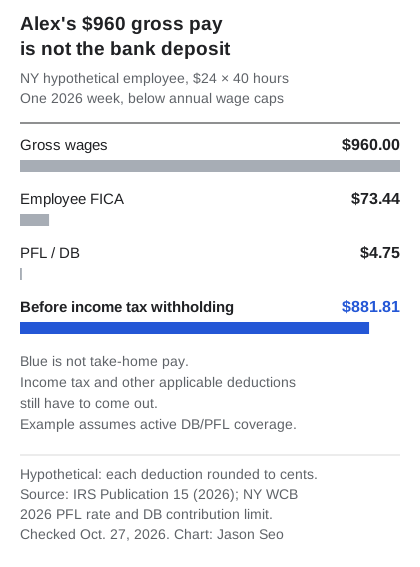
The table separates money withheld from Alex from amounts added to the owner's cost. Federal, state and applicable local income tax need employee forms and the current withholding tables. An unresolved amount is not zero.
| Employee paycheck item | Input or calculation | Amount |
|---|---|---|
| Gross wages | 40 hours × $24 | $960.00 |
| Employee Social Security | $960 × 6.2% | $59.52 |
| Employee Medicare | $960 × 1.45% | $13.92 |
| Employee PFL | $960 × 0.432%, rounded | $4.15 |
| Employee DB | Example uses permitted weekly maximum | $0.60 |
| Remainder before income tax | Subtract only the known employee deductions above | $881.81 |
| Federal, state and applicable local income tax | Employee forms, residence, pay frequency and 2026 tables | Unresolved |
| Actual net pay | $881.81 minus verified income tax and other applicable deductions | Unresolved |
The example assumes DB/PFL coverage is already effective at hire and the employee contributions are permitted under that coverage. It does not move a new employer's statutory coverage trigger to day one. Track the 2026 PFL annual cap of $411.91 and DB weekly maximum of $0.60 against the actual policy and payroll records.
Find the blue remainder in the chart, then notice why it still is not the amount to put on a check. Income tax withholding has not been filled in.
Enter Alex's W-4 and state withholding form into the current official tables or a verified payroll service. Check pay frequency, residence, filing information and additional withholding before filling in the unresolved cells. Compare the resulting deductions with gross pay, rates and year-to-date wages. Without those employee inputs, there is no honest fixed net-pay figure to publish.
If a newly hired employee has not supplied a valid W-4, apply the IRS default for a 2026 new hire: Single or Married filing separately, with no Step 2–4 entries. Check any state-form default separately. The missing form does not justify delaying earned wages; document the lawful default and finish the calculation on time. See Publication 15, using Form W-4, checked October 28, 2026.
Employer taxes and cash needed for the run
The employer adds $73.44 of its own FICA (Social Security and Medicare payroll taxes). Alex's $73.44 share is already inside the $960 gross wage and must not be added again as a new employer cost. The example is also below the unemployment wage bases this week.
| Employer item | This week's calculation | Amount |
|---|---|---|
| Employer FICA | $960 × 7.65% | $73.44 |
| FUTA (federal unemployment tax) baseline assumption | $960 × 0.6%, below $7,000 and eligible for full credit | $5.76 |
| New York new-employer UI | $960 × 4.1%, below $17,600 | $39.36 |
| Employer tax subtotal | Sum above | $118.56 |
| Wages and employer taxes to fund | $960 + $118.56 | $1,078.56 |
| Workers' comp, other employer insurance and service fees | Add actual quotes or contracts | Excluded |
View the numbers as a table
| Employer FICA | $73.44 |
|---|---|
| FUTA (federal unemployment tax) baseline assumption | $5.76 |
| New York new-employer UI | $39.36 |
From the table above; the three items sum to the $118.56 subtotal.
The funding subtotal is not all paid to Alex on payday. Pay the final net wage, reserve employee withholding, and add the employer tax liability for its own payment dates. Reconcile those components to the bank balance, then add insurance premiums and service fees. This keeps withheld employee money from being counted twice as an employer expense.
Approving payment and keeping proof
- Compare the approved time record, wage and deduction settings, withholding calculation and insurance effective dates. Resolve calculation gaps or apply the lawful missing-form defaults in time to pay earned wages by the required payday.
- For this example, the owner prepares a paper check for the completed net-pay figure and provides the required wage statement on payday. Record the check number, payment date and pay period, then reconcile the bank's clearing record.
- If choosing direct deposit instead, verify state authorization requirements and the service's actual funding cutoff. Keep employee consent, account verification and payment approval; a scheduled transaction is not proof that wages arrived.
- New York’s statement for hourly Alex needs the employee’s name, employer name/address/phone, work dates covered, pay basis, regular and overtime rates and hours, gross pay, deductions, any minimum-wage allowances and net pay. Keep the NYC leave-balance information described above connected to the same payment. Labor Law 195(3) lists the required wage fields; checked October 28, 2026.
Tax deposits, quarterly returns and year-end forms
Use IRS Publication 15 and the state instructions to select the business's actual deposit schedule. For each row, record the tax period, amount, due date and confirmation. The table describes an ordinary quarterly Form 941 (quarterly federal payroll-tax return) employer; an IRS instruction to file Form 944 is a separate branch.
| Task | Rule or due-date decision | Evidence to save |
|---|---|---|
| Federal payroll-tax deposit | New 941 employers are generally monthly depositors, due the following month's 15th. The ordinary October 2026 monthly deadline is November 16 | Electronic confirmation or EFT trace, reconciled to payroll |
| Form 941 | Quarter-end following month-end. Basic Q4 2026 filing deadline: February 1, 2027 | Accepted return and deposit reconciliation |
| FUTA and Form 940 (annual federal unemployment-tax return) | Separate accumulated FUTA liability, including the over-$500 quarterly deposit test. Basic 2026 annual filing deadline: February 1, 2027 | FUTA worksheet, payments and return confirmation |
| Employee W-2 (employee wage statement) and SSA filing | Basic 2026 wage reporting deadline: February 1, 2027 | Employee delivery and SSA acceptance |
| NY withholding | NYS-1 when accumulated withholding reaches $700; new employers generally have five business days until notified otherwise. Qualifying under-$700 quarterly amounts go with NYS-45 | Threshold tracking and payment acceptance |
| NYS-45 | April 30, July 31, October 31 and January 31; next business day for a weekend or legal holiday | Accepted UI, wage and withholding report |
| DB/PFL premiums | Separate from agency taxes, on the actual insurer billing schedule | Active policy and premium-payment record |
There are payment-with-return exceptions, including a Form 941 liability below $2,500 for the current or prior quarter without a current-quarter $100,000 next-day obligation. Check eligibility before waiting for quarter-end. Quarterly filing does not mean that tax is always due every payday, either. Federal rules also provide an additional filing period for certain timely full deposits; use the applicable instructions rather than one blanket date.
For an electronic federal payment, match tax type, period, amount and payment date to payroll, then retain the confirmation. Current IRS instructions allow qualifying EFTPS (federal tax-payment system) payments of $1 million or less on the same business day before 3 p.m. Eastern. The owner should activate access and verify funds earlier, leaving room to fix a rejected payment. A payroll provider does not remove the need to check rejection notices and agency acceptance.
Annualized costs are a different calculation
At the same hours and wage for 52 weeks, Alex's annualized pay is $49,920. This is a comparison using 2026 rates, not a forecast of an October hire's actual first 12 months. Split actual wages by calendar year and recheck rates and wage bases when the year changes.
| Annualized budget using 2026 rates | Amount or condition |
|---|---|
| Wages: $24 × 40 × 52 | $49,920.00 |
| Employer FICA | $3,818.88 |
| FUTA baseline: first $7,000 × 0.6% | $42.00 |
| NY UI: $17,600 × 4.1% | $721.60 |
| Employer tax subtotal, baseline | $4,582.48 |
| Workers' comp, benefits and administration/service costs | Quote needed; excluded |
View the numbers as a table
| Employer FICA | $3,818.88 |
|---|---|
| FUTA baseline: first $7,000 × 0.6% | $42.00 |
| NY UI: $17,600 × 4.1% | $721.60 |
From the table above, using 2026 rates; workers' comp and benefits are excluded.
Use the employee cost calculator for orientation, then replace defaults with agency rate notices, the stated assumptions and actual insurance quotes. The agency notice takes priority over a prototype calculator's default.
What the recovered-wage case can and cannot prove
On September 28, 2022, New York DOL announced recovered wages for 93 employees of Magellan Technology/Demand Vape. The official release says payment was completed on August 8, 2022. This was not a café, so do not transfer its industry-specific rules directly to Alex.
| Confirmed item | Amount or status |
|---|---|
| Back wages recovered | More than $191,000 |
| Employees affected | 93 |
| Separate penalty amount | Not established separately in this account |
Recovered wages are not a fine. For Alex's café, review hospitality spread-of-hours pay, call-in pay and uniform-maintenance requirements separately. The NY DOL hospitality FAQ requires another hour at the basic minimum wage when a workday spans more than 10 hours. Meals and off-duty gaps count in that span, and the rule applies regardless of the employee's regular rate.
Alex's 9 a.m.–5:30 p.m. day spans 8.5 hours, so this particular spread-of-hours trigger is absent. Check a changed or split shift again before approving payroll. Guidance checked October 30, 2026.
Records to finish before the first payday
Keep the registration numbers, active insurance, completed new-hire forms and notices, new-hire report acceptance, and approved times on one completion list. Post the applicable federal and state workplace notices, checking additional delivery rules for remote work or required languages. After payroll, connect the wage statement, payment proof, tax confirmations and accepted returns to the same pay-period folder.
This example excludes tips, minors, special industries, multistate work and additional local rules. If those conditions apply, identify the extra obligations before signing the arrangement or starting work rather than copying the ordinary example unchanged.
Put the state checks into the first payroll
For the Queens café, put New York State and New York City requirements in different rows. Record the wage notice, applicable weekly payday and each leave entitlement before asking the provider to configure the employee.

Have the owner and the provider agree who collects each record, who checks it and when the provider needs it. If an item is missing, write the unresolved question beside that task instead of marking the entire employee setup complete. Review tips, minors, multiple work locations and unusual pay arrangements before applying the ordinary adult, nonexempt example.
My take
For your first few employees, I'd start with Excel. Once you pass about 10 people, I'd move to a payroll system, because the records get harder to track, the people and situations vary more, and the workload grows. That's my rule of thumb, not a legal threshold. Excel only calculates and keeps records: you or your CPA still have to deposit and file the taxes and issue W-2s. If you want to talk through which system fits, email hr.bridge.us@gmail.com. It's free for now.
FAQ
Do I need an LLC before I hire my first employee in New York? No. A sole proprietor can hire employees. You still need an EIN, state registration and the required insurance.
This article is general information, not legal or tax advice. Rules change and every business is different, so check with your state agency, an employment attorney, or a CPA before making decisions.
Use the worksheet