In this article
- How to hire your first employee: forms, accounts and deadlines
- Employee or independent contractor
- EIN and federal payroll setup
- State payroll-tax registration
- Workers’ compensation and required coverage
- First-day documents and state notices
- Minimum wage, leave and the work location
- New-hire reporting deadlines and proof of acceptance
- Payroll cost and the first payment
- State guides
- Before the first-day paperwork
- My take
- FAQ
How to hire your first employee in the US: the federal steps, then your state
Official sources checked: October 24, 2026; changed points rechecked October 28, 2026

If you opened a café or shop in the US, what would you need to prepare before hiring your first employee? A hypothetical café owner is preparing to hire A at $24 an hour for 40 paid hours a week. Before making the offer, the owner needs to know which records establish the job, which accounts handle taxes and how money reaches A on payday. The federal starting point is similar across states; the café’s work location changes wages, insurance, leave and reporting.
To hire your first employee, start with the common tasks below, then use the state guide for the actual work location. An LLC(state-law business entity) registration in one state does not make that state’s employment rules apply to work performed elsewhere.
The original rate check was October 24, 2026; the classification, reporting and payroll clarifications below were reviewed October 28. State-specific guides contain the detailed calculations and current conditions. Remote work, tips, minors and special industries need additional checks before copying the ordinary café example.
How to hire your first employee: forms, accounts and deadlines
| Step | Federal or state? | When |
|---|---|---|
| 0. Decide: employee or contractor | Both | Before the offer |
| 1. Get an EIN(employer tax ID) | Federal | Before the first paycheck |
| 2. Register for state payroll taxes | State | When your state's trigger hits |
| 3. Get workers' comp (where required) | State | Before day one |
| 4. Day-one paperwork: I-9(employment-eligibility verification form), W-4(federal withholding form) and the state form | Both | Day one to day three |
| 5. Set pay that meets the state minimum and leave rules | State | Before day one |
| 6. Report the new hire | State | CA/NY/TX: 20 days; NJ electronic: 15 days, other methods: 20 |
| 7. Run payroll | Both | Every payday |
Employee or independent contractor
A title or a signed "contractor agreement" doesn't decide this. How the work happens does.
California and New Jersey use ABC tests for important wage and unemployment laws, subject to their own exceptions. Both examine independence from control and an independently established business, but the B part differs. California generally requires work outside the usual course of the business. New Jersey’s B part allows work outside the usual course or outside all the enterprise’s places of business. Remote work alone does not establish that an individual satisfies the full test.
The café sets A’s shifts and directs counter service, which is its ordinary business. Calling the position a freelance job does not remove employee obligations. Use the state-specific classification test before choosing which paperwork to collect.
If you're unsure, the conservative choice is to treat the person as an employee, and an employment attorney in your state can confirm.
Employee onboarding uses the I-9 and payroll forms below. Contractor payments instead need a separate W-9(payee tax-information form) and information-return review; some states, including New Jersey, also require reporting certain contractors to the new-hire directory.
EIN and federal payroll setup
If you formed an LLC or corporation, you likely have one. A sole proprietor who used a Social Security number until now needs an EIN to run payroll. It's free on IRS.gov, usually issued right away.
State payroll-tax registration
Each state runs its own unemployment insurance account, and most also run income tax withholding. The trigger and the deadline differ.
| California | New York | Texas | New Jersey | |
|---|---|---|---|---|
| Registration trigger | EDD within 15 days after paying more than $100 in a quarter | UI generally starts at $300 in quarterly wages; prepare withholding before first payroll | TWC within 10 days of liability: $1,500 in a quarter or employment in 20 different weeks | New business: NJ-REG at least 15 business days before opening; existing business: add employer taxes before payroll |
| Where | EDD e-Services | New York Business Express or NYS-100 | Texas Workforce Commission | NJ Division of Revenue |
| 2026 new-employer state contribution rate | 3.4% unemployment + 0.1% training tax on the first $7,000 | 4.1% on the first $17,600 | 2.7% on the first $9,000 | About 3.3% (unemployment, disability and workforce funds) on the first $44,800 |
| State income tax to withhold | Yes | Yes | No | Yes |
Save the EIN, state account numbers and assigned tax-rate notices together. If the café already registered as a business, check whether employer withholding and unemployment accounts are active rather than submitting another entity formation.
Workers’ compensation and required coverage
| California | New York | Texas | New Jersey | |
|---|---|---|---|---|
| Required? | Yes, from the first employee | Yes, plus disability and Paid Family Leave coverage | Optional for most private employers | Yes, once a non-owner works for pay |
| Additional decision | Confirm insurer, effective date and employee notices | Check separate DB/PFL coverage triggers and employee deductions | Coverage choice requires notices; nonsubscribers lose specified defenses in employee injury lawsuits | Entity form matters: working corporate officers can also be covered |
Premiums depend on the job's classification and your payroll. For New Jersey, our employee cost calculator shows 2026 rates by industry.
First-day documents and state notices
Form I-9 (federal): The employee completes Section 1 by the first day of work. You review acceptable documents and complete Section 2 within three business days after work begins. If the job lasts less than three business days, complete both sections on the first day. The employee chooses acceptable documents; keep the form rather than sending it with payroll tax returns.
Form W-4 (federal): Sets federal income tax withholding.
State withholding form: California uses DE 4, New York uses IT-2104 and New Jersey uses NJ-W4. Texas has no state income tax, so there's no state form.
New Jersey also requires a written notice of earned sick leave rights for each employee (form MW-565).
Minimum wage, leave and the work location
| California | New York | Texas | New Jersey | |
|---|---|---|---|---|
| 2026 minimum wage | $16.90; some cities higher | $17.00 NYC, Long Island, Westchester; $16.00 elsewhere | $7.25 (federal) | $15.92 for most employers; $15.23 seasonal and small |
| Paid sick leave | At least 40 hours or 5 days a year, whichever is more | 40 to 56 hours by employer size; unpaid at 0 to 4 employees with $1M or less net income | No statewide requirement | Up to 40 hours a year, every employer |
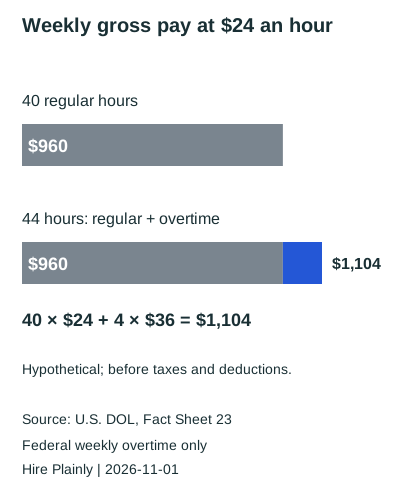
The New Jersey small-employer minimum uses a yearly headcount test, not simply today’s employee count. New York also has separate paid prenatal leave, and New York City adds protected time requirements. Read the applicable state guide before writing the café’s leave policy. A’s $24 rate clears the ordinary statewide minimums shown, but it does not settle industry, local or overtime(overtime pay) rules.
New-hire reporting deadlines and proof of acceptance
California, New York and Texas generally require reporting within 20 days of hire. New Jersey’s administrative rule, section 10:110-11.2(b), sets 15 days for electronic reports and 20 for other methods. Use the shorter applicable deadline even though a general brochure may say 20 days.
California uses Form DE 34 through EDD, New York uses its New Hire Online Reporting Center, Texas uses the Attorney General’s employer portal and New Jersey uses njcsesp.com. If a payroll service handles reporting, confirm the employee’s first paid work date and obtain the acceptance. A service subscription alone does not prove that A’s report was filed.
Payroll cost and the first payment
Federal payroll works the same everywhere. You and the employee generally each pay 7.65% for Social Security and Medicare on covered wages, with Social Security stopping at $184,500 in 2026. You also pay federal unemployment tax, 0.6% of the first $7,000 for most employers. Most employers report quarterly on Form 941(quarterly federal payroll-tax return).
Here's what employer payroll taxes add on $50,000 of pay, before workers' comp and benefits, using 2026 new-employer rates:
| California | New York | Texas | New Jersey | |
|---|---|---|---|---|
| Federal (Social Security, Medicare, FUTA(federal unemployment tax)) | $3,867 | $3,867 | $3,867 | $3,867 |
| State unemployment and related | $245 | $722 | $243 | $1,478 |
| Total employer taxes | $4,112 | $4,589 | $4,110 | $5,345 |
This is a separate $50,000 comparison input, rounded to whole dollars, rather than A’s $49,920 annualized wage. California’s $4,112 total assumes full FUTA credit and is a baseline calculation. EDD projects a 2.1% effective FUTA rate for 2026; applying that projection adds $105 and makes the California subtotal $4,217. The final credit reduction is determined after November 10, so neither scenario is a guaranteed final bill. Use the state guide for the assumptions and the employee cost calculator only after checking its defaults.
What the café must finish for each payroll
A’s first ordinary week has 40 approved hours × $24 = $960 gross pay. Gross pay is the starting wage, not the bank transfer and not the total employer cost. Keep four records connected so that calculating a number leads to a completed payment.
| Record | Owner’s action | What shows completion |
|---|---|---|
| Time record | Record actual starts, ends, meals, training and corrections; apply the workweek and any daily overtime rule | Approved paid hours and overtime calculation |
| Payroll register | Apply W-4/state forms, tax tables and lawful deductions to gross pay | Checked net pay, separate employer tax and funding amounts |
| Wage payment | Deliver wages by the required payday; provide the applicable wage statement | Payment/check record and bank reconciliation |
| Tax calendar | Separate tax deposits from returns and year-end reporting | Payment confirmations and accepted filings |
If the owner uses a provider, agree who handles each row and who checks rejections. If working manually, retain the calculation inputs and official tables with the pay-period records. For federal taxes, IRS due-date guidance separates deposits, quarterly Form 941 and annual Form 940(annual federal unemployment-tax return)/W-2(employee wage statement) duties. The state guides add the state accounts, dates and worked funding examples without requiring you to read every state’s procedure.
State guides
- How to hire your first employee in California: EDD registration, the new-hire notice packet, daily overtime and breaks
- How to hire your first employee in New York: workers' comp plus disability and Paid Family Leave, the LS 54 pay notice and NYC sick leave
- How to hire your first employee in Texas: TWC registration, the workers' comp opt-out and its notices, and the Texas Payday Law
- How to hire your first employee in New Jersey: step by step, with industry workers' comp costs
Before the first-day paperwork
The owner first needs a job that can be described consistently in the advertisement, offer and payroll setup. Write down the duties, work location, rate, expected hours and person who can approve changes. Use the same record when checking employee status and overtime treatment; those are separate decisions.
Keep recruiting and payroll preparation on parallel tracks. A candidate accepting an offer does not establish that insurance is effective, a payroll account is active or the provider can meet the planned payday. Assign those tasks before promising a start date. The state guides below concentrate on registration and pay after the role is agreed; recruiting, background checks and restrictive employment terms need their own review.
My take
For your first few employees, I'd start with Excel. Once you pass about 10 people, I'd move to a payroll system. That's my rule of thumb, not a legal threshold, and Excel only calculates: you or your CPA still have to deposit and file the taxes.
FAQ
Do I need an LLC before I hire my first employee? No. A sole proprietor can hire employees. You still need an EIN, state payroll registration and, in most states, workers' comp. See how to start an LLC if you're setting up the business.
Which of these four states is cheapest for a first employee? The table compares a limited payroll-tax subtotal, not the full cost or the best place to operate. Texas is about $4,110 on the stated $50,000 input; California is $4,112 under full FUTA credit or $4,217 under EDD’s 2026 projection. Insurance, actual wages, benefits, local rules and your existing business location can outweigh that difference.
This article is general information, not legal or tax advice. Rules change and every business is different, so check with your state agency, an employment attorney, or a CPA before making decisions.