In this article
- Why one classification test does not settle every law
- Maria's work at the bakery
- Federal tax classification: who controls the work?
- Federal wage protections: is Maria in business for herself?
- California and New Jersey require all three ABC conditions
- The same bookkeeper working for a bookkeeping firm
- Texas and New York unemployment insurance use other tests
- W-2 vs 1099 under each test, in one table
- Document the decision before work begins
- Turn the classification decision into the right workflow
- Record facts before writing a conclusion
- Which classification would I examine first?
W-2 vs 1099: Why the Same Worker Can Get Different Answers by State
Official sources checked: October 28, 2026 (IRS/CA/NJ rules; federal proposal status checked with retrieval limits)
A made-up bakery wants Maria to keep its books for about 15 hours a week, and she asks to send a monthly invoice. That invoice shows how she'd like to be paid. It doesn't settle her legal status. The W-2 (employee wage statement) vs 1099 question is whether the actual working relationship meets each classification rule that applies.
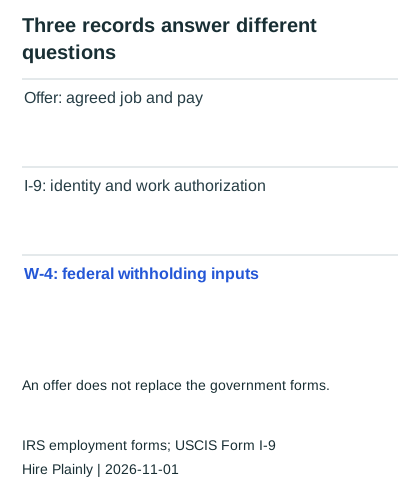
Before you choose how to pay and report, write down the facts for each law. The worker-classification facts matrix has a row for each one, and there's a blank copy to print.
The owner needs separate answers for federal taxes, federal wage protections and state obligations. Keep Maria's working facts together while checking each purpose, because one agency's contractor conclusion doesn't clear the others.
Why one classification test does not settle every law
Most federal tests ask how much control you have over the work and whether the worker is really running an independent business. Several states, including California and New Jersey, use a stricter "ABC test" for many purposes. Under it, a worker is presumed to be an employee unless you can prove three things.

The second one is where the states differ. California requires the work to fall outside your usual line of business, while New Jersey also accepts work done outside all of your places of business. Each law uses its own test, so a worker can be a contractor for one purpose and an employee for another. Apply every relevant test separately; satisfying one strict-looking test does not replace the obligations under another law.
Maria's work at the bakery
Maria is a bookkeeper who works about 15 hours a week for a small bakery. She works from her home office on her own laptop and software, never at the bakery, sets her own hours, invoices monthly and keeps a few other small clients. The bakery tells her which reports it needs each month but not how to prepare them.
Hypothetical worker for illustration. Real classification depends on all the facts, and the same label in a contract doesn't decide it.
Federal tax classification: who controls the work?
The IRS groups its questions into three areas. Behavioral control asks whether the business directs how the work gets done, and financial control asks who supplies the tools and whether the worker can make or lose money. The relationship area looks at benefits, permanence and written contracts. No single answer decides the case, so the IRS weighs them together.

Maria does well here. The bakery sets deliverables rather than methods, she pays for her own tools, and she serves other clients. On these facts she looks like an independent contractor for federal tax purposes, though that conclusion only covers taxes. Remote work alone does not settle it: an employer with the right to control the methods can have an employee working from home.
Federal wage protections: is Maria in business for herself?
The FLSA (federal wage-and-hour law) question is whether a worker is economically dependent on the business or in business for herself. In May 2025, a DOL field bulletin told investigators to stop applying the 2024 rule in enforcement and to rely on older guidance, a 2008 fact sheet and a 2019 opinion letter. A rule proposed on February 27, 2026 would bring back a test that gives the most weight to two core factors: control over the work and the worker's opportunity for profit or loss.
The official regulatory agenda retrieved on October 28, 2026 still lists that rulemaking at the proposed-rule stage. A planned October final-rule date is a timetable, not proof that a final rule has been issued. The federal test is changing, so check the live DOL rulemaking page before relying on this snapshot.
Maria has facts supporting an independent business, but a flexible schedule alone does not establish an opportunity for business profit or loss. Ask whether she can negotiate fees, decide which clients to accept and manage meaningful business expenses; simply working more paid hours is not the same thing. A court deciding a private wage claim also need not follow DOL's current investigator priorities. If she is a covered employee and no applicable exemption applies, minimum wage and overtime (overtime pay) protections need review, which is why the answer matters beyond taxes.
California and New Jersey require all three ABC conditions
Under an ABC test, Maria is an employee unless the bakery can show all three of these:

- A: She's free from the bakery's control in how she does the work.
- B: The work is outside the usual course of the bakery's business. New Jersey also accepts work performed outside all of the bakery's places of business.
- C: She's customarily engaged in an independently established trade or business of the same kind.
Bookkeeping isn't what a bakery sells, so prong B is satisfied. Her own clients and tools support prong C, and the bakery's light direction supports prong A. On these facts, the bakery has a reasonable case under the ABC test as well. California applies its ABC test to most wage and employment questions, with many exceptions, while New Jersey uses one for unemployment insurance and its wage laws. The two states also word prong B differently, and that difference matters in the next section.
The same bookkeeper working for a bookkeeping firm
Now keep Maria exactly the same but move her to a small bookkeeping firm that sells bookkeeping services to clients. Her control, tools and other clients still support independence under the IRS and DOL analyses, but the new setting deserves a fresh review. Doing the same service the firm sells can matter to the overall wage-law analysis even where no ABC test applies.

In California, the ABC test now points the other way. Bookkeeping is the usual course of the firm's business, so prong B fails, and when one prong fails she's an employee under that test, unless one of California's exemptions fits. A reviewer can check whether a specific exemption, such as the business-to-business exemption, applies; each has its own conditions.
New Jersey's prong B has a second way to pass: the work can be performed outside all of the firm's places of business. Under New Jersey's adopted rules operative October 1, 2026, an individual's home used for remote work is not the firm's place of business under N.J.A.C. 12:11-1.4(e). Maria works only from that home office, which supports the location alternative here; the firm still has to establish A and C. If the firm asked her to work at its office two days a week, that alternative would disappear, and the New Jersey answer would likely match California's.
Texas and New York unemployment insurance use other tests
Move the bookkeeping-firm version of Maria to Texas or New York. For unemployment insurance, the Texas Workforce Commission uses a 20-factor test built around the right to control the work, and New York's labor department looks at supervision, direction and control across all the facts. Neither applies an across-the-board ABC test, though both have rules for particular industries. Without the prong B question, her independence counts for more, and contractor status becomes more defensible again.
W-2 vs 1099 under each test, in one table
Read the last two columns first, since they show the same worker under each test in two different hiring situations.
| Test | Who uses it | Maria at the bakery | Maria at a bookkeeping firm |
|---|---|---|---|
| IRS common-law | Federal taxes | Independence supported; review all facts | Independence supported; fresh review needed |
| DOL economic reality | Federal minimum wage and overtime | Independence supported; review all facts | Independence supported; fresh review needed |
| ABC test, California | Most CA wage and employment laws | Contractor defensible | Employee likely (prong B fails unless an exemption applies) |
| ABC test, New Jersey | NJ unemployment insurance and wage laws | Contractor defensible | Contractor arguable (she works outside the firm's places of business) |
| Control-based state tests | TX and NY unemployment insurance | Independence supported; review all facts | Contractor arguable; review all facts |
Hypothetical outcomes for illustration only. They are not legal conclusions about any real worker.
Document the decision before work begins
Four facts did most of the work in this example: whether the work is part of what your business sells, where the work happens, whether you control how it's done, and whether the worker has a real independent business. In California, if the work is part of your core business, assume W-2 unless an attorney tells you an exemption applies. In New Jersey, also look at where the person works before you decide.

Maria's file should describe what actually happens, rather than only collect a signed agreement and a W-9 (payee tax-information form). Use the same fact sheet for each law, record who reviewed it and date the conclusion. The example below is a practical record, not a government form or a substitute for an agency determination.
| Question in the review file | Maria at the bakery | What would require a new review? |
|---|---|---|
| What does the customer buy from the business? | Baked goods; Maria provides bookkeeping | The hiring business starts selling bookkeeping |
| Who chooses methods and schedule? | Maria, subject to monthly deliverables | Owner assigns daily shifts and detailed methods |
| Where is the work performed? | Exclusively at Maria's home | Work begins at the firm or its customer locations |
| Is there a continuing independent business? | Existing bookkeeping clients and her own operations | Other clients disappear and the relationship becomes exclusive |
| Which legal purposes were checked? | Tax, federal wage law and applicable state law separately | A move, new state, changed duties or changed law |
Give a reviewer the contract and this fact sheet together, plus evidence supporting the assertions: work instructions, invoices and a description of the independent business. A template contract cannot correct a daily practice that contradicts its terms. Don't collect unrelated private information about Maria's other clients just to make the file look complete.
If the tax answer remains unclear, either party may ask the IRS for a Form SS-8 determination. That addresses federal employment-tax status; it doesn't decide the state wage or unemployment question. Ask a state agency or employment attorney the specific unresolved question instead of sending only “Is she a 1099?”
For a California bookkeeping firm, the unresolved question might be: “Does a specific exemption apply to this relationship, and if so which test replaces ABC?” For New Jersey, ask which facts establish A and C after applying the remote-home rule to B. An exemption from the ABC test can lead to another test; it is not automatic contractor status.
Turn the classification decision into the right workflow
When the applicable reviews support employee status, follow the employee onboarding, timekeeping and payroll process, as in the New Jersey or New York first-hire guide. When contractor treatment is supported, collect the appropriate tax information and keep service invoices, payment records and the classification review together.
If Maria has already been paid under a classification that may be wrong, list the affected dates, payments, hours and working arrangements first. Ask the CPA and employment reviewer which tax corrections and wage remedies apply before changing old forms. Relabeling next month's invoice does not settle earlier payroll taxes, overtime or benefit obligations.
Record facts before writing a conclusion
Use a fact such as "the café sets the worker's Tuesday and Thursday shifts" instead of "the worker is independent." For each law, record what evidence supports or contradicts the relevant element and which question remains unresolved. Counting favorable boxes cannot replace a test whose elements all have to be satisfied.
Reopen the file if the service, customer's business, work location or degree of control changes. A contract label and a previous year's 1099 do not describe those new facts. The worksheet produces a review file for an agency or adviser; it does not calculate a worker's legal status.
Which classification would I examine first?
My default for a first hire is W-2. Whether someone can be a 1099 contractor depends on the actual working relationship under each applicable test, not on how few hours the person works. The exceptions aren't something I can judge from my own experience, so check them against the official tests above.
This article is general information, not legal or tax advice. Rules change and every business is different, so check with your state agency, an employment attorney, or a CPA before making decisions.
Use the worksheet