In this article
- How to hire your first employee in Texas: records and deadlines
- Step 0. Decide if this person is an employee or a contractor
- Step 1. Get an EIN
- Step 2. Register with the Texas Workforce Commission
- Put the state checks into the first payroll
- Step 3. Decide on workers' comp and give the required notice
- Step 4. Collect Form I-9 and W-4
- Step 5. Set pay that meets Texas and federal rules
- Step 6. Report the new hire within 20 days
- Time records and approved hours
- The first paycheck and the money to reserve
- Records and notices before the next payday
- My take
- FAQ
Hire your first employee in Texas: pay and paperwork
Official sources checked: October 27, 2026; expanded points checked October 28, 2026

When you hire someone in Texas, are an agreed hourly rate and start date enough to get the first payroll ready? A hypothetical café in Carrollton has hired A at $24 an hour, with 40 paid hours in the October 5–11, 2026 workweek. A is an adult, nonexempt(worker covered by overtime rules) counter employee, and the example excludes tips, bonuses, minors and work outside Texas. The owner plans to pay A on Friday, October 16, but first needs completed records and enough money for wages and taxes.
To hire your first employee in Texas, prepare the EIN(employer tax ID), TWC account, coverage decision and employee forms, then connect them to a repeatable payroll routine. Texas has no state income tax to withhold, but federal withholding, unemployment reports and payment deadlines still need owners. For other locations, use the US first-hire guide. The original rules were checked October 27; the payroll additions and TWC clarification were checked October 28, 2026.

How to hire your first employee in Texas: records and deadlines
| Step | When | Cost |
|---|---|---|
| 0. Decide: employee or contractor | Before the offer | $0 |
| 1. Get an EIN | Before the first paycheck | $0 |
| 2. Register with the Texas Workforce Commission | Within 10 days of becoming liable | $0 |
| 3. Decide on workers' comp and give the required notice | Before day one | A policy premium if insured; notices and injury exposure remain if not |
| 4. Collect I-9(employment-eligibility verification form) and W-4(federal withholding form) | Day one to day three | $0 |
| 5. Set pay that meets Texas and federal rules | Before day one | $7.25/hour minimum |
| 6. Report the new hire | Within 20 days | $0 |
| 7. Run payroll and pay the taxes | At least twice a month for hourly workers | About $4,104 a year for A, plus any insurance |
Step 0. Decide if this person is an employee or a contractor
A job title or a signed "contractor agreement" doesn't decide this. The IRS, the Texas Workforce Commission and federal wage law each use their own test, but all of them look closely at control: who sets the hours, who provides the tools, who decides how the job gets done, and whether the person runs their own business. The more you control, the more likely they're an employee under all three.
Everything below applies only to employees. Misclassifying an employee means back taxes, unpaid unemployment contributions and possible penalties.
Step 1. Get an EIN
If you formed an LLC(state-law business entity) or corporation, you probably have one already. A sole proprietor who used a Social Security number until now needs an EIN once they have employees. It's free on IRS.gov and usually issued right away.
Step 2. Register with the Texas Workforce Commission
Texas has no state income tax, so there's no state withholding account. For a business like the café, the state payroll tax is unemployment insurance, run by the Texas Workforce Commission (TWC).
You become liable once you pay $1,500 or more in wages in a calendar quarter, or have at least one employee during 20 different weeks of a calendar year. Register online through TWC's Unemployment Tax Services within 10 days of becoming liable.
The TWC rate guidance states that the 2026 entry-level rate is 2.7% for every industry group. The general statutory formula uses the higher of 2.7% or the industry average, but TWC reports no higher-group exception for 2026. Applied to the first $9,000 of annual wages, the ordinary entry-level tax is $243 per employee. An acquired business or later experience-rated account needs its actual notice instead.
Prepare registration information before the first payroll, then register when the liability test is met and enter the assigned account number and rate in payroll. If A is the only employee, the October 16 and 23 checks total $1,920 in Q4 wages, crossing $1,500 on October 23; the 10-day registration period ends November 2, 2026. Retain the liability date and registration confirmation. This is separate from the Attorney General’s new-hire report in Step 6.
Put the state checks into the first payroll
For the Carrollton café, calendar the TWC registration trigger as wages are paid. Record the coverage decision and notices separately from federal withholding. Texas has no state individual income-tax withholding, but that does not finish unemployment reporting or the first payroll.
Have the owner and the provider agree who collects each record, who checks it and when the provider needs it. If an item is missing, write the unresolved question beside that task instead of marking the entire employee setup complete. Review tips, minors, multiple work locations and unusual pay arrangements before applying the ordinary adult, nonexempt example.
Step 3. Decide on workers' comp and give the required notice
Texas is the only state where most private employers can choose not to carry workers' comp. Buying coverage and opting out each come with their own notices.
If you buy coverage: Your insurer gives you the notice to post at work, and you tell new employees that you have coverage. If an employee is hurt on the job, workers' comp pays their medical care and part of their lost wages. In return, the employee generally can't sue you for that injury, with limited exceptions such as a death caused by gross negligence.
If you opt out (a "nonsubscriber"):
- Give each new employee written notice that you don't carry workers' comp, and keep proof you gave it, such as a copy you both signed.
- Post the state's no-coverage notice (Notice 5) in English, Spanish and any other language your employees need.
- File DWC Form-005 with the Texas Department of Insurance within 30 days of hiring your first employee, then every year between February 1 and April 30.
- Once you have five or more employees, report on DWC Form-007 any work-related death, any occupational illness you learn about and any injury that causes more than one day of lost time. It's due by the seventh day of the following month.
A nonsubscriber can be sued by an injured employee, and Texas Labor Code 406.033 takes away three common defenses. The employer can't argue that the employee was partly at fault, that a coworker caused the injury or that the employee accepted the risk of the job.
Opting out saves the premium but leaves you exposed to a full injury lawsuit. Some nonsubscribers buy a separate employer liability or occupational injury policy instead.
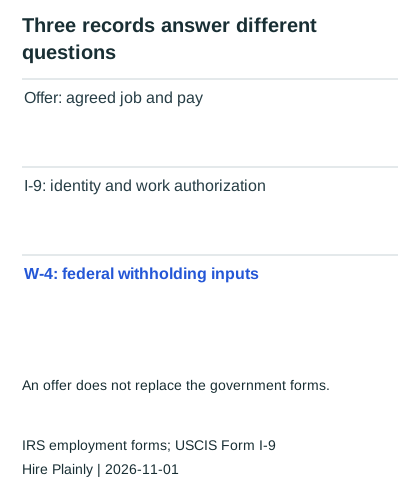
Step 4. Collect Form I-9 and W-4
Form I-9 (federal): The employee completes Section 1 by the first day of work. You review their documents and finish Section 2 within three business days, or on day one if the job lasts less than three business days. You keep the form; it doesn't go to the government.
Form W-4 (federal): Sets federal income tax withholding. Texas has no state income tax, so there's no state withholding form.
Hand over the workers' comp notice from Step 3 the same day.
I-9 mistakes come with fines per form, even when the employee is fully authorized to work.
Step 5. Set pay that meets Texas and federal rules
Minimum wage: $7.25 an hour, the federal rate. Texas doesn't set a higher one, and cities can't set their own for private employers.
Overtime(overtime pay): Federal law applies. Non-exempt employees get 1.5 times their regular rate(rate used to calculate overtime) for hours over 40 in a workweek. For the standard executive, administrative and professional exemptions, the federal baseline generally includes a $684 weekly salary level, the salary/fee-basis rule applicable to that exemption and qualifying duties. Special exemptions have different rules. A’s counter-service job is nonexempt in this example; paying a salary would not remove its overtime requirement.
Paid sick leave: Texas has no state requirement, and as of October 27, 2026, no city sick leave ordinance is in force for private employers. Any leave you offer follows your own written policy, so write it down before day one.
Paying a salary doesn't make someone exempt(overtime-exemption classification) by itself. In April 2026, the US Department of Labor recovered $77,523 in back wages for 12 kitchen workers at an Austin buffet that paid a fixed salary no matter how many hours they worked. The kitchen jobs didn't meet the overtime exemption, so the workers were owed overtime for their hours over 40.
Payday (Texas Payday Law): Pay non-exempt employees at least twice a month and exempt employees at least once a month, on regular paydays posted at work. If you fire someone, final pay is due within six calendar days. If they quit, it's due on the next regular payday.
Texas Payday Law claims go to the TWC, and you can't hold a final paycheck back because equipment wasn't returned.
Step 6. Report the new hire within 20 days
Texas requires every employer to report new and rehired employees within 20 days of hire. You report to the Texas Attorney General's Child Support Division through its employer portal. Many payroll services file it for you, so check before you file twice.
Record A’s first paid work date, the business EIN and the employee information requested by the portal. Save the accepted report with the hire-date record; if a service files, obtain that confirmation from the service.
Time records and approved hours
The owner defines the workweek as Monday through Sunday and chooses weekly Friday pay, which meets the minimum twice-monthly schedule for this nonexempt employee. The workweek determines overtime; the pay period groups wages; the payday is when A receives the money. A daily schedule is not proof of actual hours, so A records starts, meals, ends and any required training or closing work.
For this first week, A works from 9 a.m. to 5:30 p.m., Monday through Friday, with a genuine 30-minute meal break each day. A is completely relieved from work during those meals. Short paid rest breaks remain in the paid hours. These assumptions follow the DOL hours-worked guidance, rather than treating every gap in the schedule as unpaid.
| Day in the hypothetical first week | Elapsed shift | Unpaid meal | Paid hours |
|---|---|---|---|
| Monday, October 5 | 8.5 hours | 0.5 hour | 8 |
| Tuesday, October 6 | 8.5 hours | 0.5 hour | 8 |
| Wednesday, October 7 | 8.5 hours | 0.5 hour | 8 |
| Thursday, October 8 | 8.5 hours | 0.5 hour | 8 |
| Friday, October 9 | 8.5 hours | 0.5 hour | 8 |
| Approved weekly hours | 40 |
In an Excel record, use columns for work date, start datetime, meal-out datetime, meal-in datetime, end datetime, paid decimal hours and correction notes. Enter full dates and times, including the next date for an overnight finish. For a complete row, paid hours are (end − start − (meal in − meal out)) × 24; 8.5 decimal hours means eight hours and 30 minutes. Flag missing or backward entries for review rather than treating an incomplete shift as zero. The owner checks the original record, documents corrections and approves the weekly total before payroll.
A week with two extra paid hours would produce 40 × $24 + 2 × $36 = $1,032, assuming no other regular-rate adjustments. That is a different week, not an amount added to the ordinary $960 example below. Keep separate workweeks separate even when the paycheck covers more than one.
The first paycheck and the money to reserve
For the ordinary 40-hour week, gross wages are 40 × $24 = $960. Employee deductions reduce A’s payment, while employer taxes increase the café’s cost. The employee’s W-4 and the applicable IRS tables are needed before federal income tax and net pay can be fixed.
| First weekly paycheck, hypothetical A | Calculation | Amount |
|---|---|---|
| Gross wages | 40 × $24 | $960.00 |
| Employee Social Security | $960 × 6.2% | $59.52 |
| Employee Medicare | $960 × 1.45% | $13.92 |
| Remainder before federal income tax | $960 − $59.52 − $13.92 | $886.56 |
| Federal income tax | W-4, weekly pay frequency and 2026 tables | Unresolved |
| Actual net pay | $886.56 minus verified federal withholding and any other lawful deductions | Unresolved |
This employee works and resides in Texas in the example, so there is no Texas income-tax deduction. Multistate or nonresident work needs a separate withholding review. Do not copy an illustrative net-pay number into the bank instruction without the employee’s forms.
While A is below the unemployment wage bases, the employer adds the following amounts. FUTA(federal unemployment tax) uses a full-credit assumption, including timely state unemployment payments and the other credit conditions.
| Employer’s additional tax for this week | Calculation | Amount |
|---|---|---|
| Employer Social Security and Medicare | $960 × 7.65% | $73.44 |
| FUTA baseline | $960 × 0.6%, below $7,000 annual base | $5.76 |
| Texas unemployment | $960 × 2.7%, below $9,000 annual base | $25.92 |
| Employer tax subtotal | Sum above | $105.12 |
| Wages plus employer taxes to fund | $960 + $105.12 | $1,065.12 |
| Insurance, benefits and service fees | Actual policies and contracts | Excluded |
The $1,065.12 subtotal is not A’s check. Pay the verified net amount, reserve the deductions inside the $960 gross wage and separately reserve the employer’s $105.12. Do not count employee FICA(Social Security and Medicare payroll taxes) twice as a new employer expense. Stop applying the weekly unemployment formulas to wages above the relevant annual bases.
If a newly hired employee has not supplied a valid W-4, apply the IRS default for a 2026 new hire: Single or Married filing separately, with no Step 2–4 entries. Texas has no state income-tax withholding form, so no Texas withholding-form default is needed. The missing form does not justify delaying earned wages; document the lawful default and finish the calculation on time. See Publication 15, using Form W-4, checked October 28, 2026.
Payment approval and the wage record
Before October 16, the owner compares approved hours, the $24 rate, W-4 inputs, current tax tables and any authorized deductions. The owner then signs a paper check for the verified net pay, records its number and delivery date and reconciles the bank’s clearing record. Direct deposit is another option, but it requires the applicable advance arrangements and service funding cutoff; a scheduled transfer is not proof of receipt.
Give A a statement showing the pay period, regular and overtime hours, rates, gross wages, deductions and net pay. TWC distinguishes the Texas earnings-statement requirement from the exemption for FLSA(federal wage-and-hour law)-covered employees; providing a clear statement is the café’s operating practice here. Do not present every suggested field as a universal Texas statutory requirement. See TWC’s wage-delivery explanation.
Tax deposits and returns have their own calendar
Use the actual assigned rate and deposit schedule, not the frequency of A’s paycheck. New Form 941(quarterly federal payroll-tax return) employers are generally monthly federal depositors, with payment-with-return and large-liability exceptions described in IRS Publication 15. Paying A every Friday does not itself make federal taxes due every Friday.
| Task for an ordinary quarterly employer | Deadline or decision | Save after completion |
|---|---|---|
| Federal withholding and both FICA shares | Generally the following month’s 15th for a monthly depositor; check exceptions and weekend/holiday adjustment | Electronic payment confirmation matched to payroll |
| Form 941 | Following month-end after each quarter; basic Q4 2026 deadline is February 1, 2027 | Accepted return and deposit reconciliation |
| FUTA and Form 940(annual federal unemployment-tax return) | Separate accumulated-liability test: deposit after a quarter when undeposited liability exceeds $500; basic annual return deadline is February 1, 2027 | FUTA worksheet, payment and return record |
| Employee W-2(employee wage statement) and SSA filing | Basic 2026 wage-reporting deadline is February 1, 2027 | Employee delivery and SSA acceptance |
| TWC wage report and UI payment | April 30, July 31, October 31 and January 31; next business day for a closed-office holiday or weekend | Accepted wage report and separate payment confirmation |
The dates follow IRS due-date guidance and TWC’s filing calendar, checked October 28, 2026. For Q4 2026, the ordinary TWC deadline moves from Sunday, January 31 to Monday, February 1, 2027. Timely full federal deposits can provide additional return-filing time; an IRS assignment to file Form 944 also changes the return branch. Neither exception excuses a late wage payment.
For each electronic payment, compare the agency, tax type, period, amount and date with the payroll register before authorizing it. Save the confirmation and check for rejection notices afterward. If a provider files, reconcile its payroll totals, tax debits and accepted returns against the bank and agency records rather than assuming every withdrawal completed the correct filing.
Annualized budget and the actual hiring year
At $24 × 40 hours × 52 weeks, A’s annualized wages are $49,920. That is a comparison using 2026 rates, not a forecast of the first 12 months after an October hire. Actual payroll must split wages and annual wage bases by calendar year and recheck rates when the year changes.
| Annualized employer taxes at 2026 rates | Calculation | Amount |
|---|---|---|
| Employer Social Security | $49,920 × 6.2% | $3,095.04 |
| Employer Medicare | $49,920 × 1.45% | $723.84 |
| FUTA baseline | $7,000 × 0.6% | $42.00 |
| Texas unemployment | $9,000 × 2.7% | $243.00 |
| Employer tax subtotal | Sum above | $4,103.88 |
Add the actual insurance, benefits and service costs before calling a number the total employment budget. The employee cost calculator is a starting point; the agency notice and your policies take priority over its defaults.
Records and notices before the next payday
Keep the EIN and TWC confirmation, coverage decision and notices, completed employee forms, new-hire acceptance, approved time record, wage statement and payment proof together by task. Check the applicable Texas workplace posters and federal notices before opening the workplace; a new-hire report does not replace a posted notice.
Store payroll and correction records with restricted access, and set retention periods from the applicable federal and Texas rules rather than relying on a payroll service’s export window. Tips, minors, special industries, public contracts and multistate work require additional decisions beyond this ordinary adult counter-employee example. Resolve those conditions before the first shift instead of leaving basic payment work for a future article.
My take
For your first few employees, I'd start with Excel. Once you pass about 10 people, I'd move to a payroll system. That's my rule of thumb, not a legal threshold, and Excel only calculates: you or your CPA still have to deposit and file the taxes.
FAQ
Do I need an LLC before I hire my first employee in Texas? No. A sole proprietor can hire employees. You still need an EIN, TWC registration and a decision on workers' comp. If you're setting up the business, see how to start an LLC in Texas.
This article is general information, not legal or tax advice. Rules change and every business is different, so check with your state agency, an employment attorney, or a CPA before making decisions.