In this article
- Start an LLC in Texas: filing costs and completion records
- Name, registered agent and who manages the LLC
- File Form 205 and check approval
- Get an EIN, then separate business money
- Sales tax permit, tax rate and local opening approvals
- Annual franchise reporting when tax due is zero
- Owner's draw and federal taxes
- A zero-tax result still needs a reporting record
- When the café hires its first employee
- Keep formation, opening and recurring records separate
Start an LLC in Texas: Formation, Tax Accounts and Owner Pay
Official sources checked: October 28, 2026

After paying to form a Texas LLC(state-law business entity), what still stands between you and opening the café? A hypothetical café owner in Plano is ready to pay the $300 LLC formation fee, but the café has no permit, business bank account or tax calendar yet. The owner is one individual who already has permission to work in the United States, has no employees and has not elected corporation taxation. Paying the filing fee creates a state filing task; it does not finish the café's opening preparations.
The practical order is formation, matching tax identifiers, permits and business funds, followed by recurring reports. Use the US LLC guide for common federal structure and work-authorization questions. The Texas filing and reporting points below were checked October 28, 2026.

Start an LLC in Texas: filing costs and completion records
| Task | Agency or record | Amount or condition |
|---|---|---|
| Certificate of Formation, Form 205 | Texas Secretary of State | $300 state filing fee |
| Online card payment, if chosen | SOSPortal | $0.25 + 2.25% of filing fees |
| EIN(employer tax ID) after formation | IRS | No IRS application fee |
| Sales tax permit for taxable sales | Texas Comptroller | No permit fee; a security bond may be required |
| Local permits, insurance and an agent service | Relevant agency or provider | Obtain actual requirements and quotes |
| Franchise tax below the applicable threshold | Texas Comptroller | $0 when annualized total revenue is at or below $2.65 million for 2026–2027 reports |
| Annual Public Information Report for this ordinary LLC | Texas Comptroller, Form 05-102 | Still required even when no franchise tax is due |
The $300 is a formation charge, not a full opening budget. Under the online card fee above, a $300 filing costs $307.00: $300 + $0.25 + ($300 × 2.25%). This calculation excludes optional services, expedited processing, permits and operating costs; use the payment screen's actual total before approving it.
Name, registered agent and who manages the LLC
The owner first screens the proposed name against Texas entity records. Search results do not guarantee acceptance, and a state name check does not settle trademark rights. Avoid ordering signs or committing to branding based only on a preliminary search.
A Texas LLC must keep a registered agent and a Texas registered office where legal papers can be delivered. The agent may be an individual Texas resident or an eligible organization; the LLC cannot name itself. Obtain the agent's consent before naming it, and plan who will actually review papers delivered there.
Next, decide whether members or managers will govern the LLC. This is a management question, separate from whether the IRS taxes it as a corporation. The current Form 205 instructions explain the filing's governing-authority and agent fields; follow those fields rather than guessing from a template.
| Prepare for Form 205 | Input for the hypothetical café | Check before submitting |
|---|---|---|
| Legal name | The owner's chosen available LLC name | Required entity wording and consistency |
| Registered agent and office | Consenting eligible agent and Texas service address | Consent and ability to receive legal papers |
| Governing authority | The owner's actual member-managed or manager-managed choice | Names and addresses required by that choice |
| Organizer and other required information | The person signing and the actual filing details | Current form instructions and intended effective date |
Treat the table as a preparation sheet, not a substitute state form. Keep sensitive identifiers out of casual email and use only the official filing process for required information.
File Form 205 and check approval
The Secretary of State directs online filers to SOSPortal, where the required information is entered into filing screens. The state fee is $300, and online payment may be by ACH or credit card. Its current online instructions list the card convenience fee shown above and say evidence of filing is emailed to the submitter.
After submitting, keep the transaction reference and check the result. A payment receipt is not the same record as the filed formation document. If a filing is rejected or needs correction, resolve the stated issue before using the LLC's details on later applications.
For the café, save the approved document and payment record together. Copy the exact legal name, effective formation date and entity identifier into a master business-information sheet, then use that sheet for later registrations. Keeping these inputs consistent is an operating recommendation that makes mismatches easier to catch.
Get an EIN, then separate business money
The IRS tells LLCs to form with the state before applying for an EIN. Its official application is free; eligible online applications receive a number immediately if approved. Online eligibility includes a US or US-territory principal place of business and the responsible party's SSN(Social Security number) or ITIN(individual taxpayer ID). Use the IRS's alternative instructions if the online route does not apply.
Save the confirmation letter and compare the name and address with the formation record. Then ask the bank which documents it needs to open a business account. The EIN identifies the business for taxes; it is not a business license or a personal work permit.
For this one-owner café, write down ownership, management decisions and rules for taking business money for personal use in the operating agreement. Keep the agreement with the business records and keep personal spending separate from café transactions. If another owner joins, settle decision rights, contributions and exit terms before simply reusing the one-owner arrangement.
Sales tax permit, tax rate and local opening approvals
A café making taxable sales needs to address sales tax before opening. Apply through the Comptroller's official permit process, using the LLC's actual ownership, location and business information. The permit FAQ says there is no permit fee, although a security bond may be required.
Texas imposes a 6.25% state rate, with local taxes of up to 2% for a maximum combined rate of 8.25%. Use the Comptroller's rate resources for the actual location rather than assuming every Texas sale uses the maximum. Keep tax collected from customers separate in the bookkeeping from the café's sales revenue.
| Opening task | What the owner sends or checks | What to retain |
|---|---|---|
| Sales tax registration | Correct legal entity, location and taxable business activity | Issued permit, account details and assigned filing schedule |
| Local opening approvals | Proposed address, food-service activity and any alterations | Agency requirements, approvals and inspection records |
| Cost planning | Actual permit and insurance requirements | Quotes, fees and renewal dates; unknown amounts stay pending |
Ask the city and relevant health or licensing office which approvals are needed before construction and before customers enter. The LLC approval alone does not answer those questions. Keep the sales-tax return calendar separate from franchise reporting, because they are different accounts and obligations.
Annual franchise reporting when tax due is zero
The Comptroller's 2026–2027 threshold is $2.65 million in annualized total revenue. That is not the café's net profit or the cash left in its bank account. Confirm the reporting period and prescribed revenue calculation before deciding the LLC is below the threshold, especially for a short first accounting period or a combined group.
At or below that threshold, an ordinary LLC does not file the old No Tax Due Report. It still generally files the Public Information Report, Form 05-102. The Ownership Information Report is for other entity types; these two forms are not interchangeable choices for this LLC. Special exemptions, including qualifying veteran-owned or passive entities, need their own review.
The first annual report is due May 15 of the year after the entity becomes subject to franchise tax. Record the applicable year's actual due date and any weekend or holiday adjustment from the Comptroller. For example, a 2026 formation ordinarily starts with the 2027 reporting cycle; do not file a 2026 report solely because 2026 is the formation year.
| Year-end input or action | Ordinary LLC below the threshold | Evidence of completion |
|---|---|---|
| Reconcile the accounting period and annualized total revenue | Confirm that the no-tax-due branch applies | Revenue calculation and source records |
| Prepare current entity and management information | Complete the required PIR fields | Reviewed copy of Form 05-102 or corresponding Webfile filing |
| Submit through the official process | File the PIR even with $0 franchise tax | Submission confirmation and follow-up on any rejection |
| Review other taxes | Sales tax, federal taxes and payroll duties remain separate | Separate calendar and filing/payment records |
A saved draft is not a submitted report. Retain the confirmation, and check that any required correction was completed. The Comptroller warns that failure to file the information report can lead to forfeiture of the entity's right to transact business even when no franchise tax is owed.
Owner's draw and federal taxes
Texas has no individual income tax, but that does not make the café's profit tax-free. In this default-taxed, individually owned LLC, the owner generally reports the business on the applicable federal personal-return schedule. The IRS distinguishes this income-tax treatment from employment-tax obligations.
Suppose the café has $45,000 of business net profit after allowable expenses, and the owner transfers $5,000 to a personal account. The transfer is an owner's draw, not a wage deduction that reduces business profit. The following self-employment-tax illustration assumes no other wages and earnings below the Social Security wage base.
| Item | Calculation or treatment | Amount |
|---|---|---|
| Hypothetical business net profit | After allowable expenses | $45,000.00 |
| Owner's draw | Personal transfer, not payroll expense | $5,000.00 |
| Reduction in business profit from the draw | A draw is not deductible wages | $0.00 |
| Ordinary Schedule SE base illustration | $45,000 × 92.35% | $41,557.50 |
| Self-employment-tax illustration | $41,557.50 × 15.3% | $6,358.30 |
This is not the owner's complete tax bill: federal income tax, individual deductions and other income are excluded. Follow IRS self-employment guidance, plan estimated payments where required and reconcile the year-end return. An S or C corporation election changes the owner-pay analysis, so do not carry this draw method into that branch unchanged.
A zero-tax result still needs a reporting record
Make one row for the franchise-tax decision and a different row for the applicable information report. Enter the reporting year, the official guidance used and the return or report selected. If a provider says "nothing due," ask whether that describes the amount of tax or every filing assigned to the account.
The owner should be able to find the state acceptance, EIN notice and Comptroller correspondence without reconstructing the formation service's checkout. Keep the account access in the secure business file. The downloadable tracker records who will check the next report and where the confirmation is stored.
When the café hires its first employee
Hiring adds a different set of duties from LLC formation. For an ordinary general-business employer, TWC identifies unemployment liability through wage and employment tests, including $1,500 in wages in a calendar quarter or an employee in 20 different calendar weeks. TWC requires registration within 10 days after becoming liable; special employer categories have different tests.
Most private Texas employers may choose whether to obtain workers' compensation, but non-coverage brings notice duties and increased legal exposure. TDI's employer FAQ explains coverage and reporting responsibilities. Request a coverage quote and establish which notices apply before deciding that a $0 premium is an acceptable budget assumption.
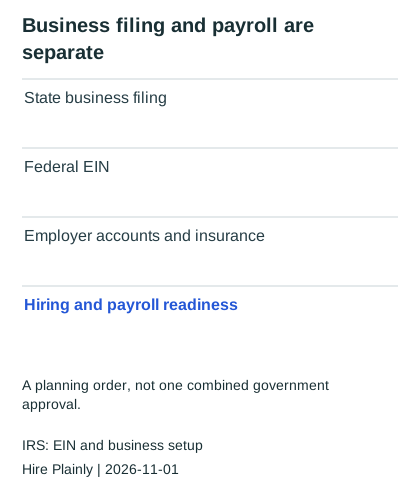
Continue with the Texas first-employee guide for I-9(employment-eligibility verification form), new-hire reporting, hours, wages, payroll deposits and returns. Keep that employee process separate from the owner's draw and from the LLC's annual PIR.
Keep formation, opening and recurring records separate
The café is ready for the next step when each required task has an actual result, rather than a tick beside “application started.” Keep three folders: formation and identity, permission to open, and recurring taxes and reports. Place a future due date and the person responsible beside each recurring item.
For BOI, FinCEN's current rule, effective August 14, 2026, exempts entities created in the United States. That exemption does not replace Texas information reporting or tax filings. Check unsolicited paid filing offers against the responsible agency before buying a service.
This article is general information, not legal or tax advice. Rules change and every business is different, so check with your state agency, an employment attorney, or a CPA before making decisions.