In this article
- How to start an LLC in New Jersey: filing tasks and recurring costs
- Confirm you can legally work in your own business
- Pick a business structure
- Check that your business name is available
- Choose a registered agent
- File the Certificate of Formation ($100)
- Get an EIN from the IRS (free)
- Register for New Jersey taxes (NJ-REG)
- Register to collect sales tax, if you sell taxable things
- Check licenses and local permits
- Open a business bank account and write an operating agreement
- Get the right insurance
- Stay current every year
- How you pay yourself as the owner
- Next: when you hire your first person
- Your checklist
- When a filing is returned for correction
- FAQ
Start an LLC in New Jersey: Filings and Owner Draws
Official sources checked: October 27, 2026

Before you sign a café lease under an LLC(state-law business entity)’s name in New Jersey, which filings and accounts should already be in place? A hypothetical owner plans a café in Newark and forms an LLC on July 6, 2026, before signing the business lease. The owner is one individual who already has permission to work, has no employees yet, and has not elected corporation taxation. The practical question is which approval is needed for the next filing, what the setup costs, and what comes due next year.
This example uses a default-taxed, individually owned LLC. Entity ownership, multiple members or an S/C corporation election changes the tax branch. Use the US LLC guide for common federal preparation, then connect the state filings below to the same café's records.

How to start an LLC in New Jersey: filing tasks and recurring costs
| Step | Where | Cost |
|---|---|---|
| Confirm you can legally work in the business | USCIS (your status) | $0 to check |
| Pick a business structure | Your decision | $0 |
| Check the name | NJ Business Formation portal | $0 ($50 to reserve) |
| Choose a registered agent | You or a paid service | $0 if you do it |
| File the Certificate of Formation | NJ Business Formation portal | $100 |
| Get an EIN | IRS.gov | $0 |
| Register for state taxes (NJ-REG) | NJ Business Registration | $0 |
| Register to collect sales tax, if you sell taxable things | Same NJ-REG form | $0 |
| Check licenses and local permits | State board, your town | Varies |
| Open a business bank account, write an operating agreement | Your bank | Varies |
| Get insurance (workers' comp once anyone else works for pay) | Insurance agent | Varies |
| Stay current every year | DORES, IRS, NJ Taxation | $75 a year |
The current state filing fee is $100, and each annual report costs $75. Keep the formation payment and recurring report on separate calendar entries; neither amount includes permits, insurance or taxes.
Confirm you can legally work in your own business
Owning a company and working for it are separate questions under immigration law.
US citizens and green card holders can own and work in their business. If you're in the US on a visa, your status decides what you can do.
USCIS says B-1 visitors can't open and operate their own business here. F-1 students may start, own and work for their own business during their initial period of OPT, with an approved work permit (EAD(employment authorization document)). The work still has to relate to their field of study.
Other paths exist for founders, such as E-2 for investors from treaty countries, L-1A(qualifying intracompany-transfer category), O-1A and international entrepreneur parole. Each one has its own rules about the role you can play.
Forming the LLC is easy. Working in it without the right status can put your status at risk, and no state form will warn you.
Pick a business structure
Most one-person businesses choose between three structures.
| Structure | How you form it | How it's taxed by default |
|---|---|---|
| Sole proprietorship | Nothing to file with the state. Register a trade name with your county if you use one | On your personal return |
| LLC | Certificate of Formation with the state | One owner: on your personal return. Two or more: as a partnership |
| Corporation | Certificate of Incorporation with the state | As a corporation, unless it elects S corp status |
For this café, compare the lease, liability exposure and ownership plans before choosing the structure. An LLC can limit personal liability for business debts, although a personal guarantee on a loan or lease still binds the owner. A low-risk side business without premises or employees presents a different decision, and investor plans can change which structure works.
By default, this individually owned LLC is a disregarded entity for federal income tax: its income generally goes on the owner's return. That income-tax treatment does not remove separate employment-tax obligations when the café hires A.
An eligible LLC can elect S corporation taxation with federal Form 2553. For current periods, New Jersey no longer requires a separate NJ S election. Follow the current NJ procedure: the correct DORES registration type, proof of federal approval and Shareholder Jurisdictional Consent. This changes taxation rather than the LLC's legal form; earlier-period retroactive elections are a separate issue.
The structure decides which forms you file for years. Changing it later means new filings and, often, a new EIN.
Check that your business name is available
Your LLC's name has to be different from every other business on file in New Jersey. It also has to include "Limited Liability Company," "LLC" or "L.L.C." You can search names inside the state's Business Formation portal before you file.
Not ready to file yet? You can reserve a name for $50. If you'll sell under a different name than your legal one, you register an "alternate name" for $50.
Search the US trademark database and the domain name too. Getting a state approval doesn't mean nobody else owns the brand.
Renaming later means new signs, a new domain and a round of bank paperwork.
Choose a registered agent
A registered agent is the person or company that receives official legal papers for your LLC. In New Jersey, the agent must have a New Jersey address.
You can be your own agent if you live in New Jersey. The catch is that your address goes into the public record. A registered agent service costs a yearly fee and keeps your home address out of that part of the record.
If a lawsuit or state notice goes to an address nobody checks, you can miss the deadline to respond.
File the Certificate of Formation ($100)
This is the step that creates your LLC. You file online through the New Jersey Business Formation portal and pay the $100 fee. Check the current DORES fee schedule before paying.
Have these ready:
- The business name and a short business purpose
- Your registered agent's name and New Jersey address
- The main business address
- The names of the members or managers
- A NAICS code that describes your industry (you can look it up during the filing)
When it's approved, you get the Certificate of Formation and a 10-digit Entity ID. Save both as PDFs. You'll use the Entity ID for state tax registration and the certificate to open a bank account.
Until this is approved, the LLC doesn't exist yet. Contracts you sign before then can leave you personally on the hook. If you have to sign a lease first, have an attorney look at how it's worded.
Get an EIN from the IRS (free)
After the state approves formation, apply through the IRS's free EIN service. Online eligibility includes a US or US-territory principal place of business and the responsible party's SSN(Social Security number) or ITIN(individual taxpayer ID). If eligible and approved, the application can produce the number immediately; otherwise follow the IRS's alternative instructions.
Have the approved legal name, formation date, address, ownership and business activity ready. Save the confirmation letter and compare it with the formation record before using the EIN on NJ-REG or payroll. The IRS charges no application fee; a preparer's optional service charge is a different cost. Check the current official application page for availability instead of planning around a copied schedule. Checked October 28, 2026.
Register for New Jersey taxes (NJ-REG)
Every business doing business in New Jersey registers with the state for tax purposes on Form NJ-REG. It's free and done online. The state asks you to register at least 15 business days before you open.
You'll need the Entity ID from Step 5, your EIN and your NAICS code. If you file online, you can print your Business Registration Certificate (BRC) right away. Your New Jersey tax ID is your EIN plus a three-digit suffix.
The state says you must display the BRC at your place of business.
This one form sets up every state tax account you'll use, including sales tax and, later, payroll.
Register to collect sales tax, if you sell taxable things
New Jersey's sales tax is 6.625%, one rate for the whole state. If you sell taxable goods or services, you check that box on NJ-REG. The state then issues a Certificate of Authority, which you must also display.
Every seller files a quarterly return, Form ST-50. It's due on April 20, July 20, October 20 and January 20. If you collected more than $30,000 in sales tax the year before, you also make additional payments for the first or second month of a quarter when that month exceeds $500; the third month is settled with ST-50. Sales-tax weekend/holiday rules follow Taxation instructions, not NJDOL contribution deadlines.
Not sure if what you sell is taxable? New Jersey taxes most products and some services, so check the Division of Taxation's guidance for your exact item before your first sale.
Sales tax isn't your money. If you forget to collect it, you still owe it.
Check licenses and local permits
New Jersey doesn't have one general business license. Instead, certain kinds of businesses need a state license, such as contractors and daycare providers.
Your town may have its own rules. Many New Jersey municipalities require zoning approval or a certificate of occupancy before you open in a space.
Some towns also issue a mercantile license. Food businesses also deal with the local health department.
Before you sign a lease, call your municipal clerk and zoning office and ask what that address needs. The NJ Business Action Center also answers questions at 1-800-JERSEY-7.
A town can stop you from opening in a space you've already paid for.
Open a business bank account and write an operating agreement
Banks usually ask for the Certificate of Formation, your EIN confirmation letter and photo ID. Keep business money in this account and personal money out of it. Mixing the two makes it harder to show the LLC is separate from you if it's ever sued.
New Jersey doesn't ask you to file an operating agreement with the state. Write one anyway.
An operating agreement says who owns what, who decides, and what happens if a member leaves. Even a one-owner LLC benefits, because banks and lenders sometimes ask for it.
Separate records support the LLC's separateness and make tax time cheaper.
Get the right insurance
For an LLC or partnership, New Jersey generally requires workers' compensation when someone other than a member or partner works for compensation. A sole proprietor has a comparable owner exclusion, but a corporation can have working officers who must be covered. Confirm coverage is effective before work starts.
Failure to insure can be a disorderly persons offense; a willful failure is a fourth-degree crime. Penalties can reach $5,000 for the first ten days without coverage and up to $5,000 for every 10 days after that. Officers can be held personally liable.
Once you're insured, you post a notice at the worksite that names your insurer. Your carrier gives you the notice.
Other coverage, like general liability or professional liability, isn't a general state requirement, though some licenses and trades require it. Clients and landlords often require it in their contracts, so read those first.
Without coverage, you can be directly liable for an injured worker's medical bills and lost wages, on top of the penalties.
Stay current every year
Compare the formation charge and recurring report fee in the chart. They are different filing events, not two charges to combine as a day-one total.
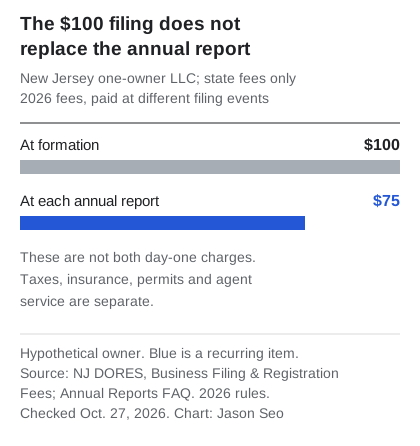
The annual-report due date is tied to the month the LLC was formed. Put the date shown in the LLC's DORES record on the calendar, and keep the acceptance even if no state reminder arrives.
Forming the LLC is a one-time task. These come back every year:
- Annual report: $75, filed online with the state. The due date is tied to the month your LLC was formed, so put it on your calendar now.
- Federal income tax: A one-owner LLC reports profit on your personal return. Two or more owners file a partnership return. Multi-member LLCs with New Jersey income also file Form NJ-1065.
- Self-employment tax: If your net earnings are $400 or more, you generally pay 15.3% (12.4% for Social Security and 2.9% for Medicare). It's figured on 92.35% of net earnings, and the Social Security part stops at the yearly wage base. Schedule SE walks you through it. This is how owners pay into Social Security when no employer does it for them.
- Estimated taxes: If you expect to owe $1,000 or more after withholding and credits, you generally pay the IRS in four installments using Form 1040-ES. New Jersey has its own estimated payment form, NJ-1040-ES.
- Sales tax returns: Quarterly, if you registered in Step 8.
One thing you no longer need: a beneficial ownership (BOI) report. FinCEN's final rule, effective August 14, 2026, made all companies created in the US exempt(overtime-exemption classification). If a website emails you about a BOI "deadline," verify the sender and the claimed obligation on FinCEN's official site before paying.
Miss the annual report two years in a row and the state can revoke your LLC. Getting it back means a reinstatement filing and fees.
How you pay yourself as the owner
A one-owner LLC taxed the default way doesn't put you on payroll. You take money out as an owner's draw, and you pay income tax and self-employment tax on the profit, whether you take it out or not.
If the LLC elects S corporation status, that changes. The IRS says an S corporation must pay a shareholder who works in the business reasonable compensation as wages before taking other distributions. That means running payroll for yourself. Whether the election saves you money depends on your profit, so run the numbers with a CPA first.
Profit and the owner's transfer are different numbers
Suppose the hypothetical café earns $45,000 after deductible business costs and the owner transfers $5,000 for personal use. A default-taxed one-owner LLC does not deduct that transfer as payroll, so its bank balance and taxable profit are different numbers. This illustration assumes no other wages and earnings below the Social Security base; it is not the owner's complete tax bill.
| Item | Calculation or meaning | Amount |
|---|---|---|
| Business net profit | Hypothetical amount after allowable costs | $45,000.00 |
| Owner's draw | Personal transfer, not a wage expense | $5,000.00 |
| Reduction in profit caused by the draw | A draw is not a business expense | $0.00 |
| Ordinary Schedule SE base illustration | $45,000 × 92.35% | $41,557.50 |
| Self-employment tax illustration | $41,557.50 × 15.3% | $6,358.30 |
Federal and state income tax, individual deductions and other income are excluded. Apply the IRS self-employment guidance and Schedule SE to actual inputs, with estimated payments and year-end reconciliation handled separately. Do not use this owner-draw illustration unchanged after a corporation tax election.
Next: when you hire your first person
Everything above covers you as an owner. Once someone else works for you for pay, payroll and labor-law duties begin. In New Jersey, that includes:
- The 2026 minimum wage: $15.92 an hour for most employers, $15.23 for seasonal employers and for small employers that meet NJ's yearly headcount test (fewer than six employees, counted across the current and prior year)
- Earned sick leave for nearly every employee, subject to the law's narrow exclusions
- Form I-9(employment-eligibility verification form) Section 1 by day one; Section 2 within three business days after the start, or day one for a job lasting less than three business days
- New-hire reporting: electronic reports within 15 days; other methods within 20, under N.J.A.C. 10:110-11.2(b)
I cover those in order in How to hire your first employee in New Jersey. Before you hire, run the numbers in the employee cost calculator.
Your checklist
This week: confirm your work authorization, pick a structure, check the name, choose a registered agent.
Before you open: file the Certificate of Formation, get the EIN, file NJ-REG at least 15 business days ahead, register for sales tax if needed, clear local permits, open the bank account, sign the operating agreement, buy insurance.
Every year: annual report, income and self-employment tax, estimated payments, sales tax returns.
When a filing is returned for correction
Suppose the café's formation is accepted, but the EIN request uses a shortened trade name instead of the accepted legal name. Stop and compare the accepted certificate, IRS instructions and registration draft before creating another application. Record which agency needs a correction and keep the original response. A second payment or a new entity application can create a different problem.
Use the tracker to carry one approved set of details through formation, EIN and NJ-REG. Keep sensitive identifiers in the secure business file; the worksheet needs only a confirmation reference and the person responsible for the next task.
FAQ
How much does it cost to start an LLC in New Jersey? The state charges $100 to file the Certificate of Formation and $75 a year for the annual report. The EIN and NJ-REG registration are free. Optional costs include a name reservation ($50), an alternate name ($50) and a registered agent service.
How long does it take? An eligible online EIN application can produce the number immediately if approved. The state filings are online too, so most of the waiting is on your side: picking a name, an agent and a bank. Plan for at least 15 business days between registering with the state and opening, because that's the lead time New Jersey asks for.
Can I form my LLC in Delaware or Wyoming instead? You can, but if you do business in New Jersey, you still register that out-of-state LLC here and pay New Jersey fees. For a local business, that usually means paying twice.
Do I need to file a BOI report with FinCEN? No, not for a company created in the US. FinCEN's final rule took effect August 14, 2026, and exempts all US-created companies.
Can I start an LLC on a visa? Forming and owning an LLC is a different question from working in it. Whether you can work in the business depends on your immigration status, so check with an immigration attorney before you start working.
This article is general information, not legal or tax advice. Rules change and every business is different, so check with your state agency, an employment attorney, or a CPA before making decisions. Immigration information here is not legal or immigration advice. Talk to an immigration attorney about your own situation.