In this article
- How to start an LLC in California: filing tasks and recurring costs
- Do the federal steps first
- Check the name and choose an agent for service of process
- Formation inputs, submission and approval records
- File the Statement of Information within 90 days ($20)
- Get an EIN
- Get a seller's permit, if you sell taxable goods
- Check city permits
- When you hire: EDD, workers' comp and labor rules
- Annual tax, the LLC fee and the default-tax return
- Operating agreement and separate business funds
- How you pay yourself: profit and owner's draw
- An address service needs three separate questions
- FAQ
Start an LLC in California: Filings and Owner Draws
Official sources checked: October 27, 2026

How much should you set aside before forming a California LLC(state-law business entity), and which costs will come back next year? A hypothetical owner plans a café in Irvine and forms an LLC on January 6, 2026, before signing the business lease. The owner is one individual who already has permission to work, has no employees yet, and has not elected corporation taxation. The practical question is which approval is needed for the next filing, what the setup costs, and what comes due next year.
This example uses a default-taxed, individually owned LLC. Entity ownership, multiple members or an S/C corporation election changes the tax branch. Use the US LLC guide for common federal preparation, then connect the state filings below to the same café's records.

How to start an LLC in California: filing tasks and recurring costs
| Step | Where | Cost |
|---|---|---|
| Do the federal steps first | See the main guide | $0 |
| Check the name and choose an agent | Secretary of State (bizfile) | $0 if you're the agent |
| File the Articles of Organization (LLC-1) | bizfile Online | $70 |
| File the Statement of Information within 90 days | bizfile Online | $20 |
| Get an EIN(employer tax ID) | IRS.gov | $0 |
| Get a seller's permit, if you sell taxable goods | CDTFA | $0 |
| Check city permits | City hall | Varies |
| Register with EDD and buy workers' comp when you hire | EDD, insurer | Varies |
| Default classification: annual tax and Form 568 | Franchise Tax Board | $800 a year |
Do the federal steps first
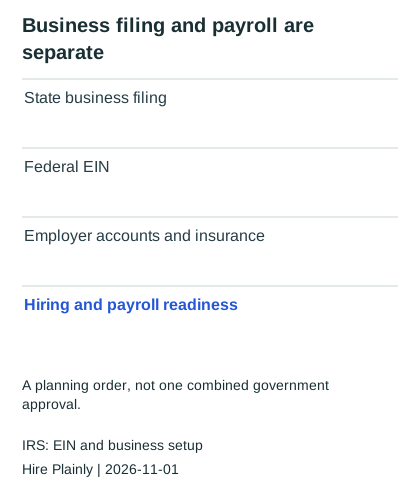
Confirm you can legally work in the business, pick your structure and know how you'll pay yourself. Start with those federal questions in the main guide.
Check the name and choose an agent for service of process
Search the Secretary of State's bizfile system to check for obvious conflicts. The state decides when it reviews your filing, and a trademark search is a separate step. California calls the registered agent an "agent for service of process." The agent needs a California address where legal papers can be delivered.
A lawsuit sent to an address nobody checks can mean a missed deadline to respond.
Formation inputs, submission and approval records
Prepare the café's legal name, addresses, required management information and the applicable agent or service-of-process mailing details. A name search is preliminary and does not resolve trademark rights. Read the actual Form LLC-1 fields, settle the inputs, then submit to the California Secretary of State with the $70 fee.
| Preparation or action | Result to retain |
|---|---|
| Check the name, addresses and applicable agent information | Final input copy |
| Submit the official formation record and state fee | Filing and payment confirmation |
| Check approval, rejection or an additional-information request | Approved formation record and state identifier, or rejection reason |
| Prepare EIN, banking and tax registration from the approval | Consistent legal name, formation date and address on later records |
Submission is not approval. Resolve a rejected filing before relying on it, then download the approved record and match later registrations to its identifiers.
File the Statement of Information within 90 days ($20)
California wants a Statement of Information (Form LLC-12) within 90 days of forming the LLC, then every two years. The fee is $20 each time. Save the 90-day deadline and the next biennial filing date when approval arrives. Complete the current LLC-12 with the approved entity details, submit it, and retain acceptance separately from the original formation approval.
Get an EIN
Apply free on IRS.gov after formation. Eligible online applications receive the number immediately if approved; save the confirmation letter. Details are in the main guide.
Get a seller's permit, if you sell taxable goods
If you sell or lease taxable physical goods in California, CDTFA generally requires a seller's permit before your first sale. It's free, though CDTFA may ask for a security deposit in some cases.
The statewide base sales tax rate is 7.25%. Many cities and counties add district taxes on top, so check the rate for your exact address.
CDTFA says you can't legally make taxable sales until you're issued the permit.
Check city permits
Your city controls zoning, business tax registration in many places, and health permits for food. Los Angeles, for example, has its own city requirements on top of the state's. Ask city hall about your exact address before you sign a lease.
For the hypothetical café, send the city permit office the proposed address, food-service activity and any planned alterations. Ask which approvals must be issued before construction and before opening, which office handles each one, and whether an inspection must be scheduled. Keep the reply with the lease review instead of treating the state LLC approval as permission to serve customers.
Build a small register with columns for the agency, permit, application number, submitted date, missing item, inspection, approval and renewal date. Mark an unknown fee as “quote pending” rather than $0. The register is a practical planning method; the actual permit list comes from the city and the relevant health or licensing agency.
When you hire: EDD, workers' comp and labor rules
Once you pay more than $100 in wages in a calendar quarter, you have 15 days to register with the Employment Development Department (EDD). New employers in 2026 start at 3.4% unemployment insurance plus 0.1% training tax on the first $7,000 of each employee's pay.
California requires workers' comp from every employer with even one employee, including family members. If you're caught without it, the state issues a stop order and a penalty of twice the premiums you should have paid or $1,500 per employee, whichever is higher.
Labor rules for 2026:
- Minimum wage: $16.90 an hour statewide; some cities and counties set a higher rate.
- Paid sick leave: At least 40 hours or 5 days a year, whichever is more.
- New hire report: Form DE 34 within 20 calendar days of the start date.
Annual tax, the LLC fee and the default-tax return
A default-classified LLC such as this café generally pays the $800 annual tax and files Form 568. One owner and default classification are separate conditions. An LLC taxed as a corporation instead follows the applicable Form 100/100S corporate regime; do not carry the 3522, 568 and LLC-fee instructions into that branch unchanged.
| Obligation for the default-taxed café LLC | Timing and completion record |
|---|---|
| Initial LLC-1: $70 | At formation; keep approved record and payment proof |
| Initial LLC-12: $20 | Within 90 days, then biennially; save acceptance and next filing date |
| Ordinary annual tax: $800 | First year: 15th day of the fourth month measured from formation; later years: fourth month of tax year. Keep FTB payment proof |
| Additional LLC fee | Separate calculation at $250,000 or more of CA total income. If applicable, estimated 3536 payment by the sixth month's 15th |
| Form 568 | Individually owned, default-classified calendar-year LLC: fourth month's 15th after year-end. Other ownership/classifications use different rows |
For this January 6, 2026 formation, the ordinary first annual-tax payment is April 15, 2026, while the basic 2026 Form 568 deadline is April 15, 2027. Filing and payment are different jobs. Use the FTB due-date table for classification, year, holidays and extensions; a filing extension is not automatically a payment extension.
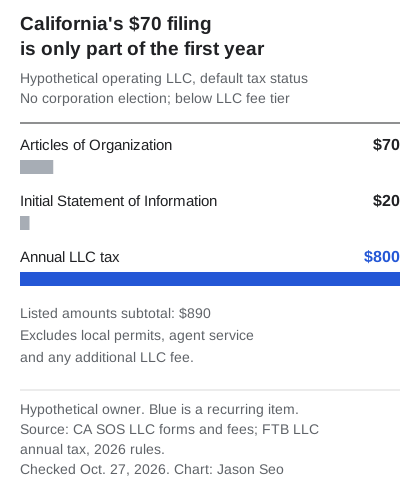
In the chart, compare the recurring annual tax with the smaller formation fee. The listed first-year baseline is $890, not the complete cost of operating a café.
CA total income is a specific fee calculation, not net profit. For example, a default-taxed LLC with $300,000 under that calculation can fall into the first fee tier even if expenses leave little net profit. Apply Schedule IW instead of excluding the fee based only on bottom-line profit.
| CA total income tier | Additional LLC fee |
|---|---|
| $250,000–$499,999 | $900 |
| $500,000–$999,999 | $2,500 |
| $1,000,000–$4,999,999 | $6,000 |
| $5,000,000 or more | $11,790 |
Assume this café has $100,000 under the fee's total-income calculation; it is below the additional fee tiers. Add actual local permits, agent service and other taxes separately. A dormant default-taxed LLC may continue to owe the ordinary annual tax until properly canceled. Check the FTB exceptions, including qualifying short-form cancellation, rather than treating the expired 2021–2023 first-year relief as a current general exemption.
The exemption for US-created companies from BOI reporting is separate. Check FinCEN's current rule, effective August 14, 2026, and do not mistake it for an exemption from California taxes or filings.
Operating agreement and separate business funds
Write an operating agreement, open a business bank account and keep business money separate. Those steps are the same in every state and are covered in the main guide.
How you pay yourself: profit and owner's draw
Suppose the hypothetical café earns $45,000 after deductible business costs and the owner transfers $5,000 for personal use. A default-taxed one-owner LLC does not deduct that transfer as payroll, so its bank balance and taxable profit are different numbers. This illustration assumes no other wages and earnings below the Social Security base; it is not the owner's complete tax bill.
| Item | Calculation or meaning | Amount |
|---|---|---|
| Business net profit | Hypothetical amount after allowable costs | $45,000.00 |
| Owner's draw | Personal transfer, not a wage expense | $5,000.00 |
| Reduction in profit caused by the draw | A draw is not a business expense | $0.00 |
| Ordinary Schedule SE base illustration | $45,000 × 92.35% | $41,557.50 |
| Self-employment tax illustration | $41,557.50 × 15.3% | $6,358.30 |
Federal and state income tax, individual deductions and other income are excluded. Apply the IRS self-employment guidance and Schedule SE to actual inputs, with estimated payments and year-end reconciliation handled separately. Do not use this owner-draw illustration unchanged after a corporation tax election.
An address service needs three separate questions
Ask whether the proposed address can serve as the business location, mailing destination and address for service of process. Record the answer for each use and check it against the relevant form's official instructions. A provider describing "a business address" does not establish that the same address fits every field or local licensing requirement.
Before submitting LLC-12, compare its names, addresses and management information with the accepted formation record and actual operation. After submission, save the accepted filing separately from a receipt for the $800 payment or another tax payment. Those records answer different questions when preparing the next return.
FAQ
How much does it cost to start an LLC in California? For the default-taxed operating example, the listed first-year state baseline is $890: $70 to file, $20 for the first Statement of Information and the $800 annual tax. Permits, an agent service and the additional LLC fee at CA total income of $250,000 or more come on top. Corporation elections and qualifying cancellation exceptions require a separate check.
Can I avoid the $800 by forming in another state? Generally no for the default-taxed operating LLC example, if you do business in California. The Franchise Tax Board applies the $800 tax to LLCs doing business in California, wherever they were formed.
Is there still a first-year exemption from the $800? The first-year exemption covered tax years beginning in 2021, 2022 and 2023. It doesn't apply to LLCs formed now.
This article is general information, not legal or tax advice. Rules change and every business is different, so check with your state agency, an employment attorney, or a CPA before making decisions.