In this article
- How to start an LLC: the short version
- Step 1. Confirm you can legally work in your own business
- Step 2. Pick the state to form in
- Step 3. Pick a business structure
- Step 4. Name, registered agent and the formation filing (state)
- Step 5. Get an EIN from the IRS (free)
- Step 6. Register for state taxes (state)
- Step 7. Licenses, permits and insurance (state and city)
- Step 8. Open a bank account and write an operating agreement
- Step 9. Federal taxes as an owner
- Step 10. Yearly state filings
- Which state costs the least to run an LLC?
- Hiring someone? What's federal and what's state
- Decide who can act for the LLC
- FAQ
How to start an LLC: CA, NY, NJ and TX before your first hire
Official sources checked: October 24, 2026; selected points rechecked October 28 and 30, 2026

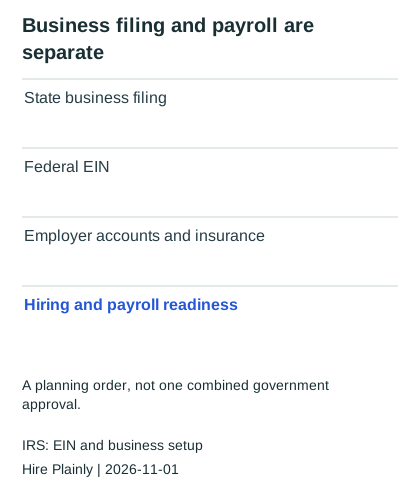
If you register an LLC(state-law business entity) today, what else must happen before you can open your café and take money home? A hypothetical first-time owner is preparing to open a café, with no employees yet and no corporation tax election planned. Before paying a formation website, the owner needs to separate three questions: where to form, which approvals allow the café to open, and how business profit becomes personal income.
The working example assumes one individual owner who already has permission to work in the United States. Federal tax rules provide the common starting point, while the actual operating state decides the formation and local registration tasks. The state pages below carry the detailed filing instructions; use this overview to choose the right path and prepare one consistent set of records.
The original fact check was October 24, 2026. The filing distinctions and cross-links below were reviewed again on October 28, 2026.
How to start an LLC: the short version
| Step | Same everywhere? | Where |
|---|---|---|
| 1. Confirm you can legally work in the business | Yes, federal | USCIS (your status) |
| 2. Pick the state to form in | Your decision | Usually where you operate |
| 3. Pick the legal form and tax treatment | State legal form; federal tax classification | State filing office and IRS |
| 4. Name, agent and formation filing | No, state | State business filing office |
| 5. Get an EIN(employer tax ID) | Yes, federal | IRS.gov, free |
| 6. Register for state taxes | No, state | State tax and labor agencies |
| 7. Licenses, permits and insurance | No, state and city | State boards, city hall, insurer |
| 8. Bank account and operating agreement | Bank requirements and state agreement rules differ | Your bank and internal records |
| 9. Federal taxes as an owner | Yes, federal | IRS |
| 10. Yearly state filings | No, state | State filing office |
Step 1. Confirm you can legally work in your own business
Owning a company and working for it are two different things under immigration law. Forming an LLC doesn't give anyone permission to work in the US.
US citizens and green card holders can own and work in their business. If you're in the US on a visa, your status decides what you can do.
USCIS says B-1 visitors can't open and operate their own business here. F-1 students may start, own and work for their own business during their initial period of OPT. They need an approved work permit (EAD(employment authorization document)), and the work has to relate to their field of study.
Other paths exist for founders, such as E-2 for investors from treaty countries, L-1A(qualifying intracompany-transfer category), O-1A and international entrepreneur parole. Each one limits the role you can play.
No state filing office checks your work authorization. Working without it can put your status at risk.
Step 2. Pick the state to form in
In most cases, form the LLC in the state where you actually run the business. That's where your shop, your office or you as the only worker are.
You'll see ads for Delaware or Wyoming LLCs. If you then do business in your home state, you register that out-of-state LLC there too and pay both states' fees. California is the clearest example. For an ordinary default-taxed LLC doing business in California, the Franchise Tax Board generally applies the $800 annual tax even if the entity was formed elsewhere. Corporation-taxed LLCs and specific exceptions need separate treatment.
For a local business, forming somewhere else usually means paying twice.
Step 3. Pick a business structure
| Structure | How you form it | How it's taxed by default |
|---|---|---|
| Sole proprietorship | Often nothing to file with the state | On your personal return |
| LLC | Formation filing with the state | One owner: on your personal return. Two or more: as a partnership |
| Corporation | Incorporation filing with the state | As a corporation, unless it elects S corp status |
Compare liability exposure, tax administration and financing plans before choosing a form. A one-owner service business, a café signing a lease and a company seeking outside investors may need different arrangements. An LLC does not replace suitable insurance, and an S corporation is a tax classification with eligibility rules, not a different formation fee in this table.
An LLC can limit your personal liability for business debts, though a personal guarantee on a loan or lease still binds you. For federal income tax, the IRS ordinarily treats a one-owner LLC as part of its owner unless it elects corporation taxation. An individual business owner generally reports operations on the applicable personal-return schedule; employment, excise and state filings remain separate questions.
Your structure sets your recurring federal and state filings.
Step 4. Name, registered agent and the formation filing (state)
Formation rules differ by state. Each state checks that your name is unique, asks who receives legal papers for the LLC, and charges a filing fee.
| California | New York | Texas | New Jersey | |
|---|---|---|---|---|
| Formation filing | Articles of Organization (LLC-1) | Articles of Organization | Certificate of Formation (Form 205) | Certificate of Formation |
| State fee | $70 | $200 | $300 | $100 |
| Extra first-year step | Statement of Information ($20) within 90 days | Publish a notice for 6 weeks in 2 newspapers, then file a $50 certificate within 120 days | None | None |
New York's publication rule is the one that surprises people. The county clerk picks the newspapers, and their charges vary a lot by county. Skip it and the state can suspend the LLC's authority to do business.
Step-by-step pages: California, New York, Texas, New Jersey.
Step 5. Get an EIN from the IRS (free)
An EIN identifies the business for federal tax administration. Form the LLC with the state first, then use the IRS EIN application. The IRS charges no application fee; any paid preparer charge is a separate service fee.
The online route requires a US or US-territory principal place of business and the responsible party's SSN(Social Security number) or ITIN(individual taxpayer ID), along with other eligibility conditions. If that route does not fit, use the IRS's alternative application instructions rather than entering an invented identifier. Approval can produce the EIN immediately, but approval is not guaranteed.
Have the approved legal name, formation date, addresses, owner information and business activity ready before starting. Save the confirmation letter when issued, then match it with the formation record before using the number for tax registration or payroll. A bank's document checklist is separate from the IRS application.
Step 6. Register for state taxes (state)
Every state runs its own sales tax and payroll tax accounts. The trigger and the deadline differ.
| California | New York | Texas | New Jersey | |
|---|---|---|---|---|
| Sales tax rate | 7.25% base, more in district areas | 4% state; 8.875% in New York City | 6.25% state, up to 8.25% with local | 6.625% statewide |
| Sales tax registration | Seller's permit, free | Certificate of Authority, at least 20 days before starting | Sales tax permit from the Comptroller | NJ-REG, at least 15 business days before opening |
| Payroll tax registration | Within 15 days after paying more than $100 in a quarter | General-business UI: $300+ in a quarter; withholding registration is separate | Within 10 days of paying $1,500 in a quarter or having an employee in 20 weeks | Same NJ-REG |
Sales tax isn't your money. If you forget to collect it, you still owe it.
Step 7. Licenses, permits and insurance (state and city)
Most small businesses need a mix of state trade licenses and city permits, not one business license. Cities control zoning and occupancy for your space. Before you sign a lease, check zoning and permits for that exact address with the city or county.
Workers' comp is the biggest state difference. New Jersey, New York and California require it once you have employees, and California's labor department says that means even one employee.
Texas lets most private employers opt out, but an employer without coverage loses the legal limit on what an injured worker can sue for.
Step 8. Open a bank account and write an operating agreement
Banks usually ask for your state formation document, your EIN letter and photo ID. Keep business money in this account and personal money out of it, so the LLC's records stay separate from yours.
None of these four states asks you to file your operating agreement with them, and New York requires you to adopt one within 90 days of forming. Write one in every state. It says who owns what, who decides and what happens if someone leaves.
Step 9. Federal taxes as an owner
A one-owner LLC taxed the default way doesn't put you on payroll. You take an owner's draw and pay tax on the profit, whether you take it out or not.
- Self-employment tax: If your net earnings are $400 or more, you generally pay 15.3% (12.4% Social Security, 2.9% Medicare), figured on 92.35% of net earnings.
- Estimated taxes: If you expect to owe $1,000 or more after withholding and credits, you generally pay the IRS in four installments with Form 1040-ES.
- S corporation option: The IRS says an S corporation must pay a working owner reasonable compensation as wages before other distributions. That means payroll for yourself, so run the numbers with a CPA first.
- BOI report: Not needed. FinCEN's final rule, effective August 14, 2026, exempts every company created in the US.
Step 10. Yearly state filings
| California | New York | Texas | New Jersey | |
|---|---|---|---|---|
| Recurring state fee | $800 annual tax every year, plus $20 Statement of Information every 2 years | Biennial statement, $9 every 2 years, plus a yearly LLC filing fee to the Tax Department ($25 for an individually owned, default-taxed LLC with relevant NY-source items; different rules for partnership or corporation taxation) | $0 franchise tax at or below $2.65 million in annualized total revenue; generally still file a PIR | Annual report, $75 a year |
| Extra fee as you grow | LLC fee from $900 once CA total income reaches $250,000 | Partnership-classified LLC fee may rise with prior-year NY gross income | Franchise tax above the threshold | None |
| State income tax on your profit | Yes | Yes | No personal income tax | Yes |
Which state costs the least to run an LLC?
Here's the state-fee math for a one-owner LLC, before tax on your profit and before optional services like a registered agent.
| Year 1 state fees | Later recurring charges | Personal income tax | |
|---|---|---|---|
| Texas | $300 | $0 at or below $2.65M annualized total revenue | None |
| New Jersey | $100 | $75 | Yes |
| New York | $250 plus newspaper costs | Two-year average $29.50 for the stated default/NY-source branch; actual due dates differ | Yes |
| California | $890 ($70 + $20 + $800) | Two-year average $810; actual payment dates differ | Yes |
The table compares specific state filing charges for the stated default-taxed, one-owner example. It is not a total business-cost ranking: local permits, agent services, insurance, income taxes and the owner's actual operating location remain outside the totals. The California and New York figures average biennial charges over two years rather than describing an annual invoice.
Texas has no individual income tax and may have no franchise tax due below the applicable revenue threshold. That is useful for an owner who actually operates there; it is not a reason to put a Texas address on a business run elsewhere. An out-of-state formation can add registration costs without removing obligations in the operating state.
Texas-specific filings and reporting: How to start an LLC in Texas.
Hiring someone? What's federal and what's state
Some rules are federal, so they apply in every state. The employee fills out Section 1 of Form I-9(employment-eligibility verification form) by the first day of work, and you complete Section 2 within three business days after the first day of work, or on day one for employment lasting fewer than three business days. You also collect Form W-4(federal withholding form). You and the employee each generally pay 7.65% for Social Security and Medicare on covered wages, and you pay federal unemployment tax.
State rules add wage, leave and reporting duties:
| California | New York | Texas | New Jersey | |
|---|---|---|---|---|
| 2026 minimum wage | $16.90 statewide; some cities higher | $17.00 NYC, Long Island, Westchester; $16.00 elsewhere | $7.25 (federal) | $15.92 general; qualifying small/seasonal employers $15.23 |
| Paid sick leave | At least 40 hours or 5 days, whichever is more | 40 to 56 hours depending on size; unpaid at 0 to 4 employees with $1M or less in net income | No statewide law | Generally 40 hours; narrow statutory exclusions |
| New hire report | Within 20 calendar days | Within 20 calendar days | Within 20 days | Electronic: 15 days; other methods: 20 days |
The full hiring steps for all four states are in How to hire your first employee in the US. To compare total cost by state, try the employee cost calculator.
Decide who can act for the LLC
Before paying a filing service, agree who will make operating decisions and sign for the business. A one-owner café and a business with a passive investor can need different management terms. Record the proposed member-managed or manager-managed arrangement and ask counsel to align the filing and operating agreement where necessary.
Then keep three completion dates: state acceptance, permission to open at the actual address, and readiness to pay an employee. The first date does not settle the other two. This guide compares the four states covered here; a business operating elsewhere needs that state's own formation, licensing and employment guidance.
FAQ
Do I have to form my LLC in the state where I live? You form it where you do business. You can form in another state, but you then register in your home state too and pay both sets of fees.
Which state is cheapest to form an LLC in? Of these four, California has the lowest filing fee ($70), but it charges an $800 annual tax every year. Texas costs $300 to form and generally no franchise tax due at or below the applicable annualized-revenue threshold; required information reporting remains.
Do I need a registered agent? New Jersey, California and Texas require an agent with an in-state address. In New York, the Department of State receives legal papers for the LLC, so a separate agent is optional.
Do I need to file a BOI report? No, not for a company created in the US. FinCEN's final rule took effect August 14, 2026.
Can I start an LLC on a visa? Forming and owning an LLC is a different question from working in it. Whether you can work in the business depends on your immigration status, so check with an immigration attorney before you start working.
This article is general information, not legal or tax advice. Rules change and every business is different, so check with your state agency, an employment attorney, or a CPA before making decisions. Immigration information here is not legal or immigration advice. Talk to an immigration attorney about your own situation.