In this article
- Salary plus employer taxes: the starting subtotal
- The first guess: "Taxes come out of the paycheck"
- Employer FICA: the biggest piece
- Federal unemployment (FUTA): small, with a catch
- State unemployment (SUTA): the piece that depends on where you are
- Workers' compensation: insurance, not a tax
- The true cost of an employee, line by line
- What changes the percentage
- Back to the original question
- Build an all-in budget from the subtotal
- Annual cost is different from payroll cash flow
- A budget needs an unresolved-cost line
- How I'd budget a first hire
The True Cost of an Employee: Why $50,000 Costs More Than $50,000
Official sources checked: October 28, 2026

You offer your first hire $50,000 a year and set aside $50,000 in your budget. A few months in, more money is leaving the business account than the salary explains. The true cost of an employee starts with a layer of taxes that you pay on top of wages, and it's easy to miss because the pay stub never shows it.
Annual employer cost, employee deductions, one-time costs and pay-date cash are four different questions. The employee cost and cash worksheet keeps them apart, and you can print a blank copy.
Assume this is a hypothetical employee working a full year, with no overtime (overtime pay), bonus or benefit contribution yet. Start with the salary, add only the employer's separate costs, and then use the employee cost calculator with your own state inputs. The example below is a subtotal with stated exclusions, not a quote or an all-in hiring budget.
Salary plus employer taxes: the starting subtotal
For a $50,000 employee, federal payroll taxes alone add about $3,867 a year on top of salary: $3,825 for Social Security and Medicare and about $42 for federal unemployment. State unemployment tax (state unemployment program) and workers' compensation insurance come on top of that and vary a lot by state and industry. In the hypothetical example below, the total lands around 9% above salary before any benefits.

The first guess: "Taxes come out of the paycheck"
Most first-time owners start here, and it's half right. Federal income tax, the employee's share of Social Security and Medicare, and often state income tax do come out of the $50,000. That money is the employee's. You hold it for a few days and send it to the government, but it doesn't add to your cost.
The other half is a separate set of taxes calculated on the same wages and paid by you. Think of payroll as two columns. One column is money you subtract from the employee's pay and pass along. The other column is money you add from your own account, and that second column is the one that pushes the cost past $50,000.
Employer FICA: the biggest piece
FICA (Social Security and Medicare payroll taxes) is Social Security plus Medicare. The employee pays 7.65% through withholding, and you match it with another 7.65% from your own account. For the $50,000 employee, your match is $3,100 for Social Security (6.2%) and $725 for Medicare (1.45%), or $3,825 in total.
Social Security stops at a yearly wage cap, which is $184,500 for 2026. Medicare has no cap. That difference doesn't matter for a $50,000 salary, but it explains why the percentage you pay on top of wages shrinks for high earners, which we'll come back to below.
Federal unemployment (FUTA): small, with a catch
FUTA (federal unemployment tax) is 6.0% of the first $7,000 of each employee's wages each year. Most employers get a credit of up to 5.4% for paying state unemployment tax on time, which brings the effective rate to 0.6%. On $7,000, that's $42 per employee per year, and it stops there no matter how much the person earns.
The catch is the word "most." If your state borrowed from the federal government to pay unemployment benefits and hasn't paid it back, the credit shrinks and your FUTA bill goes up. The Department of Labor makes the final list of these "credit reduction" states after November 10 each year, so check it before you file Form 940 (annual federal unemployment-tax return) in January.
State unemployment (SUTA): the piece that depends on where you are
Every state runs its own unemployment insurance program, and each one sets a taxable wage base and assigns new employers a rate. Both numbers differ widely, so the same $50,000 employee can cost a few hundred dollars in one state and well over a thousand in another. Some states also add small surcharges for training or disability programs.
For the example, suppose your state assigns a new-employer rate of 2.7% on the first $10,000 of wages. That's $270 a year. Those two numbers are made up to show the math, so swap in your state's actual rate notice before you budget.
Workers' compensation: insurance, not a tax
Workers' comp pays medical bills and lost wages when someone gets hurt on the job. Most states require it once you have an employee, and Texas is the notable exception, where most private employers can choose not to carry it. In most states the premium is a rate per $100 of payroll that depends on the job's risk class (Washington bases it on hours worked instead), so an office worker and a delivery driver can differ by many times.

For the example, assume a rate of $1.00 per $100 of payroll, which comes to $500 a year. Again, that's a placeholder to show the calculation, not a quote.
The true cost of an employee, line by line
Here's the full picture for the hypothetical employee. Read the last column first, since it shows whether each line is an extra cost on top of salary.
| Item | How it's calculated | Annual amount | Above salary? |
|---|---|---|---|
| Salary | Offer letter | $50,000 | No (the base) |
| Social Security (employer) | 6.2% × $50,000 | $3,100 | Yes |
| Medicare (employer) | 1.45% × $50,000 | $725 | Yes |
| FUTA | 0.6% × $7,000 | $42 | Yes |
| SUTA (hypothetical) | 2.7% × $10,000 | $270 | Yes |
| Workers' comp (hypothetical) | $1.00 per $100 × $50,000 | $500 | Yes |
| Salary, tax and insurance subtotal | $54,637 | +$4,637 (9.3%) |
View the numbers as a table
| Social Security (employer) | $3,100 |
|---|---|
| Medicare (employer) | $725 |
| FUTA | $42 |
| SUTA (hypothetical) | $270 |
| Workers' comp (hypothetical) | $500 |
Amounts from the table above. SUTA and workers' comp use the article's hypothetical rates.
SUTA and workers' comp rates are made up for illustration. Health and retirement benefits, payroll software fees and equipment are not included. Paid time off (paid time off) is already inside the $50,000 salary; only the cost of covering shifts would be extra.
The federal lines use the same rates in every state, except that FUTA rises in a credit-reduction state. The two hypothetical lines are where your real number will move, which is why a state-by-state calculator is more useful than a single national percentage.
What changes the percentage
Change one input: raise the salary to $200,000 and keep the same hypothetical state rates. Employer Social Security now stops at the $184,500 cap, so it comes to $11,439 instead of 6.2% of the full salary. Medicare is $2,900, FUTA stays at $42, and SUTA stays at $270. Those four items add $14,651, or about 7.3% of salary, compared with about 8.3% for the same four items at $50,000.
That's the pattern to remember. Taxes with wage caps hit lower salaries harder as a percentage, because the cap is reached early or never matters. Workers' comp doesn't shrink that way in most states, because the premium is usually figured on total payroll, so its share of salary stays about the same as pay rises.
Back to the original question
The $50,000 hire wasn't a $50,000 decision. Before a single benefit, the hypothetical employee costs about $54,600, and the gap came from employer FICA first, then state unemployment and workers' comp. Compare the employer tax column in the payroll register with these lines, keeping employee deductions out of the added-cost total.
Build an all-in budget from the subtotal
The $54,637 subtotal leaves out benefits and the cost of running payroll. Add actual quotes as separate lines rather than multiplying salary by an unexplained national average. The same hire can have very different total costs depending on the health plan, job equipment and shift coverage.

Here is an optional planning scenario using the same employee. Every added price is an assumption for budgeting, not a market quote, and the retirement contribution is an assumed employer amount rather than a plan recommendation.
| Additional item | Hypothetical input | Annual amount | Timing |
|---|---|---|---|
| Health-plan employer share | $400 × 12 months | $4,800 | Recurring |
| Employer retirement contribution | 3% × $50,000 | $1,500 | Recurring |
| Payroll service allocation | $50 × 12 months | $600 | Recurring |
| Laptop and setup | One purchase | $900 | First year |
| Base subtotal above | Salary, taxes and insurance | $54,637 | Full year |
| Expanded first-year budget | Sum of these assumptions | $62,437 | 24.9% above salary |
- Salary$50,000
- Payroll taxes and workers' comp$4,637
- Health plan share$4,800
- Retirement contribution$1,500
- Payroll service$600
- Laptop and setup (first year)$900
View the numbers as a table
| Salary | $50,000 |
|---|---|
| Payroll taxes and workers' comp | $4,637 |
| Health plan share | $4,800 |
| Retirement contribution | $1,500 |
| Payroll service | $600 |
| Laptop and setup (first year) | $900 |
| Total | $62,437 |
Built from the two tables above. The pieces add up to the $62,437 in the article.
Assume the benefit amounts are excluded from taxable wages under the applicable plan rules; if the actual arrangement is taxable, recalculate the wage-based taxes. Recruiting, training time, paid replacement coverage, local taxes, extra state programs and overtime are still excluded. Replace each assumed price with a quote or plan document before calling the result your budget.
Paid leave should not be added twice. If the $50,000 salary already pays an employee during vacation, those same wages are already in the salary line. A substitute's wages, overtime for a coworker or lost operating capacity can be additional costs; several states also mandate paid sick leave.
Annual cost is different from payroll cash flow
A full-year total does not mean each month costs exactly one-twelfth. Wage-based unemployment taxes can reach their annual caps early, an insurance premium may be billed separately, and equipment may be purchased before the employee starts. Dividing $62,437 by 12 gives an average reserve of about $5,203 a month, not a promise that every month's debit will match.
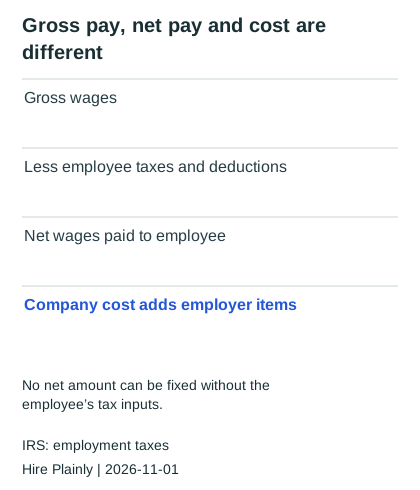
Prepare three records: a yearly hiring budget, a payroll calendar, and a list of tax and insurance payment dates. Before each payroll, reconcile gross pay minus employee deductions to net pay, then add the employer liabilities and any separately billed costs. Keep tax deposits distinct from tax returns; paying the employee does not by itself send the taxes to an agency.
A budget needs an unresolved-cost line
If the workers' compensation quote has not arrived, keep that input blank and label the sum as a known-cost subtotal. A zero would assert that there is no cost. Record the broker, expected response date and payroll basis beside the open item so the estimate can be completed without rebuilding it.
The annual cost and the cash needed for the next run answer different questions. Use the cost worksheet for recurring and setup expenses, then use the payroll calendar to identify which wages, taxes and provider charges leave the bank before the next receipt from customers.
How I'd budget a first hire
I wouldn't budget with a single multiplier like salary times some number. The result moves too much with the state, the pay type and the benefits. I'd add up the items one by one instead.
Per-employee cost runs much higher than most people expect. I budget 401(k) (employer retirement plan) administration fees separately from the employer contribution, which in my experience runs about 4–6% of pay. I don't trust a flat insurance estimate until I know about family coverage and whether the plan is fully insured or self-insured. I check premium rates in Excel during open enrollment, which is where a wrong rate for a higher-paid group tends to show up.
This article is general information, not legal or tax advice. Rules change and every business is different, so check with your state agency, an employment attorney, or a CPA before making decisions.
Use the worksheet