In this article
- What employers report for no tax on overtime
- What changed with no tax on overtime, and when
- What the number actually is
- Keep total wages and the qualifying premium separate
- Exempt status and the employees covered by code TT
- What to do before December 31
- Resolve exceptions before closing the annual total
- Resolve a difference before treating it as a deduction
No Tax on Overtime: What Employers Must Change on 2026 W-2s
Official sources checked: October 28, 2026; IRS Q20 clarification rechecked October 30, 2026

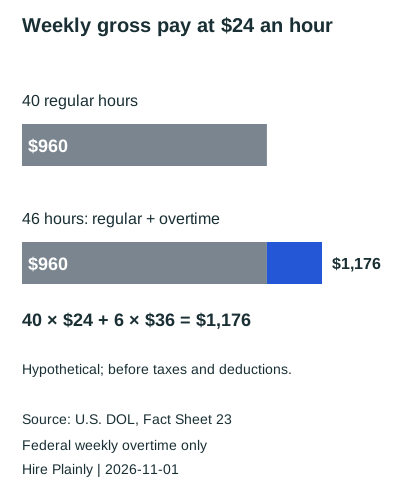
When a pay stub shows overtime(overtime pay) wages, how much of that line actually belongs in the new reporting field? A hypothetical café pays an employee $24 an hour for a 46-hour workweek in 2026. The overtime line is $216, but copying that entire amount into the new W-2(employee wage statement) field would overstate her qualified overtime compensation. Under the “no tax on overtime” rules, the reporting calculation starts with what federal overtime law requires, not the label on the pay stub.
The employer needs a record connecting weekly hours to the qualifying premium, then a year-end total that agrees with payroll. Waiting for the January W-2 preview makes missing time records and misclassified earnings harder to fix.
What employers report for no tax on overtime
For 2026, employers must report each employee's total "qualified overtime compensation" in box 12 of Form W-2 using the new code TT. Qualified overtime is only the premium part of overtime the federal Fair Labor Standards Act requires, meaning the extra half in time-and-a-half, not the whole overtime check. Overtime paid only because of state law, union contracts or company policy beyond the FLSA minimum doesn't count. Overtime remains subject to normal wage-tax rules. The deduction does not automatically remove federal income tax withholding, Social Security or Medicare.
What changed with no tax on overtime, and when
Under the One Big Beautiful Bill Act, signed July 4, 2025, eligible workers can deduct qualified overtime compensation from federal taxable income for tax years 2025 through 2028. The deduction is capped at $12,500 a year, or $25,000 for joint filers, and it starts to shrink once modified adjusted gross income passes $150,000, or $300,000 for joint filers.
For 2025, the IRS didn't require employers to report the amount separately, because forms and payroll systems weren't ready. Employers could approximate it and share it on the W-2 in box 14 or a separate statement, and many workers rebuilt the number from pay stubs. For 2026, reporting is mandatory: the IRS added code TT to box 12, and its August 2026 FAQs (FS-2026-13) say the 2026 deduction is limited to what employers report there.
What the number actually is
For this calculation, assume the standard FLSA 40-hour workweek rule, no bonus or other regular-rate adjustment, and an employee eligible for federal overtime. Suppose an employee earns $24 an hour and works 46 hours in a week. Her overtime pay for the six extra hours is $36 an hour, or $216. Only the premium, $12 an hour times six hours, or $72, is qualified overtime compensation. The other $144 is regular pay for those hours and stays out of code TT.
Now change one condition. Say she works in California, puts in a 10-hour day, but finishes the week at 38 hours. California's daily overtime rule requires premium pay for those two hours, but the FLSA doesn't, because she didn't pass 40 hours in the week. That premium is real overtime pay, and it's still $0 for code TT purposes. The same logic applies to double time: only the amount needed to meet the FLSA's time-and-a-half counts.
Two more points from the IRS FAQs matter for employers. You report the full qualifying amount even if it exceeds the employee's $12,500 deduction cap, because the cap applies on the employee's return, not on the W-2. And if you get code TT wrong, the fix is a Form W-2c to the Social Security Administration and a corrected copy to the employee.
Keep total wages and the qualifying premium separate
The café's weekly payroll has three amounts with different jobs. Read total wages as the amount owed before deductions, then read code TT as an informational subset already included in those wages.
Do not add $72 again to gross wages when filling out the W-2. The information field identifies part of the existing compensation; it is not a second payment or a subtraction from wages. A worker's eventual deduction also depends on the worker's own return, so the employer should not promise a specific tax refund.
Exempt status and the employees covered by code TT
Only non-exempt(worker covered by overtime rules) employees covered by the FLSA can have qualified overtime, so salaried exempt(overtime-exemption classification) staff have nothing to report in code TT. That makes classification matter more than it used to. If an employee you treat as exempt should have been non-exempt, you have a wage problem and now a W-2 reporting gap too. Our post on whether salaried employees get overtime covers how to check.
What to do before December 31
These steps follow from rules already in force. They're internal checks; the filing deadline itself is February 1, 2027, because January 31 falls on a Sunday, and that's when 2026 W-2s are due to employees and to the Social Security Administration.
- Split the overtime earning in payroll. The examples here use the standard 40-hour weekly rule; some jobs use special FLSA overtime methods, which FS-2026-13 (Q17) covers separately. Ask your payroll provider or software how it tracks the FLSA premium separately from straight-time pay and from state-only overtime. If overtime is one lump earning code, determine whether the required amount can be reconstructed from weekly hours and rate records. Separate earning codes can help, but the legal requirement is an accurate result, not a particular software layout.
- Run a year-to-date report now. Pull each non-exempt employee's 2026 qualified overtime and spot-check a few weeks by hand against timesheets, using the $24-an-hour math above.
- Separate state-only and policy overtime. Identify daily overtime, seventh-day premiums and double time separately, using distinct earning codes or an equivalent auditable calculation. The part of those premiums that you count toward meeting the FLSA's weekly overtime requirement can belong in box 12 code TT, while anything beyond the FLSA minimum stays out (IRS FS-2026-13, Q12).
- Include regular-rate corrections. Reconcile nondiscretionary bonuses, commissions and retroactive rate corrections with any additional FLSA overtime premium paid in 2026. A $300 bonus is not itself a $300 code TT amount. Trace the incremental overtime premium to the underlying weeks and include the qualifying amount once; review cross-year payments under the IRS timing rules rather than assigning everything to the year worked.
- Tie the annual total to records. For each employee keep the workweek, hours, regular rate(rate used to calculate overtime), required premium, payment date and any correction reference. Sum the qualifying premiums paid during 2026 and compare the result with the W-2 preview. Resolve rejected filings and retain acceptance records and the recipient-copy record.
- Tell employees what to expect. Explain that code TT identifies qualifying premium already included in wages and does not guarantee a tax-free paycheck. An employee may submit an updated 2026 Form W-4(federal withholding form) reflecting the expected deduction in step 4(b); use the employee's valid form rather than deleting withholding yourself (IRS FS-2026-13, Q9).
Resolve exceptions before closing the annual total
Hospital schedules, certain public-sector work periods and other special FLSA methods require the method that actually governs the employee; the ordinary six-hours-times-half-rate example is not universal. IRS FS-2026-13 Q17 addresses alternative section 207 calculations. Keep a review note explaining which method was applied before approving the W-2 amount.
State-only premiums need a separate reconciliation, not a blanket exclusion based on their earning-code name. If part of a daily or other qualifying premium is credited toward the FLSA obligation, include only the portion needed to satisfy that obligation. Do not double-count the credited premium and an extra weekly overtime line (IRS FS-2026-13 Q12 and Q16).
If the W-2 preview is wrong, correct the underlying calculation before release. If the filed code TT amount is wrong, follow the W-2c process and furnish the employee a corrected copy. The deduction currently runs through 2028, but a possible extension is not an instruction to delay the 2026 work.
Resolve a difference before treating it as a deduction
If the reviewed payroll detail contains $1,200 of eligible premium but the draft W-2 reports $1,100, the $100 difference is a reconciliation item. Trace it to the workweek, earnings code, adjustment and reporting rule. Do not silently replace the W-2 amount in an employee handout or assume that all overtime wages qualify.
After the provider resolves the difference, keep the corrected payroll record and reporting result together. The reported-amount limitation and other conditions in the article still apply.
This article is general information, not legal or tax advice. Rules change and every business is different, so check with your state agency, an employment attorney, or a CPA before making decisions.