In this article
- Working hours and budget assumptions
- Employee deductions and additional employer costs
- Payroll taxes in New Jersey employee costs
- Insurance, payroll service and startup equipment
- Paid sick leave and replacement staffing
- Comparing a $20 and a $25 hourly rate
- Annual budget and cash available on payday
- Missing quotes and the decision to approve the hire
- Review the month with five paydays
New Jersey Employee Costs and First-Year Cash Budget
Official sources checked: October 28, 2026

When you promise an hourly rate in New Jersey, what else must the business budget before that employee starts? Suppose you are hiring an adult kitchen assistant in New Jersey at $20 an hour and need to know whether the business can afford the commitment. Finding candidates and agreeing on duties are only part of the decision; New Jersey employee costs extend beyond the hourly wage. The amount you set aside must also cover employer taxes, insurance and the purchases needed before work begins.
At the fictional restaurant NJ Pocha, employee A provides one consistent example for building that budget without borrowing actual employee information. Start with wages, add the business's own tax obligations, and replace hypothetical operating expenses with quotes before approving the hire. This budget focuses on one employee; the separate New Jersey overtime guide covers recording hours and processing overtime(overtime pay) payroll.

Working hours and budget assumptions
A is an adult W-2(employee wage statement) employee eligible for overtime, working as a kitchen assistant without tips or other compensation beyond the hourly rate. Although the job may be described casually as part-time, this particular budget assumes forty paid hours each week for fifty-two weeks. Those paid hours include any paid time off(paid time off) within the stated annual total; overtime and bonuses are excluded from the initial budget. Actual work schedules and paid leave must be reconciled to that assumption rather than inferred from the job's label.
| Budget input | Assumption for A |
|---|---|
| Work location and tax year | New Jersey; 2026 rules used for a full-year model |
| Employment | W-2 hourly employee eligible for overtime |
| Hourly rate | $20 |
| Paid hours budgeted | 40 × 52 = 2,080 hours |
| Annual gross wages | $20 × 2,080 = $41,600 |
| Employer tax treatment | Standard new-employer rates; state disability plan assumed |
| Other compensation | No overtime, bonuses or tips |
| Taxable wages | All modeled wages taxable; no separate pretax deductions |
The wage figure is the amount before employee deductions, which makes it the right starting point for an employer budget. It still excludes the taxes and operating costs the business pays from its own funds. Separating those categories prevents a common mistake: treating every dollar remitted to a government agency as an additional employer expense.
Employee deductions and additional employer costs
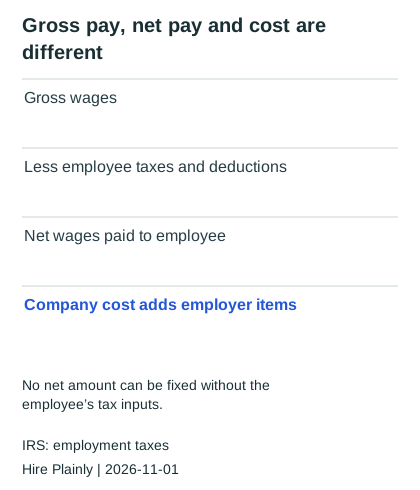
Payroll withholds income taxes and employee contributions from gross wages, then pays the balance to the employee and remits the withheld amounts. That remittance uses part of the wages already budgeted; adding it again would count the same money twice. Employer Social Security, Medicare and applicable state contributions belong in separate expense rows because they are paid in addition to the promised wages.
| Payroll component | Source of the money | Add beyond gross wages? |
|---|---|---|
| Employee net pay | Part of gross wages | No |
| Employee income-tax withholding | Part of gross wages | No |
| Employee Social Security and Medicare | Part of gross wages | No |
| Employer Social Security and Medicare | Additional business funds | Yes |
| Employer unemployment and disability contributions | Additional business funds | Yes |
Enter gross wages once, then add only the employer's additional obligations to the hiring budget. When reviewing a payroll estimate, request separate employee and employer columns rather than relying on a single combined tax total. The distinction also matters for cash planning, because withholding still needs to be reserved even though it is not an extra wage expense.
Payroll taxes in New Jersey employee costs
Social Security and Medicare are commonly grouped as FICA(Social Security and Medicare payroll taxes), but calculate their components separately before adding them to the budget. The employer rates below apply to this example's taxable wages, and A's annual pay is below the Social Security wage base. Medicare has no wage-base limit. IRS FICA guidance, checked October 28, 2026.
| Federal employer tax | Calculation | Annual cost |
|---|---|---|
| Social Security | $41,600 × 6.2% | $2,579.20 |
| Medicare | $41,600 × 1.45% | $603.20 |
| Employer FICA subtotal | Sum of both components | $3,182.40 |
Unemployment taxes work differently because the applicable wage base can be much lower than the employee's annual pay. FUTA(federal unemployment tax) has a 6% statutory rate on the first $7,000, reduced to 0.6% when the employer qualifies for the full state-tax credit. This example assumes that full credit; actual state payments and credit-reduction status must be checked before finalizing the annual tax. IRS FUTA guidance, checked October 28, 2026.
New Jersey publishes new-employer contribution rates and separate taxable wage bases, including the $44,800 employer base used here for 2026. The combined unemployment and workforce-fund rate already includes the workforce-fund component, so adding that component again would overstate the cost. An employer's assigned rate notice or private disability arrangement can change the inputs; use the business's actual notice when replacing this model. NJDOL rate information, checked October 28, 2026.
| Employer contribution | Assumed scope | Calculation | Annual cost |
|---|---|---|---|
| FUTA | Full credit; 0.6% on first $7,000 | $7,000 × 0.6% | $42.00 |
| NJ unemployment and workforce funds combined | New employer, 2.8%; first $44,800 | $41,600 × 2.8% | $1,164.80 |
| NJ temporary disability | State-plan new employer, 0.5%; first $44,800 | $41,600 × 0.5% | $208.00 |
| Contribution subtotal | These three components only | Sum above | $1,414.80 |
Add those contributions to gross wages and employer FICA before considering insurance or software. The resulting subtotal is already higher than the wages A was promised, even though the employee's pay agreement has not changed. It remains a subtotal because the operating expenses needed to employ A have not yet been included.
Insurance, payroll service and startup equipment
New Jersey's workers' compensation requirements need a separate check for the business and work being performed. Obtain a quote describing the actual duties, payroll and coverage rather than assuming an office role or small headcount makes the cost disappear. This article does not estimate a market premium. NJDOL employer requirements.
For the next calculation, the restaurant chooses the following hypothetical budget inputs, which are neither vendor prices nor insurance quotes. The annual payroll-service amount assumes no setup charge or extra service fees, and the equipment purchase is treated as a first-year cash outlay. Replace each figure with an actual quote or purchase plan before relying on the result for the hiring decision.
| Additional item | Hypothetical input | First-year amount | Cost pattern |
|---|---|---|---|
| Workers' compensation | Assumed annual premium | $600.00 | Recurring; renewal or audit can change it |
| Payroll service | $50 × 12 months | $600.00 | Recurring; extra fees excluded by assumption |
| Equipment | One initial purchase | $1,200.00 | Startup cash outlay |
| Additional budget subtotal | Sum of these inputs | $2,400.00 |
An insurer needs to know if A's duties later expand into deliveries or other work that changes the quote's assumptions. A payroll provider likewise needs the employee count and services requested, including whether year-end forms or correction work cost extra. Comparing only a monthly base price can leave those expenses outside the budget without making their omission obvious.
Now add these inputs to the earlier subtotal, distinguishing annual expense planning from the money required on any particular payday. The monthly column divides each annual amount by twelve as a savings target. It does not establish a legal payment schedule or a software withdrawal amount.
| First-year budget | Annual amount | Monthly average |
|---|---|---|
| Gross wages | $41,600.00 | $3,466.67 |
| Employer FICA | $3,182.40 | $265.20 |
| FUTA and modeled NJ contributions | $1,414.80 | $117.90 |
| Insurance and payroll service | $1,200.00 | $100.00 |
| Startup equipment | $1,200.00 | $100.00 |
| Subtotal within this scope | $48,597.20 | $4,049.77 |
| Difference from wages alone | $6,997.20 | $583.10 |
Equipment might need to be purchased before the first payday, and the insurance contract might require a different payment pattern from monthly installments. An affordable annual total therefore does not establish that the restaurant has enough cash to start. The purchase and payment dates need their own review alongside the cost calculation.
Paid sick leave and replacement staffing
New Jersey generally requires covered employees to accrue one hour of earned sick leave per thirty hours worked, up to forty hours per benefit year. The budget must accommodate applicable leave without counting the same paid hours twice. A's initial 2,080 paid-hour assumption includes paid leave within that total rather than adding it on top. NJDOL earned sick leave, checked October 28, 2026.
| Illustrative annual paid hours | Hours | Rate | Wages |
|---|---|---|---|
| Actual work | 2,040 | $20 | $40,800 |
| Paid sick leave used | 40 | $20 | $800 |
| Total paid hours | 2,080 | $41,600 |
In that situation, adding another $800 for the same leave would overstate wages because those hours are already included. Hiring someone else to cover A's absence creates a separate expense, and the owner covering the shift creates an operational tradeoff even without an additional paycheck. If the original budget included only actual working hours, paid leave may instead need to be added; the starting assumption decides which treatment is correct.
Comparing a $20 and a $25 hourly rate
Keep A's annual paid hours unchanged and increase only the hourly rate to see which costs move with wages. The comparison uses the same 2026 rules for both options, rather than predicting a future year's rates. Insurance, software and equipment are excluded from this particular comparison.
| Budget component | A at $20 an hour | A at $25 an hour |
|---|---|---|
| Annual paid hours | 2,080 | 2,080 |
| Gross wages | $41,600.00 | $52,000.00 |
| Employer FICA | $41,600 × 7.65% = $3,182.40 | $52,000 × 7.65% = $3,978.00 |
| FUTA, assuming full credit | $42.00 | $42.00 |
| NJ unemployment and workforce funds | $41,600 × 2.8% = $1,164.80 | $44,800 × 2.8% = $1,254.40 |
| NJ employer disability | $41,600 × 0.5% = $208.00 | $44,800 × 0.5% = $224.00 |
| Wages and these employer taxes | $46,197.20 | $57,498.40 |
The NJ contribution rows stop at the applicable employer wage base, while FICA continues to apply across both modeled salaries. That is why multiplying the entire cost by the wage increase percentage gives a different answer. The added expense can be reproduced from the individual changes below.
| Increase caused by the raise | Calculation | Annual increase |
|---|---|---|
| Wages | $52,000 − $41,600 | $10,400.00 |
| Employer FICA | $3,978 − $3,182.40 | $795.60 |
| Modeled NJ contributions | ($1,254.40 + $224) − ($1,164.80 + $208) | $105.60 |
| Increase within this scope | Sum of these changes | $11,301.20 |
Before offering the raise, update the payroll inputs and ask the insurer whether the higher payroll changes the premium estimate. This table establishes the modeled wage-and-tax difference, not a complete revised operating budget. Other promised benefits or changed duties can add costs that the calculation does not include.
Annual budget and cash available on payday
The $48,597.20 subtotal divided by twelve is an average reserve target rather than the amount withdrawn on every payday. Under a hypothetical weekly operating schedule, A's forty-hour week creates $800 in gross wages before employer taxes or service charges. A month with four paydays needs $3,200 in gross wages, while a month with five needs $4,000, even though the annual monthly average is $3,466.67.
Create a separate cash schedule using actual paydays, provider withdrawals, contractual bills and agency payment dates. The following table describes an operating record, not a statutory calendar. Employee withholding belongs inside the $800 gross wage amount, but money awaiting remittance must still be reserved rather than treated as spendable cash.
| Cash-schedule field | A's input or required check | Evidence of completion |
|---|---|---|
| Work period and payday | Forty hours, $800 gross wages, promised payday | Approved records match the pay calendar |
| Employee payment and withholding | Split $800 into actual net pay and employee deductions | Components reconcile to gross wages |
| Additional employer taxes | Apply rates to cumulative taxable wages | Reconcile employer rows to payroll preview |
| Provider withdrawal | Identify payment, tax and fee amounts included | Separate provider debit from outside obligations |
| Startup and irregular bills | Equipment $1,200; contractual insurance dates | Quotes and bills match available funds |
If the provider withdraws employee withholding and employer taxes together, do not reserve another payment for those same taxes without checking the withdrawal detail. Add separate rows for government notices or insurance payments outside the service's scope, then review the projected account balance before approving the run. The New Jersey first-hire guide explains how payment, tax remittance and filing acceptance require distinct completion checks.
Missing quotes and the decision to approve the hire
This subtotal excludes health-insurance contributions, retirement-plan contributions, recruiting, additional training, replacement staffing and business-specific assessments. Leaving an unknown amount out of the sum does not mean that the corresponding cost is zero. Mark an item as not applicable only after checking whether the business will incur it.
| Unresolved item | Information to obtain | Budget treatment |
|---|---|---|
| Health or retirement benefits | Whether offered, eligibility and employer contribution | Add confirmed costs |
| Workers' compensation | Actual duties, payroll quote and audit terms | Replace assumed premium |
| Payroll service | Base, employee, setup and year-end charges | Replace hypothetical service amount |
| Leave coverage | Paid hours already included and replacement needs | Avoid duplicate wages; add extra staffing |
| Government or local obligations | Business notices and applicable local requirements | Add relevant separate charges |
| Startup purchases and training | Purchase plan, paid time and payment dates | Separate initial from recurring costs |
Begin the actual worksheet with four columns: item, annual amount, evidence and payment date. Enter gross wages once, add employer taxes and verified quotes, then resolve the remaining unknowns before treating the subtotal as an approved hiring budget. The value of the calculation is seeing which obligations are known and which decisions still need an input.
Rates and leave guidance rechecked October 28, 2026. Employees, business and quoted operating amounts are hypothetical. This article is general information, not legal or tax advice. Use the business's rate notices and contracts, and consult the relevant state agency, CPA or insurer about unresolved items.
By Jason Seo, SHRM-CP®
Review the month with five paydays
A weekly gross-pay figure of $960 creates $3,840 of wages across four paydays and $4,800 across five. The extra $960 is a timing difference within the annual wage plan, before employer contributions and provider charges. Dividing annual cost by 12 does not tell the owner what must be in the bank before that fifth debit.
Use the bank calendar and the provider's actual funding cutoff to place the outflows. Keep employee withholding inside gross wages and employer contributions as additional cost. After the first completed run, compare the actual debit with the budget assumptions and replace any provisional quote.