In this article
- The bonus promise and the payroll cost
- Step 1: Decide what your employee bonus plan is for
- Step 2: Set who's eligible
- Step 3: Pick a formula you can calculate in one line
- Step 4: Handle proration and leave before it comes up
- Step 5: Run the bonus through payroll as wages
- The cash needed for a $1,800 bonus pool
- Step 6: Check the overtime math for non-exempt employees
- Step 7: Write it down and tell the team
- Reconcile the payout before evaluating the plan
- Check the adjustment at the workweek level
How to Design Your First Employee Bonus Plan, Step by Step
Official sources checked: October 28, 2026
If a quarter goes well, how do you promise a team bonus without leaving eligibility and payout rules to payday? A hypothetical café owner with six employees wants to share a good quarter with the team through a $1,800 bonus pool. A first employee bonus plan can do that well, but only if the rules are settled before the money moves. Each choice you make, from who qualifies to how the payment is taxed, feeds into the next one.
Before promising the pool, she needs to know whether $1,800 is the whole cost and what happens when someone takes leave or resigns. A promised bonus can change overtime(overtime pay) pay, so the written formula and the payroll calculation need to agree.
The bonus promise and the payroll cost
Decide what the bonus is meant to reward, who's eligible, and the exact formula before the period starts, and write it down. Pay it through payroll as wages, with income tax withholding and Social Security and Medicare taxes. If the bonus is promised in advance and a non-exempt(worker covered by overtime rules) employee worked overtime during the period, you have to add part of the bonus into their overtime pay.
Step 1: Decide what your employee bonus plan is for
The goal shapes every later step, so start there. A bonus meant to reward the whole team for a good quarter works differently from one meant to keep people through a busy season or to reward individual sales. If you can't say in one sentence what behavior or result you want more of, the plan will be hard to explain and harder to keep fair.
The café's owner picks one goal: reward the team when quarterly sales beat the same quarter last year. It's simple, everyone can see the number, and nobody has to judge anyone else's performance.
Step 2: Set who's eligible
Eligibility answers who gets a share and when someone stops qualifying. Common questions are whether part-timers count, whether new hires need to work a minimum number of days in the period, and whether someone who leaves before the payout date still gets paid. Write down the answer to each one now, because an employee who resigns two days before payday will ask.
The café makes all six employees eligible, including two part-timers, as long as they've worked at least 30 days in the quarter. Anyone employed on the last day of the quarter gets paid, even if they leave before the payout date.
Step 3: Pick a formula you can calculate in one line
The formula should be clear enough that an employee could check the math. For a team bonus, the usual options are an equal share for everyone, a share based on hours worked, or a share based on pay. Each one sends a different message: equal shares stress teamwork, while hours-based shares reward people who put in more time.
The café sets a pool of $1,800 if sales beat last year's quarter, then divides it by eligible hours worked in the quarter. Define sales consistently using the same accounting report and treatment of returns in both periods. In this example the sales condition is met; if it is not met, the pool is $0 under the hypothetical written formula. That way, part-timers get a fair share without equaling a full-timer who worked twice the hours.
Step 4: Handle proration and leave before it comes up
Proration rules cover people who weren't there for the whole period, such as new hires, employees on leave and people who changed from part-time to full-time. The café must define eligible hours before calculating shares, including how protected absences are treated under applicable law. Fewer eligible hours produce a smaller share mathematically, but that does not by itself prove that a leave exclusion is lawful. Plans based on equal shares or a percentage of salary need a written rule for these cases, or you'll end up deciding them one at a time.
Leave deserves extra care, because some types of protected leave limit how they can affect bonuses. The federal FMLA(eligible family and medical leave) generally covers private employers with at least 50 employees for the required number of workweeks. When it applies, a goal-based bonus may be denied when FMLA leave caused the employee to miss that goal, subject to the equivalent-leave rule below.
The comparison must be with employees on an equivalent non-FMLA leave status. For example, if paid vacation preserves an attendance bonus, paid vacation used for an FMLA reason must receive equivalent treatment. That does not mean every period of unpaid FMLA leave must receive the same treatment as paid vacation; the type of leave and the specific goal matter. 29 CFR 825.215(c)(2) controls this comparison.
An independent six-person café is not covered by federal FMLA on these facts. State leave laws can apply to much smaller employers, though, so check your state's rules for each type of leave before you write this part.
Step 5: Run the bonus through payroll as wages
A bonus is taxable wages, not a gift, so it goes through payroll with Social Security and Medicare taxes and income tax withholding like any other pay. For federal income tax, the IRS allows a flat 22% rate on supplemental wages such as bonuses, but only under two conditions. The bonus has to be paid or listed separately from regular wages, and you must have withheld income tax from the employee's regular wages this year or last year. Otherwise, you add the bonus to regular wages and withhold on the total, and supplemental pay over $1 million in a year must be withheld at 37%.
State withholding rules for bonuses vary, so check your state's rate as well. Paying the bonus in cash or by a separate transfer outside payroll doesn't change its tax treatment, and it creates a reporting problem later.
The cash needed for a $1,800 bonus pool
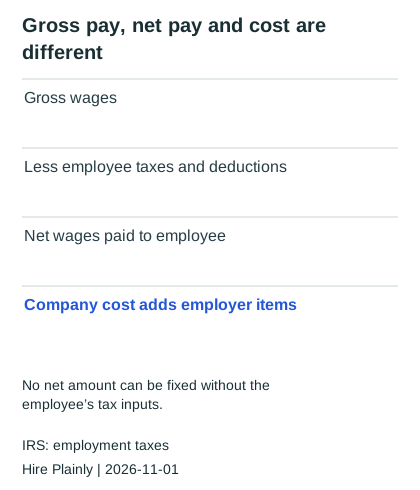
The pool is gross employee pay, so it is not the amount to move into the payroll account. Budget the bonus, any overtime adjustment, employer payroll taxes and any additional state or insurance costs. Employee tax withholding reduces the employee's deposit; it does not reduce the gross wages the business owes.
For the employee calculated below, the gross bonus and overtime adjustment total $307.14. Her take-home pay cannot be fixed without the selected withholding method and applicable deductions, so do not promise a $300 bank deposit when the plan promises a $300 gross bonus. Keep that distinction in the plan announcement.
Step 6: Check the overtime math for non-exempt employees
Skipping this step leaves a small underpayment that repeats every time you pay the bonus. When a bonus is announced in advance and tied to a result, it's considered nondiscretionary. Federal law then says it has to be included in a non-exempt employee's regular rate(rate used to calculate overtime) for any overtime worked during the period it covers. A bonus that's entirely up to you, decided only after the period ends with no promise beforehand, is treated differently.
Take one of the café's hourly employees. Everyone eligible worked 3,276 hours in the quarter, and she worked 546 of them, including 26 overtime hours, so her share of the $1,800 pool is $300. Spread across her quarter, the bonus adds about $0.55 to each hour she worked ($300 ÷ 546). For each overtime hour she's owed an extra half of that rate, so the total is $300 ÷ 546 × 0.5 × 26, or $7.14 when you round only at the end. It's a small number, but it applies to every eligible non-exempt employee who worked overtime, every time you pay the bonus.
Hypothetical numbers for illustration. Here the pool is earned uniformly per eligible hour across the quarter, making an equal per-hour allocation reasonable. Retain weekly hours and apply that increment to each week's overtime. A bonus tied to specific weeks or different measures needs the allocation appropriate to those facts under 29 CFR 778.209.
Step 7: Write it down and tell the team
Before the first covered quarter starts, fill in this operating record. These are the café's hypothetical design choices, not universal legal rules.
| Plan field | Café's entry | Record that supports it |
|---|---|---|
| Performance period | Named quarter and start/end dates | Dated plan version |
| Trigger | Sales exceed the same quarter last year | Two comparable sales reports |
| Eligible employees | Six employees meeting the 30-day rule | Hire dates and eligibility check |
| Allocation | Eligible employee hours ÷ all eligible hours × $1,800 | Approved weekly time records |
| Leave treatment | Written rule cleared for applicable leave laws | Policy and review decision |
| Payment | Specified payroll date after calculation | Bonus and overtime preview |
Do not adopt the example's last-day eligibility rule without reviewing your state's earned-wage and final-pay requirements. The plan cannot erase a payment right that applicable law protects. Document who approves exceptions and route a disputed termination or leave case for review before withholding the amount.
A one-page plan document should cover the goal, eligibility, formula, payout date and the rule for people who leave. Share it before the quarter starts, so the bonus can actually change what people do. If you change the plan for next quarter, update the document and announce the change before that quarter begins.
Reconcile the payout before evaluating the plan
Before releasing payroll, total the individual bonus shares back to $1,800, resolve rounding differences, and reconcile overtime adjustments separately. After payment, save the approved calculation, payroll register, tax-processing records and payment confirmation with the plan version used. A completed spreadsheet without the actual payroll entry is not a completed payout. The next decision is whether the plan worked. Comparing the quarter's results and how the team responded with the cost of the pool will show whether to keep the formula, change the target, or move to a different kind of reward.
Check the adjustment at the workweek level
A quarterly award can be approved as one amount while the overtime adjustment belongs to several workweeks. In a separate hypothetical week, unrelated to the quarterly allocation above, 45 hours and a $90 allocated bonus add $2 to the regular rate. Where the bonus belongs in that rate and the original overtime premium was already paid, the additional premium is $2 × 0.5 × 5 = $5.
Retain the allocation method with the hours and amount already paid for each week.
This article is general information, not legal or tax advice. Rules change and every business is different, so check with your state agency, an employment attorney, or a CPA before making decisions.