In this article
- How do hourly employees record their time?
- Excel or a time clock app?
- New Jersey part-time overtime calculations
- Pay frequency and payday
- Employee deductions and employer taxes
- Information needed before the first payroll
- How do you pay employees?
- Tax deposits and government filings
- The actual cost of unpaid overtime
- Test one export before relying on the integration
New Jersey Part-Time Overtime and Payroll Processing
Official sources checked: October 28, 2026
Gross wages are only the starting point. Follow one restaurant payroll from overtime (overtime pay) calculations through employee deductions, employer taxes, software submission, and federal and New Jersey filings. Each stage shows what the owner enters and what confirms the work is complete.
The New Jersey workweek and payroll review follows dated time entries through weekly gross pay, corrections and payroll handoff. You can also print a blank copy.
Friday is your first payday, and you still can't say how much should land in each employee's bank account. You agreed on an hourly rate and recorded their shifts, but New Jersey part-time overtime, withholding, employer taxes, and filings still need attention.
At the fictional restaurant NJ Pocha, the owner handles payroll without a separate HR or payroll employee. Three adult kitchen assistants, Alex, Ben, and Casey, each earn $20 per hour, but Alex's first busy week ends with more hours than expected. The owner must now calculate wages, configure deductions, fund payroll, and confirm which government filings the service has agreed to handle.

How do hourly employees record their time?
When Alex reports a weekly total, the owner needs daily entries that explain where those hours came from and what changed. A planned schedule cannot establish whether training, late closing duties, or interrupted meals were recorded correctly for the actual shift.

A particular time clock is not mandatory: federal guidance accepts different methods when records are complete and accurate. New Jersey also allows different systems, provided they capture the required information, including daily and weekly hours and wage records. The sample below covers time calculations rather than replacing the full employee and payroll record. Federal recordkeeping guidance · N.J.A.C. 12:56-4
Excel columns and formulas
NJ Pocha uses a fixed workweek beginning Monday at midnight and ending at the following Monday's midnight. Create the following columns and keep each employee's entries separate, using full dates and times in columns B through E. Display those cells as h:mm without deleting their underlying dates, which preserves the date change for overnight shifts.
| A: Date | B: Clock in | C: Meal starts | D: Work resumes | E: Clock out | F: Unpaid meal hours | G: Paid hours | H: Note |
|---|---|---|---|---|---|---|---|
| Mon 10/19 | 10:00 | 14:00 | 14:30 | 18:30 | 0.5 | 8 | Includes 2 training hours |
| Tue 10/20 | 10:00 | 14:00 | 14:30 | 18:30 | 0.5 | 8 | Kitchen work |
| Wed 10/21 | 10:00 | 14:00 | 14:30 | 18:30 | 0.5 | 8 | Kitchen work |
| Thu 10/22 | 10:00 | 14:00 | 14:30 | 18:30 | 0.5 | 8 | Kitchen work |
| Fri 10/23 | 10:00 | 14:00 | 14:30 | 19:30 | 0.5 | 9 | Includes closing |
| Sat 10/24 | 10:00 | None | None | 14:00 | 0 | 4 | Additional shift |
| Sun 10/25 | No work | None | None | No work | 0 | 0 | Off |
| Total | 2.5 hours | 45 hours | 40 regular; 5 overtime |
For the first data row, enter 2026-10-19 10:00 in B2 and 2026-10-19 18:30 in E2. Enter 0.5 in F2 for the genuinely duty-free, unpaid meal, then enter =(E2-B2)*24-F2 in G2, producing eight paid hours. With dated meal entries, =(D2-C2)*24 calculates the meal's duration, but it cannot decide whether that time was legally unpaid.
Copy the paid-hours formula only into worked shifts, leaving zero paid hours for a day when Alex did not work. With this week in rows two through eight, =SUM(G2:G8) produces forty-five hours; enter thirty minutes as 0.5, rather than 0.30. Displaying two decimal places is different from truncating the underlying calculation, so retain the original values for the weekly total.
Overnight shifts and missing punches
For a shift starting October 24 at 22:00 and ending October 25 at 02:00, enter both dates; the formula then returns four hours before unpaid meals. A shift crossing Monday midnight also crosses NJ Pocha's workweek boundary, so split its hours between the two weeks before totaling overtime. A single row assigned entirely to its starting date would put those hours in the wrong week. The dated calculation solves elapsed time; the owner still needs the correct weekly allocation.
If a punch is missing, resolve it with the employee and preserve the correction record before approving payroll. Add a separate review column that flags blank worked-shift punches, an end before its start, or meal hours exceeding the shift. A flag means investigate; it does not mean delete the shift or withhold pay for work actually performed. Keep days off distinct from incomplete worked shifts so missing data cannot silently become zero hours.
Training, closing duties and meals
Monday's eight paid hours already include two hours of required job training, which should neither disappear nor be added twice. Federal guidance generally excludes training only when attendance is outside regular hours, voluntary, unrelated to the job, and involves no productive work. Required training at this restaurant fails that test, while work permitted after the scheduled shift also needs to be recorded and paid. DOL hours-worked guidance
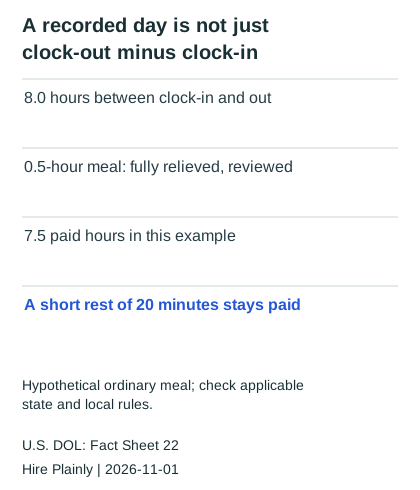
Do not subtract a meal automatically just because the schedule includes one; establish whether Alex was actually relieved of work duties. Short rest breaks generally remain compensable, while an unpaid meal requires different treatment, including freedom from work during that period. If Alex clocks out and then continues closing duties, correct the record to include compensable work rather than ignoring the additional time.
As an operating practice, review missing punches daily and resolve discrepancies with Alex before closing the period for payroll. Preserve the original entry, corrected entry, reason and reviewer, then retain accessible copies when changing software or removing an employee's account. New Jersey requires the covered wage-and-hour records to be retained for six years. N.J.A.C. 12:56-4.4
Excel or a time clock app?
An existing spreadsheet can work when the owner can review three employees' entries consistently and transfer the correct totals into payroll. Consider an app when repeated transcription or missing punches becomes difficult to manage, distinguishing time collection from payroll payment and tax filing.
The following options assume one location and three New Jersey employees who are all billable under the selected payroll service. Homebase provides a separate time clock, while Gusto's time tracking keeps records and payroll within the same account. This comparison uses published features and prices, with no personal-use claim or affiliate links.
| Option | How hours are recorded | Example monthly service cost for three employees | Owner's remaining work |
|---|---|---|---|
| Existing Excel plus separate payroll processing | Dated punches, meals and correction notes | $0 for an additional time app; Excel license and payroll cost excluded | Maintain formulas, missing entries and weekly totals |
| Homebase Basic plus Gusto Simple | Shared-device/PIN punches; verified integration or manual transfer | $0 + ($49 + $7 × 3) = $70/month | Match employees, review records and reconcile imported totals |
| Gusto Simple plus Time & Attendance Plus | Gusto web, mobile or shared-device entries | $49 + ($7 + $6) × 3 = $88/month | Configure policies, review records and approve hours |
Prices and features were rechecked October 28, 2026, excluding promotions, taxes, equipment and additional services from the calculations. Homebase Basic covers basic scheduling and time tracking for one location and up to ten employees; its own payroll service costs extra. Basic lists timesheet storage for up to ninety days, so export reviewed time records and corrections regularly into an archive that meets New Jersey's six-year requirement. Do not treat an app's storage limit as the legal retention period.
Gusto includes time tracking with Plus and Premium, while the table illustrates the separate add-on for Simple. Confirm current billing terms before choosing either setup. Homebase pricing · Gusto pricing
For a small, single-location restaurant like NJ Pocha, Homebase Basic with reviewed hours transferred into payroll is a reasonable starting option to compare. Confirm that the chosen plan actually enables the documented Gusto export; if it does not, use a reconciled manual transfer or price the necessary paid plan before choosing. Gusto's integrated tracking may suit an owner who wants fewer accounts, while Excel depends on maintaining accurate daily records and transfers. These are choices within this comparison, rather than evidence that one product is universally better or that the author has used it.
Getting recorded hours into payroll
With Homebase, add Alex, Ben and Casey, choose a shared clock device and individual PINs, and establish how workers record breaks. Review missing entries and weekly totals before exporting records, because a timesheet total still needs to agree with the underlying shifts. Gusto documents the initial connection under App directory → Homebase → Learn more → Connect. Homebase time clock
Match employee profiles without creating duplicates, then select the pay period in Homebase's Timesheets area. Use Download → Payroll Summary for Gusto → Download Formatted for Gusto, then reconcile Alex's regular and overtime hours in payroll. Do not enter imported hours again; the documented integration excludes tips and break penalties, which require separate handling where applicable. Official integration instructions
Gusto also states that each repeated Homebase export replaces the previous export, and that hours from multiple Homebase locations do not transfer correctly into one Gusto account. After a correction, reconcile the replacement totals instead of adding another copy of the hours. This example assumes one location and W-2 (employee wage statement) employees only, because the documented export does not support contractor hours.
For Gusto's own tracking on Simple, use Time and Attendance → Time tracking → Add Time and Attendance Plus, then complete setup. Assign employees, devices, break and overtime policies, and the correct workweek, testing whether Alex can record an actual shift. In the employee web account, use Time tracking → Clock in / Clock out and Take a break for a break entry. The owner reviews and approves actual records before reconciling the hours transferred into payroll. Admin setup · Employee instructions
New Jersey part-time overtime calculations
All three workers are W-2 employees eligible for overtime, with no tips, bonuses, additional compensation, or special exemption in this example. With unpaid breaks already separated from compensable work, start by calculating gross wages before working out employee deductions and the business's additional costs.
Alex's actual records show forty-five hours, while Ben works twenty hours and Casey works fifteen at the same hourly rate. Basic hourly wages use the agreed rate for compensable work, but overtime hours require the applicable higher rate.
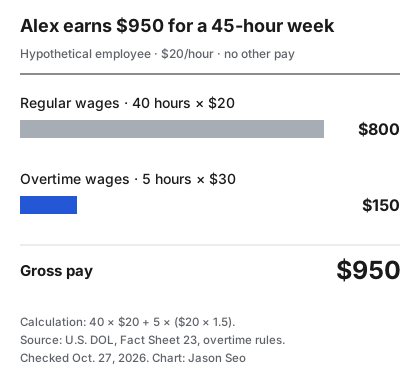
Covered employees generally receive at least one and one-half their regular rate (rate used to calculate overtime) for hours actually worked beyond forty in a workweek. Here, the single hourly rate determines the regular rate because the example excludes other compensation. Tips, bonuses, or multiple rates require a different review. NJDOL employer FAQ
| Employee | Busy-week hours | Regular wages | Overtime wages | Gross weekly wages |
|---|---|---|---|---|
| Alex | 45 | 40 × $20 = $800 | 5 × $30 = $150 | $950 |
| Ben | 20 | 20 × $20 = $400 | None | $400 |
| Casey | 15 | 15 × $20 = $300 | None | $300 |
| Total | 80 | $1,500 | $150 | $1,650 |
View the numbers as a table
| Alex | $950 |
|---|---|
| Ben | $400 |
| Casey | $300 |
From the table above ($20 an hour, hypothetical employees).
Apply the higher rate only to Alex's overtime hours, rather than replacing the rate for every hour worked that week. Averaging the three employees' hours cannot erase Alex's individual overtime entitlement.
| Alex's calculation | Formula | Amount |
|---|---|---|
| Straight time for every hour | 45 × $20 | $900 |
| Separate regular and overtime hours | 40 × $20 + 5 × ($20 × 1.5) | $950 |
| Missing wages | $950 − $900 | $50 |
- With the 1.5× overtime rate
- Every hour at straight time (wrong)
View the numbers as a table
| Hours worked in the workweek | With the 1.5× overtime rate | Every hour at straight time (wrong) |
|---|---|---|
| 20 | $400 | $400 |
| 25 | $500 | $500 |
| 30 | $600 | $600 |
| 35 | $700 | $700 |
| 40 | $800 | $800 |
| 45 | $950 | $900 |
| 50 | $1,100 | $1,000 |
| 55 | $1,250 | $1,100 |
Computed with the rule in this article: 1.5 times the regular rate for hours over 40 in a workweek. At 45 hours the gap is the $50 in the table.
Paying straight time for every recorded hour still leaves the overtime premium unpaid, so check how regular and overtime hours were separated.
Pay frequency and payday
Choosing a payment schedule involves a separate rule from calculating hours, so a monthly total does not answer when wages are due. New Jersey generally requires payment at least twice during each calendar month on regular paydays established in advance. Exceptions for certain executive, supervisory or other special classes do not describe the hourly kitchen workers in this example. Tell employees the agreed rate, pay period, payday and payment method when setting up employment. NJDOL payment-frequency guidance

| Term | Meaning | NJ Pocha's operating example |
|---|---|---|
| Workweek | Fixed seven-day period used for overtime | Monday midnight to the following Monday midnight |
| Pay period | Work dates covered by this payment | October 19–25, 2026 |
| Payday | Date employees receive wages | The following Friday, October 30 |
| Payroll submission deadline | Approval cutoff allowing bank processing | Check the account's Payroll deadline and submit earlier |
Weekly payroll is this restaurant's operating choice, rather than a requirement that applies to every New Jersey restaurant. Use agreed direct deposit or another lawful payment method, allowing actual processing time before the promised payday. The day you submit payroll can therefore differ from the date employees receive their money.
Biweekly pay and weekly overtime
If the restaurant chooses biweekly payroll instead, calculate each workweek separately before combining wages for the payment. Alex works forty-five hours in the first week and thirty-five in the second, but averaging those hours cannot remove overtime already earned. DOL overtime guidance
| Alex's record | Hours worked | Regular hours | Overtime hours | Gross wages |
|---|---|---|---|---|
| First workweek | 45 | 40 | 5 | $950 |
| Second workweek | 35 | 35 | None | 35 × $20 = $700 |
| Two-week total | 80 | 75 | 5 | $1,650 |
| Incorrect straight-time total | 80 | Incorrect method | Omitted | $1,600 |
| Difference | $50 |
New Jersey's regulations also require each workweek to stand alone, so reducing future shifts does not cancel overtime that Alex has already earned. A prior-approval policy likewise does not remove the obligation to pay for compensable work the employer required or permitted. N.J.A.C. 12:56-6.2 · Federal overtime guidance
Employee deductions and employer taxes
Before transferring money to Alex, the owner needs to account for withholding rather than treating gross wages as the amount owed to the bank account. Assume Alex lives and works in New Jersey, all wages below are subject to FICA (Social Security and Medicare payroll taxes), and annual limits do not affect this check. There are no pretax benefits or high cumulative earnings triggering Additional Medicare withholding.
Employee FICA comes out of gross wages, while employer FICA adds a separate business cost beyond the wages already promised to Alex. Calculate each component to the nearest cent so the employee and employer figures can be checked against the payroll preview separately. IRS FICA rates
| Component | Employee withholding | Additional employer cost |
|---|---|---|
| Social Security | $950 × 6.2% = $58.90 | $950 × 6.2% = $58.90 |
| Medicare | $950 × 1.45% = $13.78 | $950 × 1.45% = $13.78 |
| FICA subtotal | $72.68 | $72.68 |
The remaining balance is not final take-home pay because income tax withholding, applicable state employee contributions, and other lawful deductions remain unresolved.
| Payroll amount | Treatment | Status in this example |
|---|---|---|
| Gross wages | Regular plus overtime wages | $950.00 |
| Employee FICA | Subtract employee share | −$72.68 |
| Balance before other deductions | $950.00 − $72.68 | $877.32; not take-home pay |
| Income taxes and other deductions | Use employee forms, pay frequency, current tables and cumulative wages | Software calculation required |
| Final net pay | Gross wages minus all employee deductions | Confirm after setup |
| Employer FICA | Add separately | +$72.68 |
| FUTA (federal unemployment tax) and NJ employer contributions | Apply assigned rates, taxable limits and cumulative wages | Additional; not totaled here |
Use the employee's W-4 (federal withholding form) and NJ-W4 information rather than choosing an arbitrary withholding percentage. State unemployment, disability, and family leave programs have distinct employee and employer contributions, so enter this business's assigned rates instead of another restaurant's settings. IRS withholding guidance · NJ-W4 · NJDOL contribution rates
Before funding payroll, separate net pay, employee withholding, employer taxes, and service charges so each amount has a clear place in the budget. The calculations above illustrate FICA only, leaving other taxes and insurance costs to be added before the restaurant's full budget is complete.
Information needed before the first payroll
Gather the EIN (employer tax ID), New Jersey registration details, assigned rates, and completed employee withholding forms. Registering the business does not by itself confirm that every payroll-tax setting is ready. New Jersey employer registration uses NJ-REG, while sensitive employee information belongs in secure onboarding rather than ordinary email or public documents. NJDOL registration guidance
| Input | Where to obtain it | Setting to complete |
|---|---|---|
| Federal EIN | IRS confirmation | Legal business name and ID |
| NJ employer ID and rates | Registration results and Employer Access | Withholding/contribution accounts and rates |
| Alex's withholding elections | Completed W-4 and NJ-W4 | Federal and state withholding |
| Employment and pay terms | Agreed hiring terms | W-2 hourly, $20, overtime eligible, location and schedule |
| Payment details | Business account and valid employee authorization | Bank verification and payment setup |
Gusto's documented state setup path is Taxes & compliance → Tax setup → New Jersey Tax Setup → Manage taxes. Enter the registration details and applicable rates, then complete outstanding authorizations, because creating a software account does not finish the underlying tax registrations. Gusto NJ setup
How do you pay employees?
In Gusto's documented web flow, open Pay → Run payroll for the correct pay period. For this weekly run, enter 40 in Regular hours and 5 in Overtime hours for Alex. Check the hourly rate and each other employee's row, taking care not to duplicate any hours that have already imported from time tracking.
Amounts and dates to review before submission
Open Review summary, confirm Alex's gross wages, and expand the tax, employee take-home, company-cost and withdrawal breakdowns for comparison against the source records. Check Payroll deadline and Payday; bank processing means running payroll on payday may already be too late.
| Check | NJ Pocha's owner should verify |
|---|---|
| Regular/overtime hours | Alex 40/5; Ben 20/0; Casey 15/0 |
| Gross wages | Alex $950; Ben $400; Casey $300; total $1,650 |
| Employee deductions/net pay | Match withholding elections and applicable contributions |
| Employer taxes/funding | Include additional taxes and any separate service charges |
| Submission/payment dates | Submit before the displayed processing deadline |
Once the figures and funds are ready, use Submit payroll, retain the result, and check processing and actual payment completion afterward. These menu labels come from official documentation checked October 27, 2026, although the available layout can differ between accounts and software versions. Gusto regular payroll instructions
On payday, confirm the actual deposit and provide the employee with a statement of deductions, electronically or on paper. New Jersey's guidance describes gross wages, net wages and individually itemized deductions; compare these against Alex's records and the approved payroll. Also reconcile the period, regular and overtime hours, and rates rather than treating a bank-transfer receipt as the employee's pay statement. NJDOL deductions-statement guidance
Tax deposits and government filings
A bank debit does not prove every government payment and filing succeeded, because moving money and reporting the underlying tax liability are separate tasks. Confirm the service's authorized scope, then retain payment and filing results separately.

| Recipient | Main form or task | General filing cycle and deadline |
|---|---|---|
| IRS | Form 941 (quarterly federal payroll-tax return): withholding and both FICA shares | Quarterly; generally the last day of the following month |
| IRS | Form 940 (annual federal unemployment-tax return): employer FUTA | Annually; generally January 31, with a separate timely-deposit filing extension rule |
| Employee and SSA | Furnish W-2; submit W-2/W-3 to SSA | Annually; generally January 31 |
| New Jersey | Applicable NJ-927 return and WR-30 wage report | Generally quarterly; the 30th day of the following month |
| New Jersey | NJ-W-3 and state W-2 information | Annually; generally February 15 |
Federal weekend and holiday rules can change the actual due date, while IRS-notified Form 944 filers and other exceptions need different treatment. A small business cannot simply skip Form 941 because it has few employees or expects a relatively small amount of tax. IRS reporting · Federal due dates · NJ quarterly rules · NJ-W-3
New Jersey's NJ-927 and WR-30 quarterly deadline is different: NJDOL says weekends and holidays do not extend the thirtieth-day deadline for these reports. Check that deadline separately from federal filing extensions and the holiday rule for NJ-W-3. Deposits follow separate rules, with federal withholding and FICA generally using monthly or semiweekly schedules based on prior tax liability, subject to exceptions. FUTA can require quarterly deposits despite its annual return, so the owner should not assume that a filing deadline also determines the payment deadline. Form 941 deposit instructions
| NJ withholding category | Rule to check |
|---|---|
| Monthly/quarterly payer | When withholding in either of a quarter's first two months reaches $500, NJ-500 payment is generally due the next month's 15th |
| Below $500 in those months | Check the rule allowing remittance with the quarterly return |
| Prior-year withholding liability of $10,000 or more | Check weekly-payer rules and NJ-927W |
Match the business's history and account settings to the NJ remittance rules. Federal small-liability and new-employer rules also matter, so ask support which rule produced an unfamiliar deadline before relying on the software's displayed date.
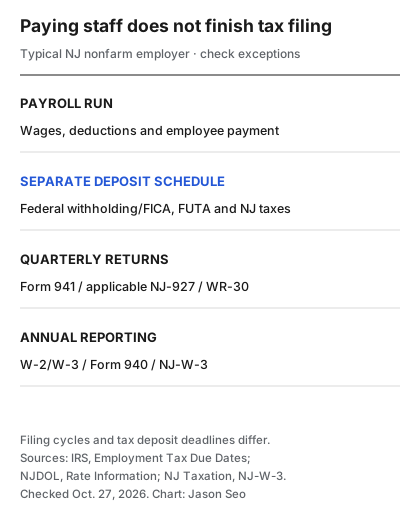
Check these records yourself, using the state portal when a filing's acceptance result is not available in the software's own document list. Gusto lists some state forms under Taxes & compliance → Tax documents → State, but directs owners to New Jersey's portal for NJ-927 and WR-30 filings.
- Save tax-payment records showing the agency, tax, period, amount and processing result.
- Confirm the filing period, business ID and acceptance result; an employee-payment status cannot replace this check.
- Resolve failed or incomplete items and separate government bills. Check whether the service covers them before paying, so you avoid duplicate remittances.
The service excludes New Jersey's separate Combined Assessment Bill from payments it handles, which makes reading government notices part of the owner's ongoing work. Gusto NJ filing scope · NJ electronic filing options
The actual cost of unpaid overtime
On August 23, 2024, the U.S. Department of Labor announced willful overtime violations affecting 84 employees at Newark's Swahili Village Bar and Grill. That real enforcement case is separate from fictional NJ Pocha, whose payroll calculations illustrate the rules without describing an actual business's conduct.

| DOL's announced component | Amount | Meaning |
|---|---|---|
| Overtime back wages recovered | $62,335 | Wages owed to employees |
| Liquidated damages recovered | $62,335 | Additional compensation to employees |
| Civil money penalties assessed | $44,100 | Separate sanction for willful violations |
| Total of these components | $168,770 | Sum of announced amounts |
View the numbers as a table
| Overtime back wages recovered | $62,335 |
|---|---|
| Liquidated damages recovered | $62,335 |
| Civil money penalties assessed | $44,100 |
Amounts from the table above; the article sums them to $168,770.
U.S. DOL announcement, August 23, 2024. Calling the whole amount a fine conceals the distinction between wages, damages and penalties. These historical case amounts describe that enforcement action, rather than current penalty maxima or automatic charges that would apply to Alex's hypothetical shortfall.
At NJ Pocha, completion means calculating gross wages, configuring withholding and employer taxes, submitting payment, and checking tax-payment and filing results. Begin by collecting the employer registrations and employee forms, then open the upcoming pay period and resolve incomplete settings before the displayed processing deadline.
Original rules and product documentation checked October 27, 2026; pricing, storage limits, export restrictions and NJ worker guidance rechecked October 28, 2026. NJ Pocha and employees Alex, Ben and Casey are hypothetical. Product steps reflect published documentation, not personal testing. This article is general information, not legal or tax advice. Multistate work, tips, bonuses, private insurance and local payroll taxes require separate checks. Registration, I-9 (employment-eligibility verification form), workers' compensation and new-hire reporting are covered separately in the New Jersey first-hire guide.
By Jason Seo, SHRM-CP®
Test one export before relying on the integration
Use a hypothetical 45-hour week at $24 with no other earnings as a control: 40 × $24 plus 5 × $36 gives $1,140 gross. Enter that approved week in the proposed tool, inspect the exported hours and compare the payroll register with the control. A matching gross total alone does not verify deductions, tax filings or payment.
Then change one time entry and repeat the handoff. Check where the correction is approved and whether the old version remains accessible. The article's single-rate example excludes tipped work and other special arrangements; use a separate review before extending the control to those workers.
Use the worksheet