In this article
- Three states require paid sick leave. Texas doesn't.
- Four in 10 part-time workers have no paid sick leave
- How many sick hours will Dana earn in her first year?
- Paid sick leave by state: the difference is when she can use it
- If Dana gets the flu in February, only New York has to pay
- What if the café is smaller, is in New York City or pays up front?
- Sick leave mistakes behind a $575,803 claim in California
- Three things to set up before Dana's first paycheck
- A leave balance needs four separate entries
- Reconcile the balance without storing medical details
- Sources
Paid sick leave by state: CA, NY, NJ and TX payroll records
Official sources checked: October 28, 2026 (BLS, CA/NY/NJ/NYC rules and enforcement source)
What would you tell your first employee if they asked whether a sick day would still be paid? Dana starts at a six-person café on January 1, working five 5-hour shifts a week for $18 an hour. During her first week she asks the owner a fair question: "Do I get sick days?" The honest answer depends on where the café is, because there is no general federal paid-sick-leave mandate for all private employers. Separate rules can apply to covered federal contractors.
Paid sick leave by state is what decides it. Of the four states this site covers, three require it and one doesn't, and the three that require it use the same accrual rate. What changes is when Dana can first use her hours, how many she can use in a year, and whether the café is small enough for an exception. Dana and the café are made up; the $18 flat rate is a calculation assumption, not a statement that it meets every city or industry minimum. The legal rules and survey figures below come from the cited official sources.
Three states require paid sick leave. Texas doesn't.
California, New York and New Jersey all require employers to give at least one hour of paid sick leave for every 30 hours worked. All three let a small business cap yearly use: at 40 hours in New York and New Jersey, and at 40 hours or five workdays, whichever is more, in California. California lets new hires start using it on day 90, New Jersey 120 days after the start date, and New York as soon as it's earned. Texas has no statewide requirement, though you can still offer leave on your own.
Four in 10 part-time workers have no paid sick leave
Is it unusual for a part-timer to ask? The BLS data show lower access for part-time workers and for workers at small establishments, reported as separate groups. The Bureau of Labor Statistics surveys employers every March, and its latest numbers cover March 2026. In the chart, compare the two blue bars with the 81% at the top.
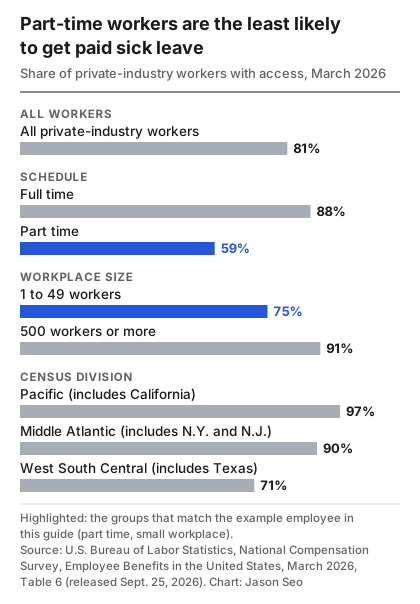
In March 2026, access was 81% for private-industry workers overall, 59% for part-time workers and 75% at workplaces with 1 to 49 workers. Dana belongs to both latter groups, but the survey doesn't report their intersection. The regional bars group several states and don't measure the effect of a particular law, so use them as context rather than a forecast for this café.
How many sick hours will Dana earn in her first year?
If Dana works every scheduled hour, 25 hours a week for 52 weeks gives 1,300 hours; leave or other absences can change that input. At one hour for every 30 worked, she adds about 0.83 hour each full working week, producing roughly 43 hours before any applicable accrual cap. New Jersey permits a 40-hour annual accrual cap, so that café need not add all 43 hours. That process is called accrual, and it means the leave builds up as she works instead of arriving all at once.
Earning and using are separate events, though. Dana can have hours in her balance that she isn't allowed to use yet, and the "40 hours" in most of these laws is a use limit rather than an earning limit. That's why she can earn 43 hours in California or New York while the café only has to let her use 40 of them in a year.
California adds a twist that depends on shift length. There, the use limit can't be lower than 40 hours or five of the employee's workdays, whichever is more. Dana's five workdays add up to only 25 hours, so 40 hours applies to her, but an employee who works 10-hour shifts would be entitled to use at least 50.
Paid sick leave by state: the difference is when she can use it
So far the three states look identical. The table shows where they split, using the questions an owner has to answer for a first hire. Read the "First day she can use it" row first, because it changes the café's schedule in Dana's first few months.
| Question | California | New York | New Jersey | Texas |
|---|---|---|---|---|
| Required statewide? | Yes, all employers | Yes, all employers | Yes, all employers | No |
| Accrual rate | 1 hour per 30 worked | 1 hour per 30 worked | 1 hour per 30 worked | None required |
| Yearly use you can cap at (small employer) | 40 hours or 5 workdays, whichever is more | 40 hours (fewer than 100 employees) | 40 hours | None required |
| First day she can use it | Day 90 | As soon as it's earned | 120 days after the start date | None required |
| Small-business exception | None | 4 or fewer employees and net income of $1 million or less: 40 hours unpaid | None | n/a |
Sources: California Labor Code §246(c), (d) and DLSE Paid Sick Leave FAQ; New York State paid sick leave guidance; NJDOL notice MW-566. Rechecked October 28, 2026. Cities can require more.
For this six-person café, the basic accrual rate matches across the three states. It's when she can use it, and whether the café's size changes the answer. New York is the only one of the three where a very small business can make the leave unpaid, and Texas is the only state where none of these rows applies.
If Dana gets the flu in February, only New York has to pay
On a Tuesday in mid-February, Dana texts the owner that she has a fever and can't come in. Whether that shift is paid depends on where the café is. In the chart, look at where the gray hatching ends on each bar and how many hours she has banked by that date.
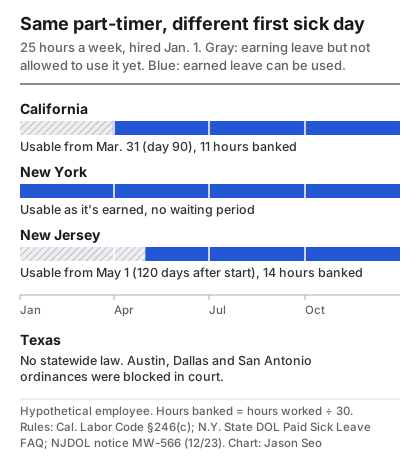
In New York, the café pays Dana from the hours she has already earned. In California and New Jersey, the owner can ask her to wait until the waiting period ends, on March 31 and May 1. By then she has about 11 hours ready in California and about 14 in New Jersey, so her next sick day is usually covered in full.
If Dana uses all 40 allowed hours at $18 an hour, the café pays $720 for hours she doesn't work, in any of the three states. Whether that's a new cost depends on the schedule. If a coworker covers her shift, the café pays both people; if the shift goes uncovered, the $720 replaces wages it would have paid anyway. For this café, assume no covered federal contract and no other obligation to pay this absence. Texas has no statewide paid-sick-leave mandate, although any leave the owner promises in a written policy becomes a promise the café has to keep.
What if the café is smaller, is in New York City or pays up front?
The café won't look the same forever. Keep Dana exactly as she is and change one fact about the business at a time.
The café has only four employees in New York. New York sizes an employer by the most people it employed at any one time during the calendar year. If the café never had more than four employees all year and had net income of $1 million or less in the prior tax year, it still owes 40 hours of sick leave, but the leave can be unpaid. Dana keeps the hours and the job protection; the café just isn't required to pay for that time. A café that shrinks from six to four mid-year keeps the paid requirement until the next calendar year.
The café is in New York City. City rules sit on top of the state law. Since February 22, 2026, New York City also requires 32 hours of unpaid protected time off, available from the start of employment. Separately, every private employer in New York State, in or outside the city, has owed 20 hours of paid prenatal leave a year since January 1, 2025. A city version of Dana's year has more protected time than the chart shows.
The owner gives Dana all 40 hours on day one. All three states allow an upfront grant instead of hourly accrual, but use and balance records still matter. California requires 40 hours or five workdays, whichever is more, at the start of each year of employment, and New Jersey requires at least 40 hours on the first day of the benefit year. New York allows the full amount at the start of each calendar year and says up-front leave can't be taken back if she works fewer hours than expected.
Sick leave mistakes behind a $575,803 claim in California
What happens when an employer gets this wrong? On February 27, 2025, California's Labor Commissioner announced a lawsuit against Food Source LLC(state-law business entity), a restaurant in Buena Park. The office said the employer denied workers access to paid sick leave and didn't show sick leave availability on pay stubs, among other violations. It also cited the state's temporary COVID-19 supplemental sick leave law.
For the sick leave claims, the state sought $575,803 in unpaid wages, damages and penalties, separate from $532,561 in wage citations covering 73 workers. Those are amounts the state cited and sought, not a final court judgment. The amounts describe different enforcement actions.
| Announced action | Amount | What it covers | Status in the February 27, 2025 release |
|---|---|---|---|
| Wage citations | $532,561 | Wage violations affecting 73 workers | Citations issued |
| Sick-leave lawsuit | $575,803 | Wages, damages and penalties, including temporary COVID leave claims | Amount sought in lawsuit |
The warning for this café is practical: record the available balance and give the required notice before the first paycheck.
Three things to set up before Dana's first paycheck
A written policy and the state notice. Put a short sick leave policy in Dana's onboarding packet that states the accrual rate, the yearly use limit and the waiting period. Then hand her any notice the state requires, such as New Jersey's written notice of earned sick leave rights.
A balance that updates in payroll. Use a payroll system or controlled spreadsheet that updates Dana's balance each pay period. California requires the available balance on the pay stub or in a separate written notice each payday.
Records you can produce on request. New York requires an employer to give an employee a summary of leave accrued and used within three business days of a request. New Jersey requires five years of records, so keep hours worked and leave used together from the first pay period.
A leave balance needs four separate entries
A usable record starts with hours, not dollars. For a hypothetical pay period in which Dana actually works 50 hours, earns leave at 1 per 30 hours and uses a previously available 5-hour balance, the record below shows each movement. Assume she has passed the waiting period, her opening balance is 10 hours, and no cap prevents this period's accrual.
| Record field | Calculation or input | Result |
|---|---|---|
| Opening balance | Previous period's closing balance | 10 hours |
| New accrual | 50 hours actually worked ÷ 30 | 1.6667 hours |
| Leave used | One scheduled shift | 5 hours |
| Closing balance | 10 + (50 ÷ 30) − 5 | 6.6667 hours |
| Gross sick pay | 5 hours × assumed flat $18 rate | $90 |
Keep full precision in the underlying record rather than repeatedly dropping fractions of an hour. The $90 assumes Dana has one flat rate and no other pay affecting the required sick-pay calculation. Don't add the five leave hours to hours actually worked when calculating this illustrative accrual. Check state sick-pay rules if Dana receives multiple rates, commissions or bonuses.
At year-end, do not automatically reset an accrual balance to zero. California distinguishes the annual use limit from the accrued-balance cap and carryover rules; New York also requires unused accrued leave to carry over subject to annual-use limits. New Jersey requires a compliant carryover or year-end payout arrangement. Front-loading changes some carryover rules, but it doesn't erase every state's recordkeeping or rollover requirements. Put the selected method in the written policy before the first year-end.
Reconcile the balance without storing medical details
For a hypothetical payroll period, an opening balance of 12 hours plus 2 earned hours minus 5 hours used leaves 9 hours. That movement needs a dated beginning record, a reason for the earned amount and the approved use. Record only the information needed to administer leave; keep sensitive supporting material in the appropriate restricted file.
The arithmetic does not decide whether 2 hours should accrue, whether use is allowed or what carries into another year. Check the applicable state, city and policy rules first. This article compares California, New York, New Jersey and Texas; it is not a nationwide state-by-state reference.
Sources
Core BLS, CA, NY, NJ and NYC sources rechecked October 28, 2026. Dallas litigation summary retained from the October 26 check; this is not a new review of all Texas litigation.
- U.S. Bureau of Labor Statistics, Employee Benefits in the United States, March 2026, Table 6
- California Labor Code §246
- New York State, Paid Sick Leave
- NYC Department of Consumer and Worker Protection, Protected Time Off
- New Jersey Department of Labor, Earned Sick Leave: what employers need to know
- California Labor Commissioner (DLSE), Paid Sick Leave FAQ
- New York State, Paid Prenatal Leave information for employers
- NYC Department of Consumer and Worker Protection, Protected Time Off FAQs
- Dallas City Hall, paid sick leave ordinance status
- California Department of Industrial Relations, Labor Commissioner action against Food Source LLC (Feb. 27, 2025)
- Jackson Lewis, court ruling on the Dallas paid sick leave ordinance (2020)
This article is general information, not legal or tax advice. Rules change and every business is different, so check with your state agency, an employment attorney, or a CPA before making decisions.