In this article
Can You Build Your Own ERP? What Failed Rollouts, Lidl's In-House System and Payroll Outages Show
Sources checked: November 9, 2026. AI-assisted draft, pending editor review.
"Could we just build our own ERP?" is a fair question now that AI tools can write working code. The honest answer from the record is: you can build parts of one, and a few parts are worth building. Building all of it, especially payroll and tax, is a different job, and writing code is the smaller part of that job. The evidence is in what happened to organizations with far bigger budgets than a small business.
What an ERP is, and why it is hard
ERP means enterprise resource planning: one system, one set of records, connecting accounting, people and payroll, purchasing, inventory and orders. Its value is that numbers agree with each other, changes are recorded, and the right people see only the right data. Those are properties of how the system is run, not of any single screen.
Eight documented failures
| Organization | Year | What failed | Reported cost or impact |
|---|---|---|---|
| Hershey | 1999 | A rushed ERP go-live in the busy season broke order processing and fulfilment | More than $100 million in confirmed candy orders could not be delivered, as reported |
| Nike | 2000 | A supply-chain planning system failed after launch | About $100 million in lost sales, as reported |
| National Grid | 2012 | SAP go-live in the days around Hurricane Sandy; payroll and finance problems | Remediation and losses estimated as high as about $585 million, as reported |
| Lidl | 2011 to 2018 | A seven-year SAP merchandise system (eLWIS). Lidl valued inventory at purchase price, SAP at retail price, and Lidl chose to customize the software instead of changing its process | About 500 million euros written off and the project scrapped, as reported |
| Revlon | 2018 | SAP cutover problems | About $64 million in lost sales, as reported |
| Canadian federal government, Phoenix pay system | 2016 | Payroll for federal employees went live with serious errors | Original budget about C$310 million (Canadian dollars). More than C$5.1 billion in total by June 2025. By July 2018 pay problems had hit close to 80% of 290,000 public servants. The Auditor General called it "an incomprehensible failure of project management and oversight" |
| Kronos Private Cloud customers | 2021 | A ransomware attack took a hosted timekeeping and payroll product offline for several weeks. Some employers used manual time sheets or repeated earlier payrolls | Settlements include about $13 million (PepsiCo), $2.4 million (Cargill), $1.2 million (UMass Memorial), and a $5.5 million fund from UKG |
| Public Health England (spreadsheet) | 2020 | Results were collected in an older Excel format limited to about 65,000 rows | 15,841 positive Covid cases were left out of central reports for about a week, from September 25 to October 2, 2020 |
View the numbers as a table
| National Grid (2012) | $585M |
|---|---|
| Hershey (1999) | $100M |
| Nike (2000) | $100M |
| Revlon (2018) | $64M |
From the table above, as reported. National Grid is an estimate of up to about $585 million; Hershey's figure is the value of orders that could not be delivered, not a measured loss. Phoenix (Canadian dollars) and Lidl (euros) are left out because the currencies differ.
What these cases do and do not show
Be clear about the limits. None of the eight is a company that built an ERP from scratch. They are rollouts of bought or hosted systems, plus one spreadsheet. They show how hard it is to run a business-critical system at all, which is the hurdle a home-built system also faces. The one build-side data point is Lidl: it stopped the SAP project in 2018 and, according to German trade press, kept developing its in-house merchandise system (Wawi) because the cost-benefit analysis favored it. The roughly 500 million euro cost of the SAP project is a press report: Lebensmittelzeitung, citing industry observers, put it at that level, and Lidl would not say how much had been spent.
What the cases have in common
- Many cases involved decisions about process and timing. Reports point to Lidl customizing the standard process, a rushed go-live in the busy season, and a go-live around a storm. Others, such as Kronos, involved a security incident outside the customer's control.
- Payroll punishes errors most. In Phoenix, errors landed in paychecks for most of a 290,000-person workforce. In Kronos, a few weeks without a hosted system forced employers to improvise pay.
- The cost grows after launch. Phoenix's reported cost rose from about C$310 million to more than C$5.1 billion. Lidl stopped its project.
- A spreadsheet is a system too. In the Public Health England case, results were left out of central reports because the transfer process exceeded an old file format's row limit.
A small company will not make Lidl's scale of mistake. But the same causes apply at small scale: no one owns the rules, nobody tested the limits, and the first real run is the live one.
Writing code versus owning a system
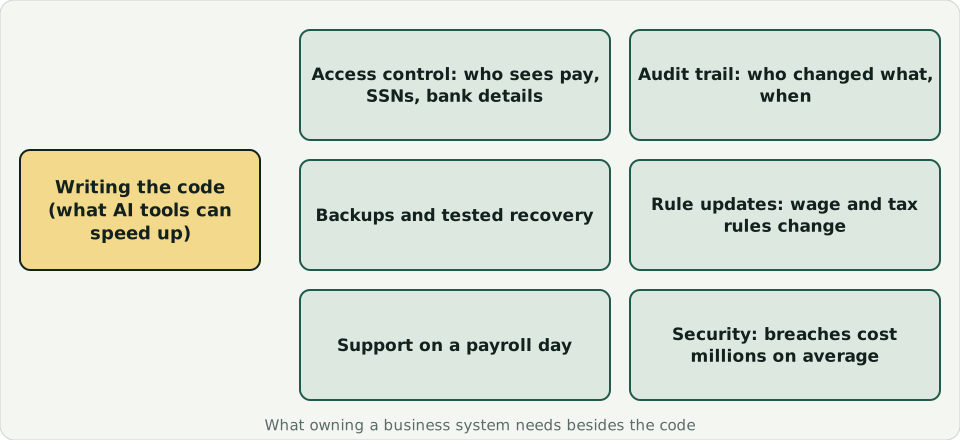
Writing code is only part of owning a system. Whether a person or an AI tool writes it, a business system also needs:
- Access control: who can see salaries, Social Security numbers or bank details, and who can change them.
- An audit trail: who changed what, and when.
- Backups and recovery, tested before you need them.
- Rule updates: tax and wage rules change, and someone must notice.
- Support on a payroll day.
- Security. IBM's 2025 Cost of a Data Breach report put the global average breach at $4.44 million and the U.S. average at $10.22 million, an all-time high for any region. IBM's averages are not estimates for a small company, but a home-built system holding payroll data carries the same kind of exposure.
Which parts could you build?
| Part | Build it? | Evidence and reason |
|---|---|---|
| Employee directory and simple records | Often yes | Low rule risk. A database with forms and access control can do it. See A Mini HRIS Data Model |
| Time-off tracker and onboarding checklists | Often yes | Your own policies drive them, and mistakes are easy to spot |
| Reports and dashboards over your data | Usually | Read-only views carry less risk, but exports can still expose sensitive data |
| Applicant tracking | Maybe | Needs privacy care. If it scores or ranks applicants, rules may apply. See AI in Hiring |
| Payroll calculation and tax filing | Usually buy | Phoenix and Kronos show what payroll errors and outages cost. Rules change, and errors reach real paychecks |
| Benefits administration | Usually buy | Carrier connections and enrollment rules are specialized |
| Full accounting and inventory | Usually buy | Hershey, Lidl and Revlon show the cost of customizing or rushing these |
Records a payroll system must hold
If you ever build part of payroll, the U.S. Department of Labor's recordkeeping fact sheet lists what employers must keep for covered workers: name and Social Security number, address, hours worked each day and week, basis of pay, regular hourly rate, straight-time and overtime earnings, additions to and deductions from wages, total wages each pay period, and the date of payment. Payroll records must be kept at least three years, and time cards and wage computation records two years. Violations are expensive in practice: in fiscal year 2025 Wage and Hour Division enforcement recovered more than $259 million in back wages for 176,957 workers, an average of about $1,465 per worker across all kinds of violations.
A sensible path
- Start with a system of record for people data, a database with roles and history, not a full ERP.
- Keep payroll and tax with a provider and connect through exports or an integration.
- Build the thin, unique pieces around it: your onboarding flow, reports and approvals.
- Write down who maintains it and what happens if they leave.
- Keep an offline fallback for payroll. The Kronos cases show that employers who could not pay from the system had to improvise.
- Re-check each year whether a bought product now covers what you built.
General information, not legal or financial advice. Reported figures come from the cited sources and may be estimates.
Sources
- ERP Research: ERP implementation failure case studies
- Computerwoche: Lidl stops its multimillion SAP merchandise project (German)
- Panorama Consulting: Lidl ERP failure
- Wikipedia: Phoenix pay system
- Baker Botts: Kronos agrees to a $6 million settlement
- Legal Dive: UKG to settle class action over the Kronos outage
- Cybersecurity Dive: Cargill's $2.4M Kronos settlement
- HR Dive: UMass Memorial's $1.2M Kronos settlement
- BBC: Why using Excel caused Covid-19 results to be lost
- IBM: 2025 Cost of a Data Breach Report
- U.S. Department of Labor: Fact Sheet #21, FLSA recordkeeping
- U.S. Department of Labor: fiscal year 2025 back wages