In this article
- Which arrangement fits a small employer?
- Coverage and reimbursement are different purchases
- ICHRA vs QSEHRA vs a group plan: same questions, three options
- Three employees and a $450 monthly allowance
- What changes when the allowance rises to $700?
- Can four part-timers get an ICHRA beside a group plan?
- How the allowance affects Marketplace tax credits
- What does a $450 allowance actually cost?
- Start the arrangement without losing the paper trail
- What changes at 50 full-time equivalents?
- Compare actual quotes and employee needs
- Take the unresolved questions to the administrator
ICHRA vs QSEHRA vs a Group Health Plan for Your First Employees
Official sources checked: October 28, 2026 (benefit limits, HRA rules and tax-credit interaction)
Could you help employees pay for health coverage by simply adding an allowance to their paychecks? A hypothetical business with three full-time employees sets aside $450 a month per person for health coverage, but the owner hasn't chosen how to deliver it. One employee already has coverage through a spouse, and another buys insurance through the Marketplace with a premium tax credit. Sending both employees $450 through payroll would leave the owner without a documented reimbursement arrangement or an answer about their subsidies.
ICHRA(individual-coverage health reimbursement) vs QSEHRA(qualified small-employer health reimbursement) is therefore a coverage decision before it's a budget comparison. A group plan buys coverage for eligible employees; a health reimbursement arrangement(employer health reimbursement arrangement) (HRA) pays approved expenses under written rules. HealthCare.gov now calls an ICHRA a CHOICE Arrangement, so you may see both names while comparing administrators. The familiar ICHRA term stays here to help you connect the documents.
Which arrangement fits a small employer?
If you have fewer than 50 full-time-equivalent employees, no group plan, and a budget under the 2026 cap of $6,450 per employee for self-only coverage, a QSEHRA is a reasonable starting point to compare. If you want to give more than that, treat different groups of employees differently, or you're growing past 50, an ICHRA is built for that. A group plan makes sense when your employees want one shared plan and you can meet the insurer's participation and contribution rules.
Coverage and reimbursement are different purchases
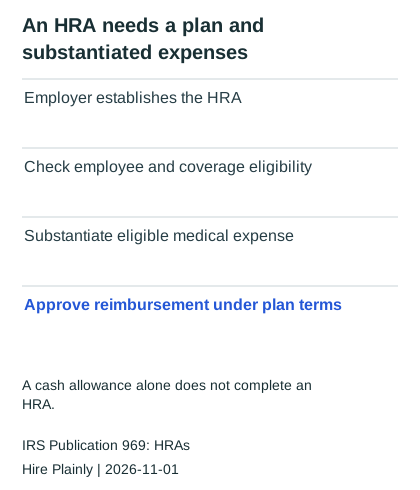
With a group plan, you buy one policy from an insurer and employees enroll in it. With a QSEHRA or an ICHRA, you don't buy insurance. Employees use coverage they arrange themselves, and you reimburse eligible expenses up to an amount you set, with tax-free treatment depending on the applicable requirements.
An ICHRA requires qualifying individual health coverage or Medicare, while tax-free QSEHRA reimbursement requires minimum essential coverage (MEC), which can include a spouse's employer plan. Either way, reimbursement comes after they show proof of the premium or medical expense. Coverage eligibility doesn't make every expense reimbursable, though: the written arrangement, the expense and its tax treatment still have to match.
ICHRA vs QSEHRA vs a group plan: same questions, three options
Read the "Who can offer it" and "Cap on what you give" rows first. Those two decide most small-business cases before the other rows matter.
| Question | Group health plan | QSEHRA | ICHRA |
|---|---|---|---|
| Who can offer it | Any employer the insurer accepts | Fewer than 50 full-time-equivalent employees, and no group health plan | Any size employer |
| Cap on what you give | None set by law | $6,450 self-only / $13,100 family for 2026 | None set by law |
| What employees must have | They enroll in your plan | Minimum essential coverage (their own or, for example, a spouse's plan) | Individual health coverage (or Medicare) |
| Treat groups differently? | Limited | No. Same terms for all eligible employees, with limited variation by age and family size | Yes, by defined classes such as full-time vs part-time or location |
| Offer it alongside a group plan? | n/a | No | Not to the same class of employees |
| Notice to employees | Plan documents | Written notice generally 90 days before the plan year | Written notice generally 90 days before the plan year |
| Participation or contribution minimums | Set by the insurer; on the federal SHOP marketplace, many states require 70% of eligible employees to enroll, with that minimum waived Nov. 15 to Dec. 15 | None | None set by law |
Rules and 2026 caps checked against IRS, CMS and HealthCare.gov materials on October 28, 2026. Premium costs aren't listed because they depend on your state, carrier, and employees' ages, and a blank is more honest than a guess.
The biggest takeaway from the table is that the QSEHRA's two limits, the 50-employee ceiling and the annual cap, are what push employers toward an ICHRA. After those two, the differences that usually decide the choice are how you want to divide employees into classes and how the allowance affects their marketplace tax credits.
Three employees and a $450 monthly allowance
Picture a business with three full-time employees in one state, no group plan, and a budget of $450 a month per person for health costs. That's $5,400 a year each, which sits under the 2026 QSEHRA cap of $6,450.
A QSEHRA fits cleanly here. You set one allowance for everyone, employees keep or buy coverage that counts as minimum essential coverage, and you reimburse up to $450 a month. One thing employees should know: a QSEHRA allowance can reduce any premium tax credit they'd otherwise get on the marketplace, so the arrangement should be explained, not just announced.
What changes when the allowance rises to $700?
Change only the budget. Now you want to give $700 a month, or $8,400 a year per person. For self-only coverage, the QSEHRA cap stops you at $6,450, so $1,950 of what you wanted to give can't go through it.
| Assumed allowance | Calculation | Annual amount | Compared with the 2026 self-only QSEHRA cap |
|---|---|---|---|
| $450 per month | $450 × 12 | $5,400 | Below $6,450 |
| $700 per month | $700 × 12 | $8,400 | $1,950 above $6,450 |
An ICHRA has no legal cap, so the full $700 a month works. The trade-off is that ICHRAs come with more rules about classes and how they interact with marketplace subsidies, which usually means using an administrator. There's no standard fee set by any agency, so get quotes from two or three administrators for your actual headcount.
Can four part-timers get an ICHRA beside a group plan?
Now the business has eight full-time and four part-time employees. The full-timers want a traditional group plan, and the part-timers just want help paying for their own coverage.
A QSEHRA can't sit next to a group plan, so it's out. An ICHRA can go to one class of employees while another class gets the group plan, but you can't offer both to the same class. There's also a size rule that trips up small businesses: when you split classes like full-time and part-time this way, an employer with fewer than 100 employees needs at least 10 people in the ICHRA class.
If no employee gets a group plan, these class-size minimums do not apply. With only four part-timers beside a group plan, however, this business doesn't meet that minimum, so the split isn't allowed.
Options include a group plan for everyone eligible, or an ICHRA for everyone instead of a group plan. A QSEHRA is another option if the business meets its eligibility rules and offers no group plan. If the business later grows to 10 or more part-timers, the split becomes possible, subject to the other class and plan requirements. Growing headcount alone does not approve the design.
How the allowance affects Marketplace tax credits
A premium tax credit (PTC) is assistance with an employee's Marketplace insurance bill. Don't promise that your allowance will sit on top of their existing credit unchanged. Give employees the HRA notice before they compare coverage, and ask them to update their Marketplace application using the actual allowance and start date.
| Arrangement | If the offer is affordable under its rules | If the offer is unaffordable and the employee otherwise qualifies for a PTC |
|---|---|---|
| QSEHRA | No PTC for the affected month | A reduced PTC may be combined with the QSEHRA; the permitted benefit reduces the credit |
| ICHRA / CHOICE Arrangement | The offer blocks PTC eligibility even if declined | Employee must opt out of the HRA to use the PTC; cannot use both |
Source: HealthCare.gov, Marketplace coverage and HRAs, checked October 28, 2026. Affordability calculations differ between the two arrangements; an employee's Marketplace determination is not an employer's ALE safe-harbor calculation.
For the employee already covered through a spouse, a QSEHRA may reimburse eligible expenses under its terms without forcing a new individual policy. But a premium already paid pre-tax through the spouse's employer cannot become a second tax-free benefit through reimbursement. IRS Notice 2017-67, Q&As 48 and 63, addresses this taxable reimbursement issue. Have the administrator identify the eligible expense and payroll treatment before paying it.
What does a $450 allowance actually cost?
Return to the three-employee example and assume everyone is eligible for all 12 months. An allowance is a reimbursement ceiling, so budget for the full exposure while paying only approved claims. The following claim amounts are hypothetical, not insurance quotes or promised savings.
| Budget or claim | Calculation | Amount | Period |
|---|---|---|---|
| Maximum allowances for three employees | 3 × $450 | $1,350 | Month |
| Maximum annual allowance exposure | $1,350 × 12 | $16,200 | Year |
| Approved claims this month | $450 + $300 + $0 | $750 | Month |
| Unclaimed part of this month's allowance | $1,350 − $750 | $600 | Month; availability later depends on plan terms |
| Administration and setup | Actual written quotes needed | Not included | Separate from allowances |
| Employee premium example | $600 eligible premium − $450 reimbursement | $150 | Month, before any subsidy calculation |
The $600 is not necessarily permanent savings: a later eligible claim may still be reimbursable under the arrangement. An employee who pays a $600 eligible premium and receives $450 reimbursement still pays $150 before any applicable subsidy calculation. Verify coverage dates, claim approval and the payment record rather than treating an allowance announcement as completed insurance enrollment.
Start the arrangement without losing the paper trail
Before telling employees a benefit starts, choose the plan year, eligible employees, expense categories, allowance and administrator. Ask the administrator to confirm the eligibility and class design in writing, including how a midyear hire is handled. QSEHRA's annual ceiling is prorated for months of eligibility; a full-year cap is not automatically available to a late-year hire.
Then obtain the written plan and required notices, and schedule their delivery. The usual advance-notice rule has specific new-plan and newly eligible employee provisions, so don't assume a startup must always wait 90 days. Keep the delivered notice, effective date and employee enrollment or opt-out record with the benefit file.
For each reimbursement, retain the coverage substantiation, eligible expense approval, amount and payment date through a secure process. Ask the administrator what reporting remains with you, including the QSEHRA permitted benefit in Form W-2(employee wage statement) box 12, code FF. That reporting amount is the benefit made available under the rules, not simply the claims paid. Keep medical details out of a broadly shared payroll spreadsheet.
What changes at 50 full-time equivalents?
A business generally becomes an applicable large employer after averaging at least 50 full-time and full-time-equivalent employees in the prior calendar year, counting related companies together. QSEHRA eligibility ends when ALE status begins, generally the following January 1; hiring employee number 50 is not itself the cutoff date. Under the Affordable Care Act(federal health-coverage law), ALE status means the coverage you offer has to meet affordability and minimum value rules or you risk an employer penalty. An ICHRA can meet those rules, but only if the allowance is large enough relative to local premiums. At this size, a benefits broker or attorney belongs in the conversation.
Compare actual quotes and employee needs
Two things stay open no matter which column you pick. The first is cost: group premiums and administrator fees vary by state, carrier and employee ages, so get quotes for your actual headcount. The second is what your employees value. Some people want the simplicity of one shared plan, and others like choosing their own. A short conversation with your team will tell you more than any table.
Take the unresolved questions to the administrator
Bring a short fact sheet to the administrator: employee count, other health-plan offers, proposed employee classes, desired start date and monthly allowance. Ask for a written explanation of which arrangement fits those facts, what notice is needed and how employees should resolve coverage and premium-tax-credit questions. Keep medical documents out of the owner's budget worksheet.
New monthly allowances of $300 for each of three employees total $900. Each employee's available amount, including any permitted carryover, follows the plan terms; one employee cannot use another employee's allowance. Across the reviewed employee records, $700 approved and $500 paid leaves $200 of approved claims unpaid.
This article is general information, not legal or tax advice. Rules change and every business is different, so check with your state agency, an employment attorney, or a CPA before making decisions.