In this article
Build vs Buy for HR Systems: A Decision Framework, With Lessons From Failed Rollouts and One In-House Survivor
Sources checked: November 9, 2026. AI-assisted draft, pending editor review.
Build-or-buy is rarely one decision. An HR stack has many parts and the right answer differs by part. The most useful evidence comes from cases where buying went wrong, because it shows that "buy" is not a safe default either.

Lessons from buying
| Case | What was bought | What went wrong | Reported result |
|---|---|---|---|
| Phoenix pay system, Canada (2016) | An off-the-shelf commercial payroll system for federal employees | Implementation and oversight failed. The Auditor General found executives did not heed warnings from the pay centre | Budget about C$310 million (Canadian dollars), total cost over C$5.1 billion by June 2025, pay problems for close to 80% of 290,000 public servants by July 2018. In June 2025 the government awarded a ten-year, C$350.6 million contract for a replacement |
| Lidl (2011 to 2018) | SAP for retail (eLWIS) | Lidl valued inventory at purchase price while SAP used retail price. Rather than change its process, Lidl customized the software | About 500 million euros as reported by Lebensmittelzeitung citing industry observers (Lidl would not say). Lidl stopped the project in 2018 and kept developing its in-house system, Wawi, which German trade press said the cost-benefit analysis favored |
| Kronos Private Cloud customers (2021) | A hosted timekeeping and payroll service | A ransomware attack took it offline for several weeks | Employers improvised with manual time sheets or repeated payrolls. Settlements include about $13 million (PepsiCo), $2.4 million (Cargill), $1.2 million (UMass Memorial) and a $5.5 million UKG fund |
View the numbers as a table
| More than C$5.1 billion by June 2025 | C$5,100M |
|---|---|
| Replacement contract (10 years) | C$350.6M |
| Original budget | C$310M |
From the table above (about C$5.1 billion in total against a budget of about C$310 million).
Be aware of what this evidence covers. Every failure above is a purchase, and the one build-side data point is Lidl keeping its own system. We found no documented case that measures the cost of building an HR system, so the build side of the framework below rests on judgment. Three lessons from the purchase cases. A bought product still needs your process to fit it. Reports on Lidl point to customizing the software to keep its old inventory method as a major contributor. Oversight matters. The Auditor General found that warnings about Phoenix were not heeded. A hosted vendor is a dependency. When Kronos was down, customers could not run payroll from it.
Four questions for each part of your stack
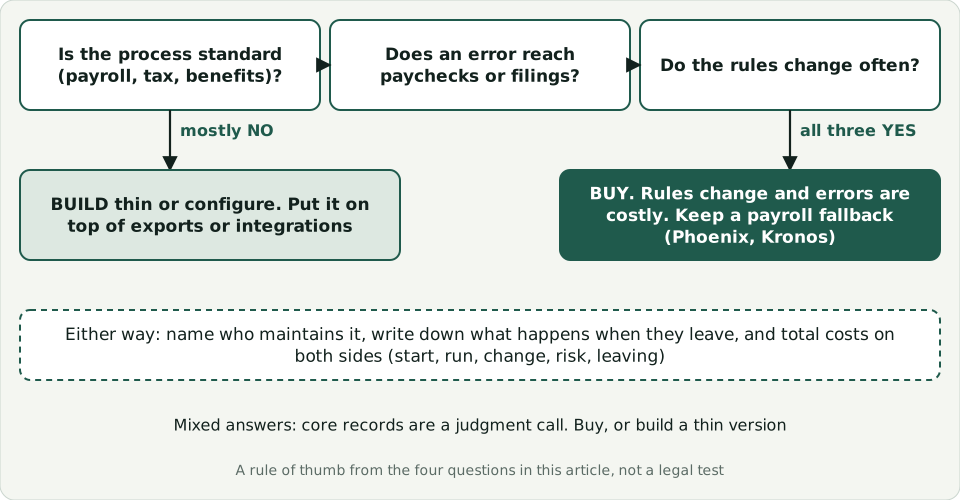
- How standard is the process? Running payroll, filing taxes and enrolling in benefits look alike across employers, so a bought product tends to fit. A particular onboarding flow or approval chain is yours, so a built piece can make sense.
- What does an error cost? Pay and tax errors reach real paychecks. In fiscal year 2025, U.S. Wage and Hour Division enforcement recovered more than $259 million in back wages for 176,957 employees, an average of about $1,465 per worker across all kinds of violations. A mistake in an internal checklist is easy to spot.
- How often do the rules change? Wage, tax and benefits rules change. A bought product spreads the tracking across its customers. A built one puts it on you.
- Who maintains it? If the answer is one person, write down what happens when they leave.
Score each part
| Part of the stack | Standard process? | Error cost | Rules change often? | Lean |
|---|---|---|---|---|
| Payroll and tax | Yes | High | Yes | Buy |
| Benefits enrollment | Yes | High | Yes | Buy |
| Core employee records | Mostly | Medium | Some | Buy, or build a thin version |
| Time-off tracking | Mostly | Low | Policy-based | Either |
| Onboarding workflow | Partly | Low | No | Build or configure |
| Internal reports | No | Low | No | Build on top of exports |
Total the costs on both sides
Do not compare a subscription price with "free" code. Put each of these on both sides:
- Getting started: setup, data migration, training and your own people's time.
- Running it: licenses or hosting, support, updates and monitoring.
- Change: adapting it when a rule or policy changes. The Lidl case is a change-cost case.
- Risk: the cost of an error, an outage or a data incident. IBM's 2025 report put the average breach at $4.44 million globally and $10.22 million in the U.S.
- Leaving: exporting your data and switching later. Phoenix's replacement shows that even a government may have to start over.
Questions to ask any vendor
- Can I export all my data in a usable format, at no extra charge?
- Is there an audit log of who viewed and changed records?
- What roles and permissions exist, and can I limit access to pay data?
- Where is the data stored, and who at the vendor can see it?
- How will I pay people if your system is down, and what is your written recovery plan?
- How do you notify customers of a security incident?
- If the product uses AI, what data does it use, is my data used to train models, and can I turn it off? If it scores or ranks candidates, can you show an independent bias audit? The Workday case shows vendors can be sued as well. See AI in Hiring.
- What happens to my data if I cancel?
A decision rule that holds up
Buy the parts where rules change and errors are costly. Build the thin pieces that are specific to you, on top of exports or integrations. Keep a payroll fallback. Revisit each year. Neither choice is permanent. Write down why you chose, so the next person can change it for a reason.
General information, not legal or financial advice. Reported figures come from the cited sources and may be estimates.
Sources
- Wikipedia: Phoenix pay system
- Computerwoche: Lidl stops its multimillion SAP merchandise project (German)
- Panorama Consulting: Lidl ERP failure
- ERP Research: ERP implementation failure case studies
- Baker Botts: Kronos agrees to a $6 million settlement
- Cybersecurity Dive: Cargill's $2.4M Kronos settlement
- U.S. Department of Labor: fiscal year 2025 back wages
- IBM: 2025 Cost of a Data Breach Report
- NIST: AI Risk Management Framework