In this article
- What Dana gives the AI, and what comes back
- Why the checks matter: two cases and a study
- What AI does well in a job post, and what it can't know
- Five steps from notes to a posted job
- How Dana sets a pay range she can stand behind
- What New York and New Jersey require in a posting
- The post Dana publishes
- A checklist before you post
- Sources
Writing Job Posts With AI: What to Check and How to Set a Pay Range
Sources checked: November 9, 2026. AI-assisted draft, pending editor review.
It's Sunday night, your shift supervisor just gave two weeks' notice, and the job post has to go up before the holiday rush. Pasting your notes into an AI chat and asking for a job description takes about a minute, and the draft will read well. Whether it describes your job, asks only for what the work needs and states pay you can stand behind is a separate question, and you're the one who has to check it.

Say the owner is Dana. She runs a café in Hoboken, New Jersey, with 12 employees, and she's had at least 10 people on payroll all year. Dana is made up, and so is the draft she gets back. The laws, cases and wage figures below are real, with sources at the end.
What Dana gives the AI, and what comes back
Dana types what she knows about the job, in her own words:
- Opens or closes the café four or five shifts a week
- Runs the floor with three to five baristas and covers their breaks
- Counts the drawer and makes the bank deposit
- Places the weekly milk and pastry order from a set list
- Needs a year of café or restaurant experience and comfort on the register and espresso bar
- We can teach the ordering sheet and the closing checklist
The draft comes back polished, with a summary, duties and requirements. Four of its lines never appeared in her notes. This draft was written for this article to show the pattern. It isn't output from a named product.
| Line in the draft | What's wrong with it | What Dana does |
|---|---|---|
| "Manage vendor relationships and negotiate supplier contracts" | An invented duty. Dana places an order from a set list. Nobody in this job negotiates a contract | Deletes it and writes the real duty |
| "Bachelor's degree preferred" | A preference the work doesn't need. It shrinks the pool for no reason Dana could explain | Cuts it |
| "Ideal for a recent graduate who thrives in a young, high-energy team" | Wording tied to age instead of the work | Rewrites it around the work: a fast pace and early or late shifts |
| "Competitive pay and great perks" | Not a pay range. New Jersey's posting rule asks for more, as the table further down shows | Replaces it with a real range and a short benefits line |
Every one of those lines sounds like a job post, which is why they're easy to miss. A language model writes what job posts usually say. It has no way to know what this job is.
Why the checks matter: two cases and a study
None of the evidence below measured AI-written job posts. It covers resume screening and application software, which are the closest examples found for this article. Read the table for the pattern, then for what a small employer can do about it.
| Evidence | Facts | Why it matters for a job post |
|---|---|---|
| Amazon recruiting tool (2014 to 2017) | Reuters reported that a model trained on about 50,000 terms from past resumes penalized the word "women's" and favored verbs that appeared more on male engineers' resumes, such as "executed" and "captured" | Language patterns can carry bias. This case was about resumes, not job posts, so whether AI-drafted posts repeat it is a risk to check, not a measured result. Read wording for who it excludes |
| iTutorGroup (settled 2023) | Application software auto-rejected women aged 55 or older and men aged 60 or older. More than 200 qualified U.S. applicants were rejected. The $365,000 settlement also bars asking applicants for birth dates | Do not put age-linked requirements or questions in a post or form. Check whether any field screens people out by age |
| University of Washington study (October 2024) | Researchers varied 120 first names on more than 550 real resumes and had three open-source language models rank them against more than 500 job listings in nine occupations, over three million comparisons. The models favored white-associated names 85% of the time versus Black-associated names 9%, and male-associated names 52% versus female-associated names 11%. The release notes that companies are using such models to write job descriptions, sift resumes and screen applicants | Evidence that language models can rank people differently by name. It tested research models, not commercial products, and screening, not drafting |
What the record establishes is narrower than "AI is biased," and still useful. Language models pick up patterns tied to sex, race and age from the text they learned from, and the EEOC's suit over software that screened people out by age settled for $365,000. Dana's "recent graduate" line is the small-business version of that risk. A job post is also the one place where she can catch it by reading, because nothing goes out until she posts it.
What AI does well in a job post, and what it can't know
| Good at | Cannot know |
|---|---|
| Turning rough notes into clear, readable text | What this job really does in your company |
| Suggesting a standard structure (summary, duties, requirements) | Which duties are essential and which are occasional |
| Simplifying jargon | Your budget and your current pay for similar roles |
| Producing a first draft in two languages | Whether a requirement is actually needed |
AI can organize Dana's notes. It can't verify anything about her café, so everything in the right column has to come from her.
Five steps from notes to a posted job
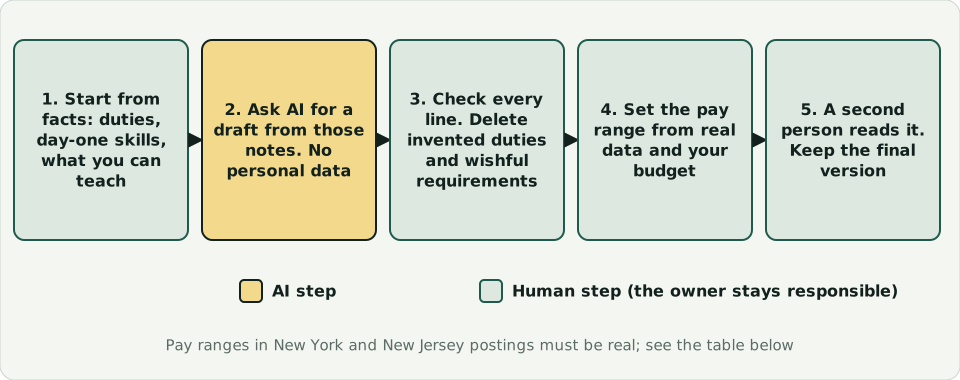
Dana's corrected process has five steps, and only one of them belongs to the tool.
- Start from facts. List what the person will do in a typical week, what they must be able to do on day one, and what you can teach.
- Ask for a draft from those notes, with no personal data about any current employee.
- Check every line. Delete any duty you did not give it. Cut requirements that are preferences. Keep language about the work, not the person, and question any wording linked to age, sex or other protected traits.
- Set the pay range from real information. The next section walks through it.
- Have a second person read it before it is posted, and keep the final version.
How Dana sets a pay range she can stand behind
Dana starts with public data. The pay explorer on this site shows U.S. Bureau of Labor Statistics (BLS) wage estimates by state and metro area. The closest BLS title to her job is "First-Line Supervisors of Food Preparation and Serving Workers," and these are the New Jersey figures.
| Point in the New Jersey pay distribution | Hourly wage |
|---|---|
| 10th percentile | $17.29 |
| 25th percentile | $18.41 |
| Median | $23.28 |
| 75th percentile | $29.35 |
| 90th percentile | $37.41 |
The table is a starting point and no more. One BLS title groups many different jobs, from a small café to a hotel kitchen, and statewide figures blend very different local markets. The section at the bottom of the pay explorer, "But is this information enough?", explains what else employers consult.
Next Dana looks at what she pays today. In this example her two current shift supervisors earn $22.00 and $23.50 an hour, and her budget tops out at $25. She posts $22 to $25 an hour. Both ends are numbers she would really pay, and the range makes sense next to the people already doing the job.
| Input in this example | Figure | How Dana uses it |
|---|---|---|
| BLS 25th and 75th percentiles for New Jersey | $18.41 and $29.35 | A check: her range sits between them |
| Lowest-paid current supervisor | $22.00 | The low end, so the post doesn't advertise less than the job pays today |
| Highest-paid current supervisor | $23.50 | Has to fall inside the range |
| Budget ceiling | $25.00 | The high end |
| Posted range | $22 to $25 an hour | Both ends are amounts she would pay |
How I set posting ranges at a large employer
At a large employer, I helped build the pay ranges we used in job postings. We set them from four inputs: outside salary surveys, what current employees in the same role were paid, the pay band for the level, and differences by work location. The range usually ran about 10% to 15% above and below the midpoint. A small business won't have most of that machinery, and it doesn't need it. My advice for a posting in New York or New Jersey is simpler: put only amounts you'd actually pay at both ends of the range.
Dana compares the range with current pay before posting because a posted range is public. Economists Cullen and Pakzad-Hurson found in Econometrica that pay transparency reduces individual bargaining power and tends to lower average wages. A Kenan Institute review notes a paper finding that a transparency law reduced the gender pay gap by 1.2% to 2%, which the review says was driven mainly by lower male wages. Ranges change behavior on both sides, and Dana's current supervisors will read the posting too.
Two things stay out of the AI tool at this step. Don't paste a current employee's salary or review into it to "match" a range. And don't let the tool decide the range: it has no access to your pay data or budget and may produce a plausible number with no basis.
What New York and New Jersey require in a posting
Some states require a pay range in job postings. These two examples come from official pages.
| Topic | New York State | New Jersey |
|---|---|---|
| Who is covered | Employers with four or more employees | Employers with 10 or more employees over 20 calendar weeks that do business, employ people or take applications in New Jersey |
| What to post | A salary, hourly rate or range of pay, for jobs performed at least in part in New York, and for some jobs outside New York that report to a supervisor, office or worksite in New York | An hourly wage or salary, or a range, plus a general description of benefits and other compensation, in postings for new job and transfer opportunities |
| Effective | September 17, 2023 | June 1, 2025 |
| Official page | NYS Department of Labor | NJ Department of Labor and Workforce Development |
On the facts of this example, with 12 employees all year and a job in Hoboken, Dana appears to be covered by New Jersey's rule. Her posting would need the hourly range and a general description of benefits and other compensation, which is why "competitive pay and great perks" had to go.
New York's guidance, which applies to New York postings, adds a standard for the range itself. It must be the salary or range the employer believes, in good faith, to be true at the time of posting, and it should give the applicant a legitimate idea of the expected pay.
The post Dana publishes
After the checks, the post is shorter than the AI draft, and every line is true. This is still the hypothetical example.
- Shift Supervisor, Hoboken. $22 to $25 an hour
- Benefits: paid time off, a shift meal and a staff discount
- You'll open or close four or five shifts a week, run the floor with three to five baristas, count the drawer, make the deposit and place the weekly order from our list
- You need a year of café or restaurant experience and comfort on the register and espresso bar
- We'll teach you our ordering sheet and closing checklist
Her assistant manager reads it before it goes up. Dana saves the final version and the date she posted it, since postings can be examined later.
A checklist before you post
- Every duty came from your notes, not from the tool
- Every requirement is something the work needs on day one
- The wording is about the work, with nothing linked to age, sex or other protected traits
- The range is one you'd really pay at both ends, set from your own pay and public data
- The posting meets your state's rule, including New Jersey's general description of benefits if it applies to you
- No current employee's pay or review went into the tool
- A second person read it, and you kept the final version and the posting date
- If any step of your hiring uses software to screen or rank applicants, read AI in Hiring
Want the next guide when it's published? Join the list.
General information, not legal advice. Pay transparency laws are changing; check the official pages below and your own state.
Sources
- Reuters: Amazon scraps secret AI recruiting tool
- EEOC: iTutorGroup to pay $365,000
- University of Washington: AI tools show biases in ranking job applicants' names according to perceived race and gender, October 31, 2024
- Econometrica: Equilibrium Effects of Pay Transparency
- Kenan Institute: A clear-eyed look at salary transparency laws
- New York State Department of Labor: Pay Transparency
- New York State Department of Labor: Pay Transparency Law (FARE Grant)
- New Jersey Department of Labor: pay and benefits transparency law
- New Jersey Department of Labor: salary range law effective June 1 (press release)
- BLS: Occupational Employment and Wage Statistics tables, May 2025
- BLS: OEWS technical notes