In this article
An AI Handbook Bot: What NYC's MyCity and Air Canada Teach About Guardrails
Sources checked: November 9, 2026. AI-assisted draft, pending editor review.
"Where do I find the PTO policy?" "How do I report an expense?" Many HR questions are answered in documents that already exist. A bot that answers from those documents can save time for employees and HR. A bot that guesses can do real harm. Two public cases show how, and a third shows why companies still build them.
Two public failures
New York City's MyCity chatbot (2024). The city launched a chatbot to help small business owners, powered by Microsoft's Azure AI services. In March 2024 The Markup reported it was telling businesses to break the law. It said an employer could take a cut of workers' tips, which is wrong, and that there were no rules on telling staff about schedule changes, also wrong. AP's testing found it falsely suggested it is legal to fire a worker who complains about sexual harassment. When ten Markup staff members asked whether buildings had to accept housing vouchers, the bot told all of them no, which is wrong, and at another point told a reporter the opposite. The mayor acknowledged in April 2024 that answers were "wrong in some areas," and the city kept the bot online with a stronger disclaimer that its answers are not legal advice.
Air Canada's chatbot (2024). A customer was told by the airline's chatbot that he could get a bereavement fare refund after purchase. The airline's actual policy was different. In February 2024 the British Columbia Civil Resolution Tribunal found Air Canada liable for negligent misrepresentation. It rejected the airline's argument that the chatbot was a separate legal entity responsible for its own actions, and held that the airline was responsible for all information on its website, whether from a static page or a chatbot. The customer was awarded about 812 Canadian dollars in total, including damages, interest and tribunal fees. The amount was small. The principle was not.
A counter-example: companies still do it. IBM's CEO said in 2025 that AI agents had replaced the work of a couple of hundred HR workers, and that the company hired more programmers and salespeople. IBM's own case study reports that its AskHR assistant contains 94% of common questions, has cut support tickets by 75% since 2016 and handled more than 11.5 million employee interactions in 2024. These are company figures. Unlike MyCity and Air Canada, AskHR is an HR assistant, so it is the closest example of the bot this article describes, and the two public failures are customer-facing or city-wide bots, not HR handbook bots. Klarna said in 2024 that its AI assistant handled two-thirds of customer chats, then said in May 2025 that customers should always be able to reach a human. The pattern is volume to AI, and complex or sensitive questions to people.
What the bot should and should not do
| Good fit | Not a fit |
|---|---|
| Where a policy or form lives | Whether a specific employee qualifies for leave or an accommodation |
| What the written policy says, with the section quoted | Advice on a complaint, discipline, investigation or termination |
| Who to contact for what | Anything involving pay for a named person |
| How a process works step by step | Legal advice or interpretations the handbook does not state |
Seven guardrails, each tied to a case
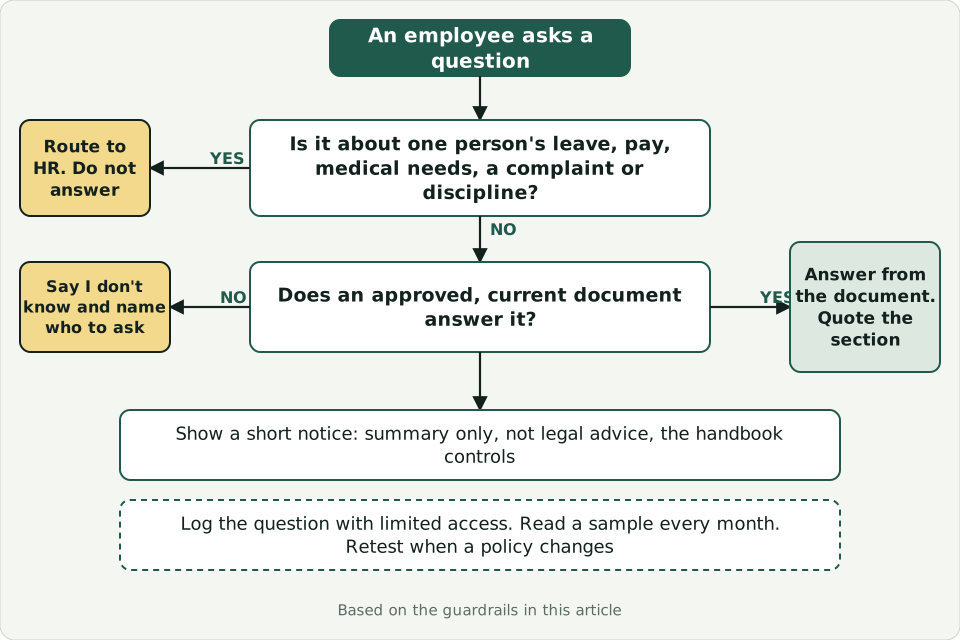
- Answer only from approved documents. MyCity's problems came from answering broadly about the law. Load the current handbook and policies, not the open internet.
- Quote the section and point to it, so the employee can read the source, and check that the answer matches it. In the Air Canada case the correct policy page existed and the chatbot linked to it, yet its own answer contradicted the page.
- Say "I don't know." If the documents do not answer, say so and name who to ask. The MyCity bot answered a housing-voucher question one way for ten staff members and the opposite way for a reporter.
- Route sensitive topics to HR (leave, medical, accommodation, harassment, discrimination, pay disputes) without trying to resolve them. MyCity's wrong answers were exactly on tips, scheduling and harassment complaints.
- Show a short notice: this tool summarizes the handbook and is not legal advice or a decision; the handbook controls. A notice helps, but it does not replace testing: the tribunal held Air Canada responsible for all the information on its website.
- Keep logs with care. Questions can contain personal details. Decide who reads the logs and how long you keep them, and tell employees.
- Version the documents. When a policy changes, update the bot's source and test again.
Test before launch
Collect real questions employees have asked, remove names, and write the right answer for each from the handbook. Run them through the bot and mark each as correct, wrong, or "should have said I don't know." Include trick questions: something not in the handbook, a question about a specific person, a question that mixes two policies. Ask the same question several times and by different people, since MyCity gave opposite answers to the same housing question at different times. Do not launch until you are comfortable with the results, and retest after any change.
Treat it as a managed AI use
NIST's AI Risk Management Framework, which is voluntary, groups the work into Govern, Map, Measure and Manage. For a handbook bot: a named owner and approval (Govern), a written scope and list of data used (Map), a test set and a regular sample check (Measure), and a way to correct or switch it off (Manage). In Texas, the Responsible AI Governance Act has provisions that credit organizations that follow a recognized framework such as NIST's, under conditions set in the law. See Using AI in HR.
Privacy and employee data
Do not load individual employee files into the bot. Keep it to policies and public company information. Employees may paste personal details into a chat, so say in the notice what not to type. See AI Tools and Employee Data.
If the bot touches employment decisions
A handbook bot should not decide anything about a person. If you extend it to screen, rank or score people, places such as New York City and Illinois have specific rules. See AI in Hiring.
General information, not legal advice. Have your lawyer or HR advisor review the bot's scope and notice.
Sources
- The Markup: NYC's AI chatbot tells businesses to break the law
- AP: NYC's AI chatbot was caught telling businesses to break the law
- Civil Resolution Tribunal of British Columbia: Moffatt v. Air Canada, 2024 BCCRT 149
- American Bar Association: BC tribunal confirms companies remain liable for chatbot information
- IBM: Transforming HR support with agentic AI (AskHR case study)
- The Wall Street Journal: IBM CEO on AI replacing HR work
- Customer Experience Dive: Klarna recruits humans again
- NIST: AI Risk Management Framework
- Texas Attorney General: Consumer AI rights (TRAIGA)
- FTC: Protecting Personal Information, A Guide for Business